
Every May, millions of students take Advanced Placement (AP) exams to earn college credit and prove mastery of college-level material. But after test day, one big question remains: How are AP tests graded?
Understanding the AP scoring system helps you estimate your results, interpret your scores correctly, and plan your next academic steps. This guide breaks down the AP exam grading process, how raw scores are converted to final scores, and what each score really means.
What Is the AP Scoring Scale?
All AP exams are scored on a 1–5 scale, with 5 being the highest possible score.
| AP Score | Meaning | Equivalent College Grade |
| 5 | Extremely Well Qualified | A / A+ |
| 4 | Well Qualified | A– / B+ |
| 3 | Qualified | B / C |
| 2 | Possibly Qualified | C– / D |
| 1 | No Recommendation | F |
A score of 3 or higher is generally considered passing and may qualify you for college credit or advanced placement — depending on the university’s policy.
You can check specific credit policies at College Board’s AP Credit Search.
How Are AP Tests Graded?
Each AP test has two major sections:
- Multiple-Choice Section
- Free-Response Section (FRQ)
These sections are weighted differently for each subject but usually count roughly 50% each toward your final AP score.
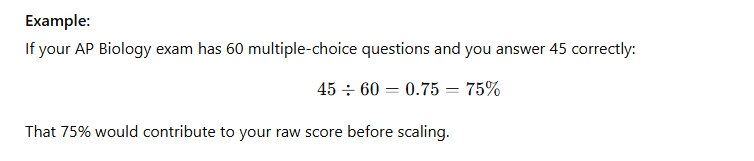
1. Multiple-Choice Grading
- Each correct answer earns one point.
- There is no penalty for wrong answers (since 2011).
- The total number of correct answers forms your raw multiple-choice score.
This section is graded electronically by computer for accuracy and consistency.
2. Free-Response Grading (Essays, Short Answers, or Problems)
The free-response section is graded by college professors and AP teachers during the annual AP Reading, usually held in June.
Each response is scored using a detailed rubric that measures:
- Accuracy
- Analysis and reasoning
- Argument quality (for essay-based exams)
- Method and explanation (for math and science exams)
Depending on the subject, each FRQ may be worth 6–10 points, and graders assign partial credit for work that shows correct reasoning even if the final answer is wrong.
Example:
In AP Calculus, if you correctly show your setup but make a small arithmetic error, you can still earn 3–4 points out of 9.

How Raw Scores Become AP Scores (1–5)
After grading, your multiple-choice and FRQ scores are combined into a raw composite score.
Then, the College Board converts this raw score into a scaled AP score (1–5) through statistical processes called equating.
This ensures that difficulty differences between test versions or years don’t unfairly impact scores.
Example (AP U.S. History):
| Raw Composite Score | Final AP Score |
| 115–130 | 5 |
| 90–114 | 4 |
| 65–89 | 3 |
| 40–64 | 2 |
| Below 40 | 1 |
(These ranges vary slightly each year.)
When and How You Get Your AP Scores
Your official AP scores are released in early July via your College Board account.
Scores are available by region and then archived so you can send them to colleges later.
What you’ll see:
- Each AP subject taken
- Your score (1–5)
- Option to send or withhold scores from colleges
What Is a “Good” AP Score?
Here’s a general guideline for interpreting your AP exam performance:
| Score | Meaning | Typical Outcome |
| 5 | Excellent | Most colleges grant full credit |
| 4 | Strong | Often accepted for credit |
| 3 | Passing | May count for placement but not credit |
| 2–1 | Below passing | No credit, but may still help learning |
Remember: Even if a school doesn’t grant credit for a 3, the experience and GPA boost from AP coursework are valuable for admissions.
How to Estimate Your AP Score Before Results Day
You can estimate your AP score using a simple approach:
- Find your test’s section weights. (e.g., 50% multiple choice, 50% FRQ)
- Convert your correct answers to a percentage.
- Estimate your FRQ performance (e.g., out of 9 points, guess 6).
- Use an AP score calculator (like those available on educational sites).
For overall course grades, you can use TestGradesCalculator.com to calculate your weighted average or percentage score.
Tips to Improve Your AP Test Performance
- Practice timed sections. Simulate exam conditions.
- Study rubrics. Know what graders look for in FRQs.
- Review past exams. College Board provides free official samples.
- Focus on high-weight topics. Some questions count more than others.
- Use score calculators. Estimate how many points you need to reach a 3, 4, or 5.
Consistency and strategy matter more than perfection.
FAQ: AP Test Grading Questions
1. How are AP tests graded overall?
They combine your multiple-choice (machine-scored) and free-response (hand-graded) results, then scale the composite score to a 1–5 range.
2. Who grades the AP free-response questions?
College professors and experienced AP teachers grade them at the AP Reading each June.
3. What is considered a passing AP score?
A score of 3 or higher is considered passing and may qualify for college credit.
4. Can AP tests be rescored?
Yes, you can request a rescore for a fee if you think there was an error, but changes are rare.
5. Do colleges see your full AP score report?
Only if you choose to send them. You can withhold or cancel scores through your College Board account.
Conclusion: Understanding AP Test Grading Helps You Plan Ahead
Knowing how AP tests are graded can help you predict your score, focus your study efforts, and set realistic college credit goals. Each point counts — but one question won’t make or break your success.Stay confident, prepare strategically, and use TestGradesCalculator.com to track your test averages, estimate grades, and calculate what you need for your next AP milestone.