
Knowing how to calculate your final grades and GPA is essential for any student aiming to stay on top of their academic performance. Whether you’re checking how your assignments, midterms, and finals add up — or trying to figure out your GPA for college applications — this guide will help you master both.
We’ll break down each step, show you the formulas, and share how to instantly calculate your grades using TestGradesCalculator.com.
Why It’s Important to Know Your Final Grade and GPA
Your final grade shows your performance in a specific class, while your GPA (Grade Point Average) represents your academic performance across multiple classes.
Here’s why understanding them matters:
- Track your academic progress over the semester.
- Plan your study strategy before finals.
- Meet scholarship or program requirements.
- Prepare accurate GPA reports for university applications.
By knowing exactly how your scores add up, you can make smarter decisions about how to improve and maintain good academic standing.
How to Calculate Final Grades (Step-by-Step)
Your final grade is a combination of all your coursework — homework, quizzes, midterms, and final exams — each with a different weight.
Let’s go step-by-step.
Step 1: Identify Each Category’s Weight
Check your syllabus or ask your teacher for the grading breakdown.
Example:
- Homework: 20%
- Quizzes: 15%
- Midterm: 30%
- Final Exam: 35%
Step 2: Find Your Average in Each Category
Suppose you’ve earned:
- Homework average = 85%
- Quizzes average = 90%
- Midterm = 80%
- Final Exam = 88%
Step 3: Convert Percentages into Decimals
Just divide by 100:
- Homework = 0.85
- Quizzes = 0.90
- Midterm = 0.80
- Final Exam = 0.88
Step 4: Multiply Each by Its Weight
Now multiply each decimal grade by its weight (as a decimal).
| Category | Grade (Decimal) | Weight | Weighted Result |
| Homework | 0.85 | 0.20 | 0.17 |
| Quizzes | 0.90 | 0.15 | 0.135 |
| Midterm | 0.80 | 0.30 | 0.24 |
| Final Exam | 0.88 | 0.35 | 0.308 |
Step 5: Add Them All Up
Now add all the weighted results:
0.17+0.135+0.24+0.308=0.853
Your Final Grade = 85.3% (B)
Tip: You can skip the math using the Final Grade Calculator to instantly get your weighted average and letter grade.

How to Calculate GPA (Grade Point Average)
Your GPA converts your grades into numerical values on a standardized scale (usually 0–4.0 in the US). It’s your average academic performance across all your classes.
Let’s go through the process.
Step 1: Know the Grade Scale
Most schools use a 4.0 scale:
| Letter Grade | Percentage Range | Grade Points |
| A | 90–100% | 4.0 |
| B | 80–89% | 3.0 |
| C | 70–79% | 2.0 |
| D | 60–69% | 1.0 |
| F | Below 60% | 0 |
Some schools use plus/minus (e.g., B+ = 3.3, A– = 3.7). Always check your institution’s scale.
Step 2: List Your Grades and Credits
Suppose your classes and grades are:
| Course | Letter Grade | Grade Points | Credit Hours |
| English | A | 4.0 | 3 |
| Math | B+ | 3.3 | 4 |
| Science | B | 3.0 | 3 |
| History | A– | 3.7 | 2 |
Step 3: Multiply Grade Points by Credit Hours
This gives you the quality points per class.
| Course | Grade Points | Credits | Quality Points |
| English | 4.0 | 3 | 12 |
| Math | 3.3 | 4 | 13.2 |
| Science | 3.0 | 3 | 9 |
| History | 3.7 | 2 | 7.4 |
Step 4: Add All Quality Points
12 + 13.2 + 9 + 7.4 = 41.6
Step 5: Divide by Total Credit Hours
Total credit hours = 3 + 4 + 3 + 2 = 12
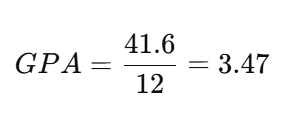
Your GPA = 3.47
Tip: Use a GPA Grade Calculator to calculate your semester or cumulative GPA instantly.
Weighted vs. Unweighted GPA
- Unweighted GPA: Calculated on a 4.0 scale — all classes are treated equally.
- Weighted GPA: Honors, AP, or advanced classes carry more weight (e.g., 5.0 scale).
Example:
If you got an A in an AP class, it might be worth 5.0 points instead of 4.0, boosting your weighted GPA.
Use a Free Online Final Grade and GPA Calculator
Doing all these calculations by hand can take time — and mistakes are easy. Instead, use a free online calculator to save effort and ensure accuracy.
At TestGradesCalculator.com, you can:
- Calculate final grades using weighted averages.
- Compute semester GPA or cumulative GPA.
- View letter grades and percentage equivalents instantly.
- Save and compare results for multiple subjects.
It’s fast, free, and ideal for students, teachers, and parents alike.
Tips to Maintain or Improve Your GPA
- Prioritize high-credit courses: They influence your GPA more.
- Track progress early: Don’t wait until finals.
- Retake courses (if possible) to replace low grades.
- Stay consistent: Small improvements across classes add up.
- Use grade calculators: Stay aware of where you stand academically.
Related Post: How to Calculate a Grade After a Test
Frequently Asked Questions (FAQ)
1. How do I find out what I need on my final to get a certain grade?
Use the final exam calculator on TestGradesCalculator.com. Enter your current grade, desired grade, and exam weight — it calculates the exact score needed.
2. How is GPA calculated if classes have different credits?
Each class’s grade points are multiplied by its credit hours, then divided by total credits.
3. What’s a good GPA in college?
Typically, a 3.5+ GPA is considered excellent, 3.0 is good, and 2.0 is average. Scholarship and graduate programs often prefer 3.7+.
4. What’s the difference between term GPA and cumulative GPA?
- Term GPA: Only includes classes from one semester.
- Cumulative GPA: Includes all courses from your academic history.
5. Can GPA calculators be used internationally?
Yes! Many universities worldwide use GPA systems (sometimes converted to 4.0 or 7.0 scales). Always check your region’s grading method.
Conclusion: Take Charge of Your Academic Performance
Learning how to calculate final grades and GPA helps you stay proactive and confident in your studies. Whether you’re tracking your semester progress or preparing a college application, these formulas — or a free GPA calculator — make it easy.
Try it now: Visit TestGradesCalculator.com to calculate your final grade and GPA instantly. Stay informed, stay prepared, and reach your academic goals with confidence.