
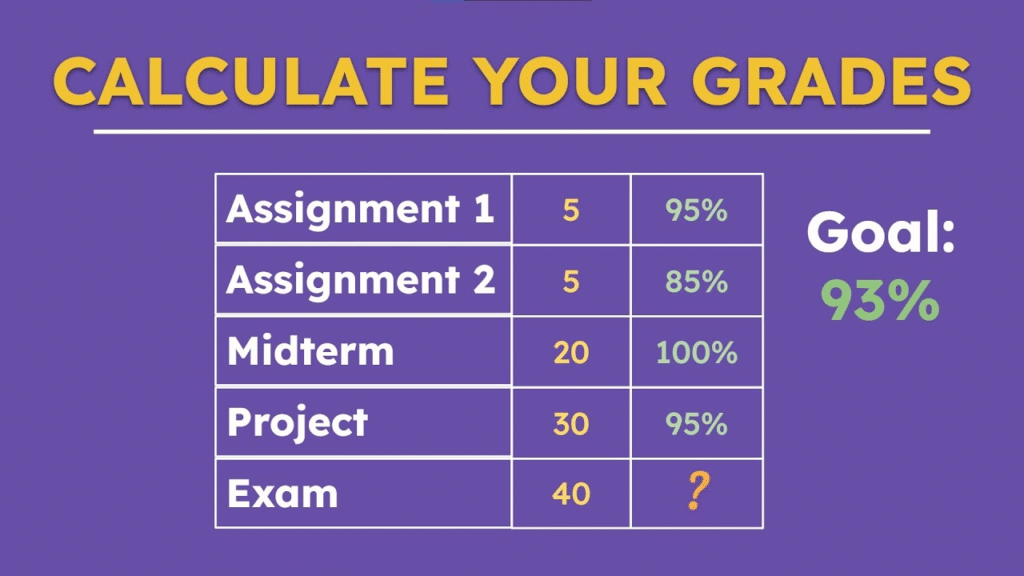
Understanding how to calculate grade average is essential for every student who wants to track performance, plan, and improve results. Whether you’re preparing for finals or checking if you’re on track for your target GPA, knowing your grade average gives you clarity.
You can also use smart tools like the Final Grade Calculator to make the process even easier—especially when you want quick results without manual calculations.
Why Calculating Your Grade Average Matters
Your grade average helps you:
- Understand where you currently stand
- Identify weak subjects
- Plan your study strategy
- Stay motivated throughout the term
- Predict future results using tools like the Exam Grade Calculator
Knowing your average is a powerful way to take control of your academic performance.
How to Calculate Grade Average (Step-by-Step)
Learning how to calculate your average isn’t complicated. Follow the steps below for a clear understanding with real examples.
Step 1 — List All Your Grades
Start by writing down all the grades you’ve received so far.
For example:
- Math: 85
- English: 92
- Science: 78
- History: 88
Make sure you’re using consistent scoring—either all percentages or all points.
Step 2 — Add All the Grades Together
Once you have your list, add them up.
Example:
85 + 92 + 78 + 88 = 343
Step 3 — Count the Number of Subjects or Assignments
In the example, there are 4 subjects.
Step 4 — Divide the Total by the Number of Grades
Now divide:
343 ÷ 4 = 85.75
This means your average grade is 85.75%.
How to Calculate Grade Average With Weighted Grades
Sometimes grades aren’t equal. A final exam might be 40% of your score, while quizzes may count for only 10%. To calculate weighted averages, you can also check the Weighted Grade Calculator for quick results.
Step-by-Step Weighted Example
Let’s say:
- Assignments: 88 (30%)
- Midterm: 80 (30%)
- Final exam: 92 (40%)
Multiply each grade by its weight:
- Assignments → 88 × 0.30 = 26.4
- Midterm → 80 × 0.30 = 24
- Final exam → 92 × 0.40 = 36.8
Now add the results:
26.4 + 24 + 36.8 = 87.2
So your weighted average grade is 87.2%.
Helpful Tips to Easily Manage Your Grade Average
Keeping track of grades becomes simpler when you apply these quick tips:
✔ Keep a record
Use a notebook, app, or spreadsheet.
✔ Update regularly
Every quiz or test changes your average.
✔ Use online tools
Tools like:
- GPA Calculator
- Final Grade Calculator
These help you predict and plan your target results.
✔ Identify your weak areas
Once you know your average, focus on improvement.
Common Mistakes Students Make (And How to Avoid Them)
Mistake #1: Forgetting Weight Percentages
Students sometimes assume all grades are equal. Always confirm weightage.
Mistake #2: Using Incorrect Numbers
Ensure grades are in the same format (percentages or points).
Mistake #3: Not Updating Results
Your average changes constantly—keep it updated.
Examples of Grade Average Calculations
Example 1: Simple Average
Grades: 70, 80, 90
Average = (70 + 80 + 90) / 3 = 80%
Example 2: Multiple Subjects
Grades: 85, 77, 90, 92, 88
Average = 432 ÷ 5 = 86.4%
FAQs About How to Calculate Grade Average
1. How do teachers calculate grade averages?
Teachers typically add all grades and divide by the number of items, or use weighted systems depending on the syllabus.
2. What if all my subjects have different weightages?
Use weighted calculations. Tools like the Weighted Grade Calculator make it easier.
3. Do I need to convert letter grades to numbers?
Yes. For example:
A = 90–100, B = 80–89, C = 70–79, etc.
Then calculate using percentages.
4. How do I know what grade I need to reach a target average?
You can use the Final Grade Calculator to predict the score you need in future exams.
5. Can I calculate my GPA with the same method?
GPA uses grade points instead of percentages, but the averaging principle is similar. Use the GPA Calculator for accuracy.
Conclusion
Knowing how to calculate grade average empowers you to plan smarter, perform better, and stay in control of your academic journey. Whether you prefer doing the math yourself or using tools like the Final Grade Calculator, staying informed helps you achieve your goals faster.
Explore more tools on TestGradesCalculator to track your academic success with confidence.