
Grading assignments fairly and consistently is essential for both teachers and students. Whether you’re assessing homework, essays, or lab reports, understanding how to grade assignments helps ensure transparency and accuracy.
In this guide, we’ll break down how grading works, explain how to calculate your grade for an assignment, and show how you can save time using a free online tool like TestGradesCalculator.com.
Why It’s Important to Grade Assignments Accurately
Assignment grades often make up a large percentage of your final course grade. Grading correctly ensures:
- Fair evaluation: Every student receives the same standard.
- Clear feedback: Helps students see where they excel or need improvement.
- Progress tracking: Both students and teachers can monitor academic growth.
- Consistency: Weighted categories (like quizzes, assignments, and exams) align with your syllabus.
Step-by-Step: How to Grade Assignments
Let’s go through how teachers or graders usually calculate assignment scores.
Step 1: Determine the Total Points Possible
Every assignment should have a maximum possible score — for example, 50 points, 75 points, or 100 points.
Example: An essay might be graded out of 50 total points based on a rubric.
Step 2: Record the Points Earned
Next, note how many points the student earned.
Example: A student earned 43 out of 50 points.
Step 3: Use the Percentage Formula
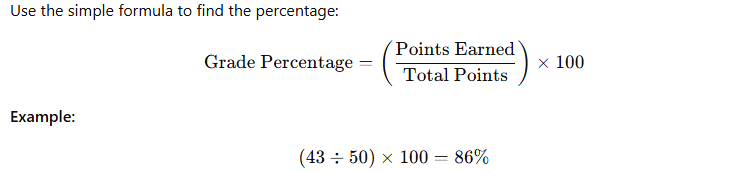
✅ The assignment grade = 86% (B)
Step 4: Convert to a Letter Grade
Most schools use this standard grading scale:
| Percentage | Letter Grade | Grade Point |
| 90–100% | A | 4.0 |
| 80–89% | B | 3.0 |
| 70–79% | C | 2.0 |
| 60–69% | D | 1.0 |
| Below 60% | F | 0.0 |
So, an 86% would typically be a B grade, or about 3.0 GPA on a 4.0 scale.
How Do You Calculate Your Grade for an Assignment?
If you’re a student trying to see how your assignment affects your overall grade, follow these simple steps.

Step 1: Find the Assignment Weight
Check your syllabus or grading policy. Assignments might count for a certain percentage of your total grade.
Example: Assignments = 25% of total grade.
Step 2: Calculate the Assignment Average
If you’ve had multiple assignments, average them first.
Example:
Assignment 1 = 90%, Assignment 2 = 85%, Assignment 3 = 80%
(90 + 85 + 80) ÷ 3 = 85% average
Step 3: Multiply by the Weight
Now, multiply your average by the weight (as a decimal).
85% × 0.25 = 21.25%
That means your assignments contribute 21.25% toward your final course grade.
Step 4: Add Other Weighted Categories
Combine the assignment weight with other grade components (like quizzes, tests, participation, or exams).
| Category | Average | Weight | Weighted Score |
| Assignments | 85% | 25% | 21.25% |
| Quizzes | 90% | 15% | 13.5% |
| Midterm | 80% | 30% | 24% |
| Final Exam | 88% | 30% | 26.4% |
| Total | — | 100% | 85.15% |
✅ Final Course Grade = 85.15% (B)
💡 Tip: Use the Assignment Grade Calculator to skip the math and instantly see your weighted scores.
Tips for Grading Assignments Fairly
Grading is more than just math — it’s about clarity, fairness, and consistency. Here are some best practices:
- Use a clear rubric: Define criteria for content, structure, creativity, and effort.
- Stay consistent: Grade all assignments using the same standards.
- Provide comments: Feedback helps students learn from mistakes.
- Avoid bias: Grade anonymously if possible.
- Automate calculations: Use online grade tools for accurate results and transparency.
For teachers managing multiple classes, a digital calculator like TestGradesCalculator.com ensures no errors or missed entries.
Common Mistakes to Avoid When Calculating Assignment Grades
- Forgetting to apply the correct weight for each category.
- Using the wrong total points possible.
- Rounding percentages too early — always calculate to two decimal places.
- Not updating averages after dropping the lowest grade (if allowed).
(read more : What Grade Is 80% Out of 100%? (Letter Grade & GPA Explained))
FAQ: Grading Assignments
1. How do teachers grade assignments?
Teachers usually use rubrics and point systems, converting total points earned into percentages and letter grades.
2. How can I calculate my assignment grade manually?
Divide your earned points by total points, then multiply by 100. Example: (45 ÷ 50) × 100 = 90%.
3. How much do assignments usually count toward my grade?
It depends on the course — often 20–40% of the final grade.
4. How do I calculate my grade if assignments have different weights?
Multiply each assignment’s percentage by its weight, then add them all up.
5. What’s the easiest way to track my assignment grades?
Use a free Assignment Grade Calculator to calculate and track your progress automatically.
Conclusion: Grade Smarter, Not Harder
Knowing how to grade assignments — and calculate your assignment grades accurately — helps you stay organized and confident throughout the semester.
Whether you’re a teacher managing multiple students or a student tracking your own progress, consistent grading ensures fairness and clarity.👉 Try it now: Visit TestGradesCalculator.com to calculate your assignment, test, and final grades instantly.