
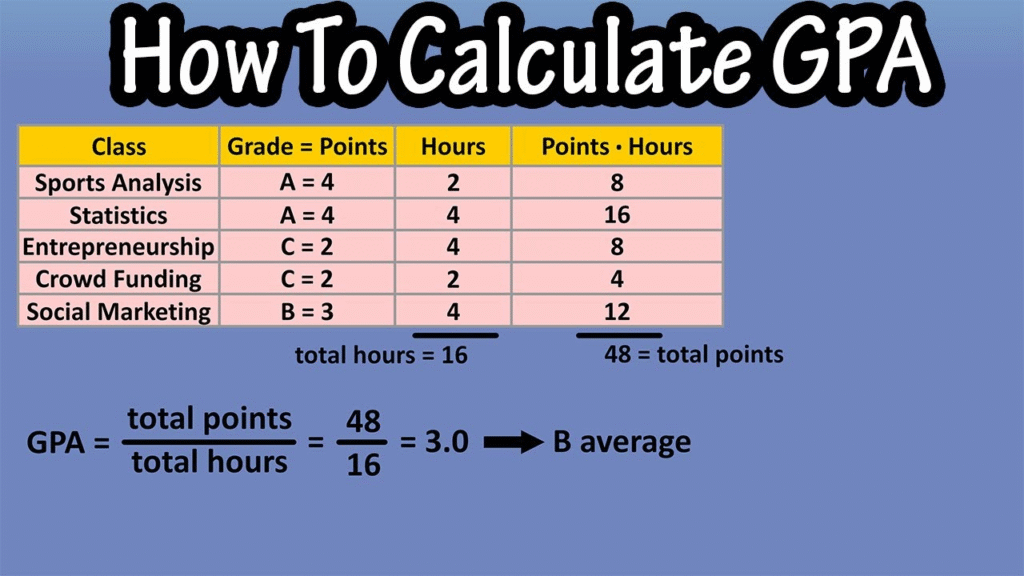
Calculating GPA with weighted grades might seem tricky, but it’s essential for students who want to track academic performance accurately. Weighted GPA gives more credit to challenging courses, making your GPA a better reflection of your true performance. For instant and precise results, you can use a trusted weighted GPA calculator, which simplifies calculations in seconds.
This guide will walk you through formulas, step-by-step examples, common mistakes, and tips to calculate your GPA with weighted grades easily.
What Is Weighted GPA and Why Does It Matter
Weighted GPA considers both your grades and the difficulty of your courses. Honors, AP, or advanced courses carry more weight than standard courses.
Benefits of weighted GPA:
- Reflects academic rigor accurately
- Helps with college admissions and scholarship applications
- Allows comparison of students across different courses
- Guides strategic course selection
Unlike a unweighted GPA, a weighted GPA ensures students are rewarded for taking challenging courses.
Basic Formula to Calculate Weighted GPA
The formula for weighted GPA is:
Weighted GPA = (Sum of (Grade Points × Course Weight)) ÷ Total Credits
Where:
- Grade Points = numerical value of your grade (A=4.0, B=3.0, etc.)
- Course Weight = credit hours or difficulty multiplier
- Total Credits = sum of all course weights
You can also use a weighted GPA calculator to save time and avoid errors.
Step-by-Step Guide to Calculate Weighted GPA
Step 1: Convert Grades to Grade Points
Use a standard scale:
- A = 4.0
- B = 3.0
- C = 2.0
- D = 1.0
- F = 0
Step 2: Multiply by Course Weight
Multiply each grade point by the course credit or difficulty weight.
Example:
- Math (Honors, 4 credits) = A → 4.0 × 4 = 16
- English (Standard, 3 credits) = B → 3.0 × 3 = 9
Step 3: Add Weighted Points
Sum all weighted points:
16 + 9 + 12 = 37
Step 4: Divide by Total Credits
Total credits = 4 + 3 + 3 = 10
Weighted GPA = 37 ÷ 10 = 3.7
Using an online weighted GPA calculator can make this process faster for multiple courses.
Tips for Accurate Weighted GPA Calculation
- Verify credit hours or course weights
- Keep your grade point scale consistent
- Avoid early rounding
- Track results semester-wise
- Use a reliable GPA calculator for instant accuracy
These steps ensure your GPA reflects your true performance.
Common Mistakes to Avoid
Even small mistakes can affect your GPA. Watch for:
- Incorrect grade point scales
- Forgetting to multiply by the course weight
- Including non-weighted courses
- Miscalculating total credits
- Not checking semester-by-semester results
A trusted weighted GPA calculator can prevent these errors.
How Weighted GPA Impacts College Admissions
Colleges use weighted GPA to evaluate course rigor. Students with high grades in challenging courses are viewed more favorably than those with similar grades in standard courses.
Advantages include:
- Better scholarship opportunities
- Stronger placement in competitive programs
- Clearer reflection of academic performance
Frequently Asked Questions (FAQs)
What is the difference between weighted and unweighted GPA?
Weighted GPA accounts for course difficulty, giving extra points for honors or AP classes, while unweighted GPA treats all courses equally.
Can I calculate weighted GPA manually?
Yes, by using the formula: (Sum of (Grade Points × Course Weight)) ÷ Total Credits. For fast results, use a weighted GPA calculator.
How does weighted GPA affect college applications?
It reflects the rigor of your coursework, helping colleges identify students who challenge themselves academically.
Is a 4.0 weighted GPA possible?
Yes, if you earn straight A’s in all weighted courses.
Which tool is best for calculating weighted GPA?
A reliable weighted GPA calculator ensures accurate and instant results.
Conclusion: Track Your Weighted GPA Accurately
Now that you know how to calculate GPA with weighted grades, you can monitor academic progress, plan your course load strategically, and prepare for college applications. Manual calculations are useful, but using a weighted GPA calculator is faster, simpler, and more accurate. If this guide helped you, share it with classmates, leave a comment, and subscribe for more academic tips and tools.