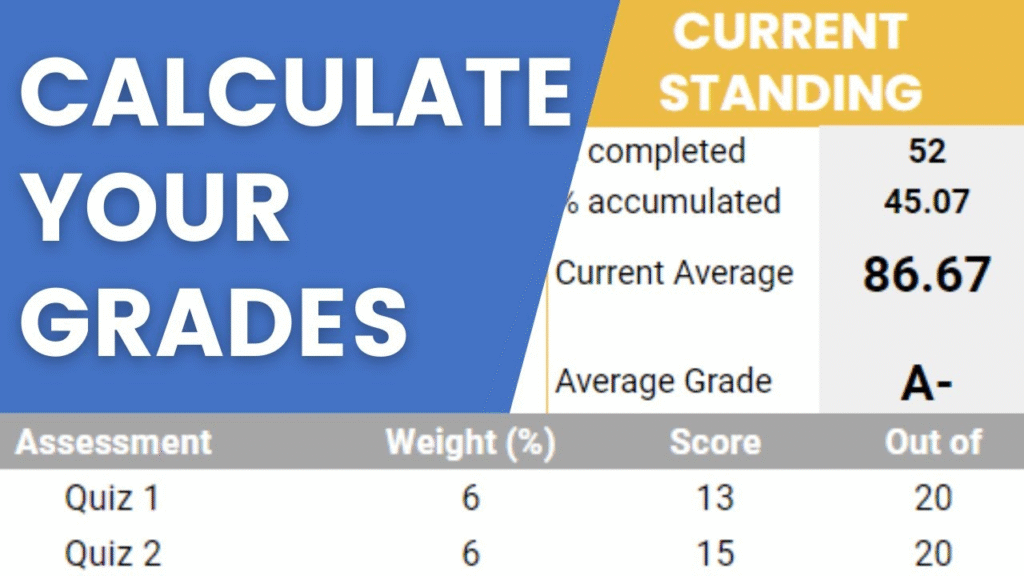
Knowing how to calculate final grades in class is crucial for students who want to understand their academic performance clearly. Whether it’s for school tests, semester exams, or overall report cards, calculating grades accurately helps you track progress, identify strengths and weaknesses, and plan improvement strategies. If you want to calculate grades quickly without errors, you can use a reliable grade calculator tool to get instant results.
This guide will explain the exact steps, give practical examples, highlight common mistakes, and provide tips to make grade calculation simple and effective.
What Does “Grades in Class” Mean?
Grades in class are the numerical or letter indicators of a student’s performance in a subject or course. They summarize how well a student understood the material and completed assignments, exams, and participation tasks.
Grades are important because they:
- Reflect on academic performance
- Help in evaluating strengths and weaknesses
- They are used for school reports, scholarships, and admissions
- Track overall progress over the year
Understanding your grades is the first step toward academic success.
Why Calculating Grades in Class Is Important
Calculating your grades lets you take control of your learning. It helps you:
- Set realistic academic goals
- Prepare for exams more effectively
- Improve weak subjects
- Monitor your semester performance
- Ensure your report card matches your expectations
Students who calculate grades regularly are better prepared and more confident in their academic journey.
Basic Formula to Calculate Grades
The formula for calculating grades in class is simple:
Grade = (Total Points Earned ÷ Total Points Possible) × 100
Where:
- Total Points Earned = sum of all marks scored in assignments, tests, quizzes, and exams
- Total Points Possible = sum of maximum marks for all assessments
You can also use an online grade calculator to speed up the process and avoid mistakes.
Step-by-Step Guide to Calculate Grades in Class
Step 1: List All Assignments and Tests
Write down all assignments, quizzes, projects, and exams with their maximum marks.
Example:
- Math Quiz: 20 marks
- Science Project: 50 marks
- English Test: 30 marks
Step 2: Record Your Scores
Add the marks you scored in each assessment.
Example:
- Math Quiz: 18/20
- Science Project: 45/50
- English Test: 27/30
Step 3: Calculate Total Points Earned and Total Points Possible
- Total Points Earned = 18 + 45 + 27 = 90
- Total Points Possible = 20 + 50 + 30 = 100
Step 4: Apply the Formula
(90 ÷ 100) × 100 = 90%
Your final grade in class is 90%, which can also correspond to an “A” depending on your school’s grading scale.
Want to skip the math? Enter each assignment in our average grade calculator, turn on weighting, and use each assignment’s total points as its weight.
How to Calculate a Weighted Class Grade
Most teachers don’t add up raw points. They split your grade into categories, and each category counts for a set percentage of the final grade. You’ll find these weights in your syllabus.
Formula:
Class Grade = (Category 1 Average × Weight 1) + (Category 2 Average × Weight 2) + (Category 3 Average × Weight 3) + …
Write each weight as a decimal: 20% becomes 0.20.
Example:
| Category | Your Average | Weight | Contribution |
|---|---|---|---|
| Homework | 90% | 20% | 90 × 0.20 = 18.0 |
| Quizzes | 80% | 30% | 80 × 0.30 = 24.0 |
| Tests | 85% | 50% | 85 × 0.50 = 42.5 |
| Class grade | 100% | 84.5% |
84.5% is a B. The weights must add up to 100%. If your teacher hasn’t graded one category yet, see how the remaining work affects your grade with the final grade calculator.
Use the semester grade calculator to enter each category and its weight, and get your class grade in seconds.
Points Method vs Weighted Method: Which Does Your Class Use?
The two methods can give very different grades from the same scores.
Example: You score 9/10 on a quiz and 60/100 on a test.
| Method | How it works | Result |
|---|---|---|
| Simple average of percentages | (90% + 60%) ÷ 2 | 75% (C) |
| Points method | (9 + 60) ÷ (10 + 100) × 100 | 62.7% (D–) |
The points method gives the test 10 times more influence than the quiz, because it’s worth 10 times more points. The simple average treats both equally. That’s why averaging your percentages can make you think your grade is higher than it is.
How to tell which one your class uses:
- If your syllabus lists percentages per category (for example “Tests 50%”), it uses the weighted method.
- If your gradebook shows points (for example “412/500”), it uses the points method.
- If you’re not sure, ask your teacher or check your online gradebook.
For points-based classes, enter each assignment in our average grade calculator. Turn on weighting and use each assignment’s total points as its weight. You’ll get the same result as the points method.
Percentage to Letter Grade Chart
| Letter Grade | Minimum % | Range | GPA (4.0 scale) |
|---|---|---|---|
| A | 93% | 93–100% | 4.0 |
| A– | 90% | 90% to under 93% | 3.7 |
| B+ | 87% | 87% to under 90% | 3.3 |
| B | 83% | 83% to under 87% | 3.0 |
| B– | 80% | 80% to under 83% | 2.7 |
| C+ | 77% | 77% to under 80% | 2.3 |
| C | 73% | 73% to under 77% | 2.0 |
| C– | 70% | 70% to under 73% | 1.7 |
| D+ | 67% | 67% to under 70% | 1.3 |
| D | 63% | 63% to under 67% | 1.0 |
| D– | 60% | 60% to under 63% | 0.7 |
| F | Below 60% | 0% to under 60% | 0.0 |
Schools without plus/minus grades use the basic 10-point scale: A = 90–100%, B = 80–89%, C = 70–79%, D = 60–69%, F = below 60%. Always check your school’s own scale. See how your class grades turn into a GPA with the GPA calculator.
Tips for Accurate Grade Calculation
- Include all types of assessments (homework, quizzes, participation)
- Double-check marks for errors
- Keep a record after each test or assignment
- Use a grade calculator tool for multiple subjects
- Convert percentages to letter grades if required by your school
Accurate calculation helps you make informed decisions about your studies.
Common Mistakes Students Make
Even a small error can affect your grade. Common mistakes include:
- Forgetting assignments or extra credit marks
- Mixing up total points possible and earned points
- Using the wrong formula
- Rounding too early or too late
- Not tracking grades regularly
A reliable grade calculator can prevent these errors and save time.
How Teachers Use Grades in Class
Teachers use grades to:
- Evaluate student performance
- Identify weak areas
- Prepare progress reports
- Plan classroom instruction
- Track overall class performance
Knowing how teachers calculate grades can help students understand their results better and plan for improvement.
Frequently Asked Questions (FAQs)
How do I calculate my grade for one subject?
Add all your earned points, divide by the total points possible, and multiply by 100.
Can I calculate grades for multiple subjects together?
Yes, sum the points earned across all subjects and divide by the total points possible for all subjects.
What is the easiest way to calculate grades in class?
Using an School grade calculator is the fastest and most accurate method.
How do percentages convert to letter grades?
Schools have different scales, but commonly:
- 90–100% = A
- 80–89% = B
- 70–79% = C
- 60–69% = D
- Below 60% = F
Can grade calculation affect my GPA?
Yes, your class grades are usually converted to grade points and included in GPA calculations.
Conclusion: Calculate Grades Accurately and Stay on Track
Now that you know how to calculate grades in class, you can monitor your academic performance with confidence. Whether you calculate manually or use a Test Grade Calculator, accuracy is key. Track your grades regularly, identify areas to improve, and plan for better results. If this guide helped you, share it with classmates, leave a comment, and subscribe for more student-friendly academic tips.