
Grades shape academic futures — from honor roll recognition to college admissions to scholarship eligibility. But a grade only means something in context. A score of 75 could be a C, a distinction, or a near-failure depending on which grade scale is in use.
This guide breaks down every major grading scale used in U.S. and international schools, explains how each one works, and shows you exactly how to calculate grades accurately under any system. Whether you’re a student, teacher, or parent, understanding grade scales helps you interpret results — and act on them.
What Is a Grade Scale?
A grade scale (also called a grading scale) is a defined system that converts raw academic performance — points, percentages, or assessments — into a standardized measure such as a letter grade, GPA value, or proficiency level.
Grade scales serve several essential functions:
- Standardization: They ensure a score of “B” means the same thing across classes and teachers.
- Communication: Students, parents, and institutions can quickly understand performance without seeing every assignment.
- Comparison: Colleges and employers can evaluate applicants across different schools and subjects.
- Accountability: Clear thresholds motivate students and give teachers measurable targets.
Without a grade scale, a percentage score is essentially meaningless outside of its original context. With one, it becomes a universally readable academic signal.
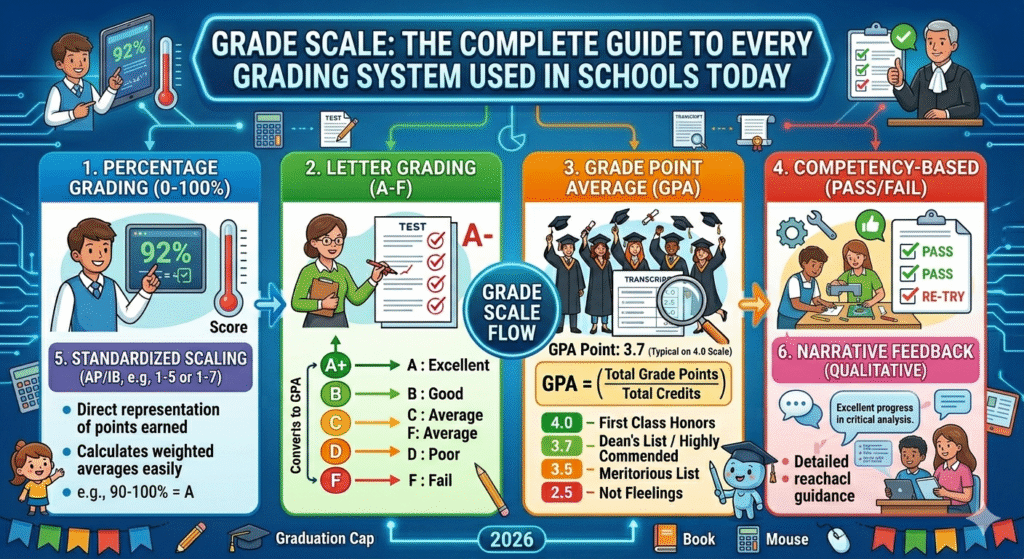
The 6 Main Types of Grade Scales
1. Percentage Grading Scale
The percentage scale is the most straightforward — and the most globally recognized. Every piece of work is measured out of 100 (or converted to a percentage), and ranges of scores correspond to letter grades or descriptors.
Core formula:
Grade % = (Points Earned ÷ Total Points Possible) × 100
Example: A student earns 34 out of 45 on an essay.
(34 ÷ 45) × 100 = 75.6%
From there, the percentage maps to a letter grade using the school’s published scale.
Knowing what grade is 75% or what grade is 70% comes down entirely to which thresholds your school uses — so always check the syllabus.
To work through multi-assignment calculations, a grade percentage calculator will handle the math accurately and quickly.
2. Letter Grading Scale
The U.S. letter grading system translates percentages into letter grades ranging from A to F. It’s used across K–12 schools and virtually all American colleges and universities.
Standard U.S. Letter Grade Scale
| Percentage | Letter Grade | GPA Value |
| 97–100% | A+ | 4.0 |
| 93–96% | A | 4.0 |
| 90–92% | A− | 3.7 |
| 87–89% | B+ | 3.3 |
| 83–86% | B | 3.0 |
| 80–82% | B− | 2.7 |
| 77–79% | C+ | 2.3 |
| 73–76% | C | 2.0 |
| 70–72% | C− | 1.7 |
| 67–69% | D+ | 1.3 |
| 63–66% | D | 1.0 |
| 60–62% | D− | 0.7 |
| Below 60% | F | 0.0 |
Several questions come up frequently with this scale:
- Is 70 a C or a D? — A 70–72% earns a C− at most schools, which is passing.
- What grade is 80%? — 80–82% is typically a B−.
- Is 78 a C? — No; 78% usually falls in the C+ range (77–79%).
- Is 89.5 an A or B? — It depends on your school’s rounding policy. Many institutions round 89.5 up to 90%, earning an A−, but this is not universal.
- Is a 60 an F or D? — At most U.S. schools, 60–62% is a D−. However, some schools set the failing threshold at 60%, making it an F.
3. GPA Grading Scale (4.0 Scale)
GPA (Grade Point Average) is the numerical system colleges use to represent overall academic performance. Each letter grade earns a fixed number of grade points, and those points are averaged across all courses using credit hours as weights.
GPA Conversion Table
| Letter Grade | GPA Points | Percentage Range |
| A+ / A | 4.0 | 93–100% |
| A− | 3.7 | 90–92% |
| B+ | 3.3 | 87–89% |
| B | 3.0 | 83–86% |
| B− | 2.7 | 80–82% |
| C+ | 2.3 | 77–79% |
| C | 2.0 | 73–76% |
| C− | 1.7 | 70–72% |
| D+ | 1.3 | 67–69% |
| D | 1.0 | 60–66% |
| F | 0.0 | Below 60% |
GPA Formula:
Cumulative GPA = Σ (Grade Points × Credit Hours) ÷ Total Credit Hours
Example:
| Course | Credits | Grade | Points | Weighted |
| Biology | 4 | B+ | 3.3 | 13.2 |
| Literature | 3 | A | 4.0 | 12.0 |
| Statistics | 3 | B | 3.0 | 9.0 |
| History | 3 | A− | 3.7 | 11.1 |
GPA = (13.2 + 12.0 + 9.0 + 11.1) ÷ (4 + 3 + 3 + 3) = 45.3 ÷ 13 = 3.48
A 3.48 GPA is solidly in the B+ territory — generally competitive for college admissions.
One common misconception: is 70% a 3.0 GPA? It’s not. A 70% earns a C− (1.7 GPA). A 3.0 GPA corresponds to a B, which is roughly 83–86%.
To convert your courses into a GPA, use a GPA calculator from letter grades.
4. Weighted GPA vs. Unweighted GPA
This distinction trips up many students — and parents — when reviewing transcripts.
Unweighted GPA
Every course receives the same maximum grade points regardless of difficulty. A student earning an A in a standard English class and an A in AP Physics both receive 4.0 points. The scale always maxes at 4.0.
Weighted GPA
Advanced courses — honors, AP, IB — receive a bonus to reflect their increased rigor.
| Course Type | Max Weighted GPA |
| Standard | 4.0 |
| Honors | 4.5 |
| AP / IB | 5.0 |
So an A in AP Chemistry earns 5.0 weighted vs. 4.0 unweighted.
Is a 4.0 GPA straight As? On an unweighted scale, yes. On a weighted scale, a student taking AP courses can exceed 4.0 even with an occasional B.
What is a 5.0 GPA in the USA? It means a student earned As in AP- or IB-level courses across the board — one of the highest achievable GPAs in U.S. high schools.
For students in weighted programs, use a weighted GPA calculator to get accurate results.
5. Standards-Based Grading (SBG)
Standards-based grading evaluates students against specific learning standards rather than averaging all scores together. Instead of a letter grade, each skill or standard receives its own rating.
Typical SBG scale:
| Score | Descriptor |
| 4 | Exceeds standard |
| 3 | Meets standard |
| 2 | Approaching standard |
| 1 | Below standard |
SBG is widely used in elementary and middle school settings. It gives a more detailed picture of what a student can and cannot do — but it doesn’t convert directly to GPA unless the school provides a formal equivalency guide.
6. Pass/Fail Grading
In pass/fail courses, a student either earns credit or doesn’t — there’s no letter or percentage recorded on the GPA. The passing threshold varies: most colleges set it at a D (60%) or C (70%) depending on the course level.
Pass/fail grading is common for:
- Elective or exploratory courses
- Graduate research and dissertation work
- Courses students take outside their major
The main tradeoff: pass/fail protects GPA in a difficult course but removes the opportunity to demonstrate excellence. Students considering this option should calculate the impact on their transcript before deciding.
International Grade Scales: A Global Comparison
Educational systems around the world use very different grading conventions. Here’s how major systems compare:
Grading Scale Comparison Table
| Country / System | Scale | Top Grade | Passing Grade | Notes |
| USA | A–F / 4.0 GPA | A / 4.0 | D / 60% | Most common K–college system |
| UK | 0–100% | First Class (70%+) | Pass (40%+) | Honours degree classification |
| Germany | 1.0–6.0 | 1.0 (Sehr gut) | 4.0 | Lower = better |
| France | 0–20 | 20 (Très bien) | 10 | Scores above 16 are rare |
| India | Percentage | Distinction (75%+) | 33–40% | Varies by board |
| Australia | HD / D / C / P | HD (85%+) | P (50%+) | HD = High Distinction |
| Canada | A–F / % | A+ / 90%+ | 50–60% | Varies by province |
| China | 100-point | 90–100 (优秀) | 60 | Letter grades also used |
| Japan | S / A / B / C | S (90%+) | C (60%+) | S added above A in many universities |
Students transferring internationally or applying to foreign graduate programs often need a formal credential evaluation — organizations like WES (World Education Services) provide recognized conversion assessments.
How Grade Scales Affect GPA and Academic Performance
Understanding how a grade maps to GPA isn’t just academic trivia. It directly affects scholarships, program eligibility, honor roll status, and college admission.
The Cumulative Effect of Individual Grades
Will one C hurt my GPA? The short answer is: it depends on how many credits you’ve already earned. A C in a 3-credit course when you’ve completed 15 total credits will noticeably drop your GPA. The same C after 90 credits has a much smaller effect.
Is C+ better than C? Yes — measurably. C+ earns 2.3 GPA points vs. 2.0 for a C. Over multiple courses, those 0.3-point differences add up significantly.
GPA Benchmarks That Matter
| GPA Range | Academic Standing | Typical Significance |
| 3.7–4.0 | A / A− average | Dean’s List, merit scholarships |
| 3.3–3.6 | B+ / A− mix | Competitive for selective colleges |
| 3.0–3.2 | B average | Solid standing; most program minimums |
| 2.5–2.9 | B− / C+ mix | Adequate; some scholarship limits apply |
| 2.0–2.4 | C average | Academic probation risk at some schools |
| Below 2.0 | Below C average | Often triggers academic warning |
Can I raise my GPA quickly? Yes — but it’s a math problem. The more credits you’ve completed, the harder it is to move the needle. Earning As in high-credit courses produces the fastest gains. A grade average calculator can model different scenarios before you commit.
How to Calculate Grades Under Different Scales
Calculating a Percentage Grade
- Count the total points earned
- Divide by total points possible
- Multiply by 100
Quick examples:
- What grade is 9 out of 11? → 9 ÷ 11 × 100 = 81.8% (B−)
- What grade is 15 out of 20? → 15 ÷ 20 × 100 = 75% (C)
Calculating a Weighted Course Grade
When a course has categories (tests, homework, projects) with different weights, each category’s average must be multiplied by its decimal weight.
Weighted Course Grade = Σ (Category Weight × Category Average)
Example:
| Category | Weight | Average |
| Tests | 50% | 84% |
| Homework | 25% | 91% |
| Projects | 25% | 79% |
Grade = (0.50 × 84) + (0.25 × 91) + (0.25 × 79) = 42 + 22.75 + 19.75 = 84.5% → B
Use a weighted average grade calculator to verify your work, especially when category weights are uneven.
Understanding what weight a test grade carries compared to homework is essential — a test worth 50% of your grade has ten times the impact of a homework category worth 5%.
Calculating Your Final Course Grade
To project your final grade or determine what you need on a remaining exam:
Required Exam Score = (Target Grade − Current Grade × (1 − Exam Weight)) ÷ Exam Weight
Example: Target grade = 87%. Current grade = 84%. Final exam = 30% of course grade.
= (0.87 − 0.84 × 0.70) ÷ 0.30 = (0.87 − 0.588) ÷ 0.30 = 0.282 ÷ 0.30 = 94%
You’d need a 94% on the final to reach 87% overall. A final grade calculator runs this instantly.
For full semester projections, see how to calculate final grades and how to calculate semester grades.
The what grade do I need calculator is especially helpful before finals when you know exactly what’s at stake.
Calculating Your Overall Course Score
To find your total grade across all assignments, sum all points earned and divide by total points possible across all work. This gives you an unweighted raw score. For a weighted overall score, use the weighted average method above.
Grading Individual Assignments
Teachers and self-assessors can follow a consistent process to grade assignments accurately:
- Set total points before grading begins
- Score each component or criterion
- Divide earned by total and convert to percentage
- Map to letter grade using the official school scale
- Apply category weight when entering into gradebook
For post-exam updates, calculating how a grade changes after a test helps students immediately understand where they stand.
AP and Curved Grades
AP courses use a dual grading structure. Your in-class grade appears on your transcript and affects GPA. Your AP exam score (1–5) is separate — it may earn college credit but doesn’t directly change your course grade. Learn more about how AP tests are graded.
When class averages are low, some teachers apply a grade curve. Common approaches include adding a flat bonus to all scores, scaling to the highest score earned, or using a square-root curve. See how to curve test grades for a breakdown of each method.
Common Mistakes Students Make When Reading Grade Scales
Assuming all scores count equally. Category weighting means a quiz worth 5% and a midterm worth 30% have completely different stakes. Always review the syllabus before the semester begins.
Confusing percentage with GPA. A student with an 80% average doesn’t have a 2.0 GPA — they have roughly a 2.7 (B−). These systems don’t have a 1:1 relationship.
Not knowing the school’s rounding policy. A 79.4% and a 79.9% look similar but may both be treated as 79% — meaning no rounding to 80%. Confirm this with your professor before assuming you’ll be bumped up.
Overlooking borderline grades. Students often accept a grade that’s 0.3% below an A− without realizing that one small effort — a resubmission, extra credit, or asking a clarifying question — could have changed it. How to calculate grades in class throughout the semester prevents these last-minute surprises.
Misreading fractional scores. When a test is graded out of 11, 17, or another non-round number, students sometimes misjudge the percentage. Converting to percentage first removes all ambiguity.
Tips for Improving Your Grade in Any Scale
Track your grade weekly, not just before finals. Use a grade average calculator to monitor progress. Catching a problem in week 6 gives you time to fix it; catching it in week 15 doesn’t.
Prioritize high-weight assignments. If tests count for 60% of your grade, a strong test performance matters more than perfect homework. Allocate study time accordingly.
Calculate your target before each exam. Knowing you need an 88% on the next test — rather than just “doing well” — gives you a concrete, motivating goal.
Use extra credit strategically. Extra credit is most valuable when your grade sits just below a threshold. Calculate how many points you need to cross into the next letter grade before pursuing it.
Understand your GPA trajectory. If you’re wondering whether to take on a challenging course, model out how a B in that class would affect your cumulative GPA. Sometimes the weighted bonus for an AP course makes a B more valuable than an A in a standard class.
Key Takeaways
- A grade scale converts raw scores into standardized measures — percentages, letter grades, GPA points, or proficiency levels.
- The six main types are: percentage, letter grade, 4.0 GPA, weighted GPA, standards-based, and pass/fail.
- Weighted GPA allows students in AP and honors courses to exceed the 4.0 unweighted ceiling, up to 5.0.
- International grade scales vary significantly — a passing grade in Germany (4.0) looks like a failing grade on the U.S. scale.
- To calculate a weighted course grade, multiply each category’s average by its decimal weight and sum the results.
- One C rarely destroys a GPA, but its impact grows when total credit hours are low.
- Monitoring grades throughout the semester — not just at finals — is the single most effective academic planning habit.
Frequently Asked Questions
Q1: What is a grade scale in education?
A grade scale is a standardized system that converts raw scores or assessment results into a recognized measure such as a letter grade (A–F), percentage, GPA point value, or proficiency level. Schools use grade scales to communicate performance consistently.
Q2: What is the standard grading scale in the U.S.?
The standard U.S. scale uses letter grades A through F, with A representing 90–100%, B representing 80–89%, C representing 70–79%, D representing 60–69%, and F below 60%. Exact thresholds vary by institution.
Q3: How is GPA calculated from a grade scale?
Multiply each course’s grade point value by its credit hours, sum all results, then divide by total credit hours. For example, an A (4.0) in a 3-credit course contributes 12 grade points.
Q4: What is the difference between weighted and unweighted GPA?
Unweighted GPA maxes at 4.0 for all courses. Weighted GPA adds bonus points for AP, IB, and honors courses — typically up to 4.5 for honors and 5.0 for AP/IB — to reflect greater academic rigor.
Q5: Is a 70% a passing grade?
In most U.S. schools, yes. A 70% typically earns a C−, which is a passing grade. However, some programs (nursing, education, pre-med) require a C (73%+) or higher to earn full course credit.
Q6: Why do some countries grade differently?
Educational traditions, national curriculum standards, and assessment philosophies differ across countries. Germany grades on a 1–6 scale where 1 is best; France uses 0–20; Australia uses HD/D/C/P/F categories. Each system reflects cultural and institutional approaches to measuring academic achievement.
Q7: How does one low grade affect my GPA?
The impact depends on the course’s credit hours and your total accumulated credits. A D in a 4-credit course early in college has a larger effect than the same grade after you’ve completed 80+ credits.
Q8: What GPA do I need to get into college?
Selective universities typically expect a 3.7–4.0+ unweighted GPA. Competitive schools often look for 3.5+. Most four-year colleges consider applicants with 2.5–3.0+. Community colleges generally admit all applicants regardless of GPA.
Q9: Can a student earn above a 4.0 GPA?
Yes — on a weighted scale. A student earning As in AP or IB courses can achieve a weighted GPA above 4.0, sometimes reaching 4.5–5.0. Unweighted GPAs cannot exceed 4.0.
Q10: How do I convert my grades from another country to a U.S. GPA?
Organizations like WES (World Education Services) provide official transcript evaluations. For informal estimates, reference conversion tables that map the foreign scale to U.S. letter grades, then apply standard GPA conversion.
Conclusion
A grade scale is far more than a number at the top of a returned assignment — it’s the framework through which academic performance is measured, compared, and acted upon. Knowing which scale your school uses, how it converts to GPA, and how individual grades affect your academic standing gives you genuine control over your academic trajectory.Whether you’re calculating a semester grade, figuring out how your grades in class add up over the term, or trying to understand an international transcript, the tools and tables in this guide have you covered. Check your standing regularly, prioritize the assignments that move the needle most, and use the right scale to interpret every score accurately.