If you scored 24 out of 30 on a test or assignment, you might be wondering: Is that good? What percentage is it? What letter grade does it represent? You are not alone. Many students, parents, and teachers face the same question every day — especially when assessments use non-standard point totals like 30, 40, or 50 instead of the familiar 100-point scale.
This guide breaks down exactly what a 24/30 grade means across every major grading system used in schools and universities today. You will find percentage calculations, letter grade equivalents, GPA values, comparison tables, and practical tips for improving your academic performance.
What Does 24/30 Mean? The Quick Answer
A score of 24/30 means you earned 24 points out of a possible 30. To find the percentage, divide your score by the total and multiply by 100:
Formula:
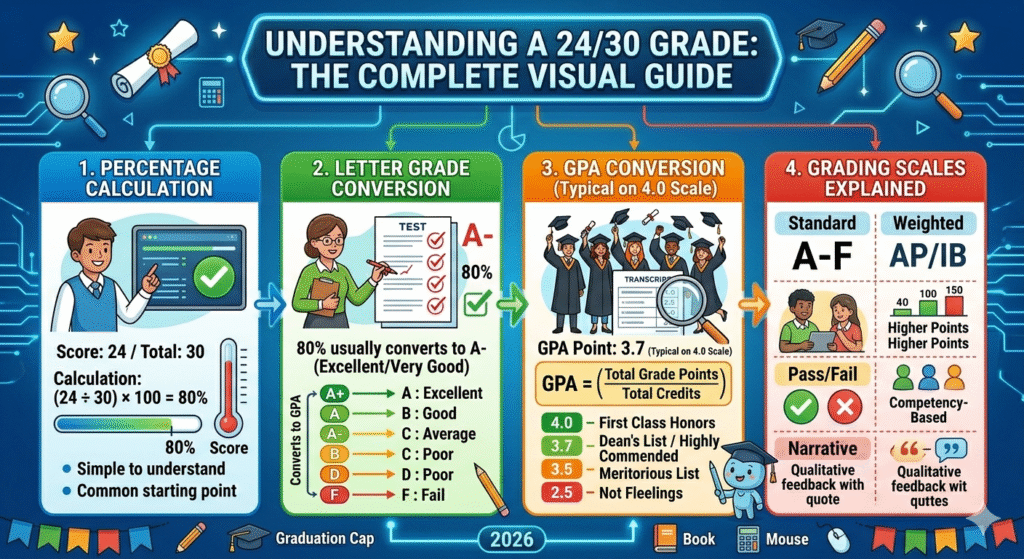
(Points Earned ÷ Total Points) × 100 = Percentage (24 ÷ 30) × 100 = 80%
So a 24/30 is an 80%, which typically earns a B letter grade on the standard U.S. grading scale. It is a solid, above-average result — you demonstrated good understanding of the material, though there is still room to reach the A range.
If you want to run similar calculations for other scores, our grade percentage calculator makes it fast and simple.
Understanding Grading Scales: What They Are and Why Schools Use Them
What Is a Grading Scale?
A grading scale is a standardized system that converts raw scores (like 24/30) into a meaningful measure of performance — whether that is a percentage, a letter grade, a GPA point value, or a descriptor like “Proficient.” Schools use grading scales to communicate student achievement clearly and consistently across different subjects, teachers, and institutions.
Why Do Schools Use Grading Scales?
Grading scales serve several critical purposes:
- They allow fair comparison across different tests, classes, and schools
- They help colleges and employers evaluate applicants
- They give students clear feedback on where they stand academically
- They motivate students by defining visible performance thresholds
- They provide a universal language for academic communication
Without grading scales, a “24/30” on one teacher’s exam and a “48/60” on another’s would be impossible to compare — even though both represent exactly 80%.
Understanding how to grade assignments accurately is therefore a foundational skill for any educator.
The Five Major Grading Scales Explained
Schools around the world use different grading systems. Here is a complete breakdown of the most common ones and how a 24/30 (80%) fits into each.
1. Percentage Grading Scale
The percentage scale is the most straightforward. Every score is expressed as a number from 0 to 100%.
How to calculate your percentage from any raw score:
Percentage = (Raw Score ÷ Maximum Score) × 100
For 24/30: (24 ÷ 30) × 100 = 80%
Standard Percentage Grade Ranges
| Percentage Range | Performance Level |
| 90% – 100% | Excellent / A |
| 80% – 89% | Good / B |
| 70% – 79% | Average / C |
| 60% – 69% | Below Average / D |
| Below 60% | Failing / F |
At 80%, a 24/30 sits comfortably in the B range. It is above average, but six more percentage points would push it into A territory.
Need to understand how other common scores fit in? Check out what grade is 75%, what grade is 70%, and what grade is 80% for detailed breakdowns.
2. Letter Grading Scale
The letter grade system is the most recognized grading format in the United States and many other countries. It converts percentages into letter-based categories.
Standard U.S. Letter Grade Scale
| Letter Grade | Percentage Range | Description |
| A+ | 97% – 100% | Exceptional |
| A | 93% – 96% | Excellent |
| A− | 90% – 92% | Near Excellent |
| B+ | 87% – 89% | Very Good |
| B | 83% – 86% | Good |
| B− | 80% – 82% | Above Average |
| C+ | 77% – 79% | Slightly Above Avg |
| C | 73% – 76% | Average |
| C− | 70% – 72% | Below Average |
| D+ | 67% – 69% | Poor |
| D | 63% – 66% | Very Poor |
| D− | 60% – 62% | Barely Passing |
| F | Below 60% | Failing |
A 24/30 (80%) earns a B− on this precise scale. However, many schools use a simplified version where 80%–89% is a flat “B.” Either way, it is a respectable, passing grade that reflects solid academic effort.
Curious about borderline scores? Learn whether 89.5 rounds to an A or B and whether 78% is a C.
3. GPA Grading Scale
The Grade Point Average (GPA) system converts letter grades into numerical points, which are then averaged across all courses to produce a single cumulative score. Most U.S. high schools and colleges use a 4.0 GPA scale.
Standard GPA Conversion Table
| Letter Grade | Percentage Range | GPA Value (4.0 Scale) |
| A+ | 97% – 100% | 4.0 |
| A | 93% – 96% | 4.0 |
| A− | 90% – 92% | 3.7 |
| B+ | 87% – 89% | 3.3 |
| B | 83% – 86% | 3.0 |
| B− | 80% – 82% | 2.7 |
| C+ | 77% – 79% | 2.3 |
| C | 73% – 76% | 2.0 |
| C− | 70% – 72% | 1.7 |
| D+ | 67% – 69% | 1.3 |
| D | 63% – 66% | 1.0 |
| F | Below 60% | 0.0 |
A 24/30 (80%) translates to a GPA of approximately 2.7 to 3.0, depending on whether your school assigns B or B− at 80%.
To learn more about how GPA calculations work, read how to calculate GPA from letter grades and explore whether a 3.5 GPA is good for college.
4. Weighted GPA vs. Unweighted GPA
Unweighted GPA
An unweighted GPA treats all courses equally. A B in a regular class and a B in an honors class both count as 3.0.
Weighted GPA
A weighted GPA gives extra points for more challenging courses:
| Course Type | Extra Points Added |
| Honors Course | +0.5 |
| AP / IB Course | +1.0 |
| Dual Enrollment | +1.0 |
So if you earned an 80% (B) in an AP class, your weighted GPA for that course could be 3.7 to 4.0 instead of 2.7–3.0.
This matters significantly for college admissions. A student with a 3.5 weighted GPA is often more competitive than someone with a 3.5 unweighted GPA. Learn the full details about how to calculate weighted GPA and what a 5.0 GPA means in the U.S..
Also worth knowing: Is a 4.0 GPA always straight A’s? The answer may surprise you.
5. Standards-Based Grading (SBG)
Standards-based grading moves away from points and percentages entirely. Instead of giving a student 24/30, a teacher would rate the student on specific learning objectives using a 1–4 or 0–3 scale:
| Score | Descriptor |
| 4 | Exceeds Standard |
| 3 | Meets Standard |
| 2 | Approaching Standard |
| 1 | Below Standard |
An 80% (like 24/30) would typically land at a 3 — Meets Standard in most SBG systems. This grading method is increasingly used in K–8 schools because it focuses on mastery of skills rather than point accumulation.
6. Pass/Fail Grading
Many colleges offer a Pass/Fail option for elective courses. The threshold varies by institution, but the most common cutoff is:
- Pass: 60% or above (some schools require 70%)
- Fail: Below 60% (or 70% at stricter institutions)
At 80%, a 24/30 would comfortably qualify as a Pass under any standard. However, Pass/Fail grades typically do not affect your GPA — which can be both an advantage (takes pressure off) and a disadvantage (misses an opportunity to boost your GPA).
International Grading Systems: How 24/30 Translates Globally
Grading standards differ significantly across countries. Here is how an 80% score compares internationally:
International Grade Comparison Table
| Country / System | Equivalent to 80% | Description |
| USA | B / B− | Good |
| UK | 2:1 (Upper Second) | Good Honours |
| Germany | 2 (Gut) | Good |
| France | 14–15 / 20 | Assez Bien (Fairly Good) |
| Italy | 24/30 | Buono (Good) |
| Canada | B / B+ | Good |
| Australia | Credit (CR) | Good |
| India (CBSE) | B1 / 7–8 Grade Point | Good |
| China | 良 (Liáng) | Good |
| Japan | 良 (Ryō) | Good |
Interestingly, in Italy — where universities officially use a 30-point scale — scoring 24/30 is a recognized passing grade equivalent to “Good.” This is one reason why the “24/30” format appears in academic contexts beyond the U.S.
How Grading Scales Affect Your GPA and Academic Performance
Every grade you earn has a ripple effect on your cumulative GPA. Understanding that impact is essential for academic planning.
The Cumulative Impact of One Grade
Suppose your current GPA is a 3.2 across 15 credit hours. You earn a B (3.0 GPA value) in a 3-credit course. Your new GPA:
New GPA = ((Current GPA × Current Credits) + (New Grade Points × New Credits)) ÷ Total Credits = ((3.2 × 15) + (3.0 × 3)) ÷ 18 = (48 + 9) ÷ 18 = 3.17
A single B slightly lowers a 3.2 GPA. This shows why every grade matters — even small changes accumulate over time. To explore this further, learn will one C hurt your GPA and whether you can raise your GPA quickly.
For full semester planning, our semester grade calculator and final grade calculator are valuable tools.
Common Grade Conversion Methods
Method 1: Simple Percentage Formula
The most universal method:
Grade % = (Score ÷ Total) × 100
Examples:
- 24/30 → (24 ÷ 30) × 100 = 80%
- 15/20 → 75% → See what grade is 15/20
- 9/11 → 81.8% → See what grade is 9/11 on a test
Method 2: Weighted Grade Calculation
When your grade comes from multiple components (tests, homework, quizzes), each has a different weight:
Weighted Grade = Σ (Component Score × Component Weight)
Example:
| Component | Score | Weight | Weighted Points |
| Tests | 80% | 40% | 32 |
| Homework | 90% | 30% | 27 |
| Quizzes | 85% | 20% | 17 |
| Participation | 75% | 10% | 7.5 |
| Total | 100% | 83.5% |
This approach is explained in detail in our guide to how to calculate weighted average grades.
Method 3: Curved Grading
Some teachers curve test grades when the class average is lower than expected. Common approaches include:
- Adding a flat point bonus to everyone’s score
- Adjusting so the highest grade becomes 100%
- Using a square root curve
Our test grade curve calculator explains all three methods.
Method 4: Points-Based Total Calculation
If your class runs on total accumulated points, use:
Overall Grade % = (Total Points Earned ÷ Total Points Possible) × 100
Learn more in our guide on how to calculate your total grade and how to calculate your overall score.
How to Calculate Grades in Different Situations
Calculating Your Class Grade
To find your current standing in a class at any point in the semester:
- Add up all points earned so far
- Add up all points possible so far
- Divide and multiply by 100
Use our class grade calculator for an instant answer.
Calculating What Grade You Need on a Final Exam
This is one of the most searched questions before finals:
Required Final Grade = (Goal Grade − (Current Grade × Current Weight)) ÷ Final Exam Weight
Our what grade do I need calculator does this automatically.
Calculating Your Grade After a Test
After each test, you can quickly update your running class grade. See how to calculate your grade after a test for a step-by-step walkthrough.
Understanding Test Weight
Not all tests carry equal weight. A midterm worth 25% of your grade moves your average far more than a 5-point quiz. Learn how much a test grade is worth and what the weight of a test grade means for clear explanations.
AP Test Grading
AP exams use a 1–5 scale, entirely separate from your school grade. An 80% on class tests does not automatically translate to a 4 or 5 on the AP exam. Read how AP tests are graded for a complete breakdown.
Common Mistakes Students Make When Interpreting Grades
Mistake 1: Treating All Grading Scales as Identical
A 70% at one school might be a C, but at another institution it could be considered a D. Always check your specific school’s grading policy. For example, learn whether 70% is a 3.0 GPA, whether 70% is a C or D, and whether a 60% is an F or D.
Mistake 2: Ignoring Assignment Weights
Students often panic over a low quiz score without realizing it counts only 5% of their grade. Conversely, they underestimate the damage a poor final exam can cause. Always review your syllabus and understand the weight of each test and assignment.
Mistake 3: Not Distinguishing C and C+
A C and a C+ are not the same. A C+ carries a GPA value of 2.3 while a C is 2.0. Over multiple courses, that 0.3 difference adds up significantly. Read more about whether C is better than C+ grade.
Mistake 4: Forgetting That GPA Is Cumulative
Students sometimes think one bad grade disappears over time. It does not — it stays in your cumulative calculation. Understanding the grade average calculation helps you plan strategically.
Mistake 5: Confusing Weighted and Unweighted GPA
Submitting the wrong GPA type on a college application is a serious error. Always confirm which type a college requests, and understand how your coursework affects each figure.
Practical Tips for Improving Your Grade from 24/30 to Higher
An 80% is good — but if you want to break into the A range (90%+), here are actionable strategies:
1. Do a Point-Loss Audit
After every graded assignment, identify exactly where you lost points. Was it conceptual misunderstanding, calculation errors, missed steps, or time management? Specific diagnosis leads to specific improvement.
2. Focus on High-Weight Assignments First
If your final exam is worth 40% of your grade, improving your exam performance has four times the impact of improving on a 10%-weight quiz. Use the how to calculate final grade tool to model scenarios.
3. Build Spaced Repetition Into Your Study Schedule
Research consistently shows that reviewing material at spaced intervals (rather than cramming) leads to better long-term retention and stronger test performance.
4. Use Office Hours Strategically
Most students never use office hours. Those who do regularly outperform their peers. Teachers notice this effort, and more importantly, you get to clarify misunderstandings before they cost you points on the next exam.
5. Practice With Real Test Conditions
Timed practice under exam conditions — no notes, no phone — builds the retrieval skills that actually translate to better test scores. Doing homework while listening to music is not the same mental process.
6. Track Your Grade Throughout the Semester
Do not wait until finals to calculate your grade. Use our semester grade calculator regularly to stay aware of where you stand and what you need to hit your target.
Grading Scale Comparison: Quick Reference Table
| Score | Percentage | Letter Grade | GPA (4.0 Scale) | Performance Level |
| 30/30 | 100% | A+ | 4.0 | Perfect |
| 29/30 | 96.7% | A | 4.0 | Excellent |
| 28/30 | 93.3% | A | 4.0 | Excellent |
| 27/30 | 90% | A− | 3.7 | Near Excellent |
| 26/30 | 86.7% | B+ | 3.3 | Very Good |
| 25/30 | 83.3% | B | 3.0 | Good |
| 24/30 | 80% | B / B− | 2.7–3.0 | Above Average |
| 23/30 | 76.7% | C+ | 2.3 | Above Average |
| 22/30 | 73.3% | C | 2.0 | Average |
| 21/30 | 70% | C− | 1.7 | Below Average |
| 20/30 | 66.7% | D+ | 1.3 | Poor |
| 18/30 | 60% | D | 1.0 | Barely Passing |
| 17/30 | 56.7% | F | 0.0 | Failing |
Key Takeaways
- 24/30 = 80% — calculated by dividing 24 by 30 and multiplying by 100
- On the U.S. letter grade scale, 80% earns a B or B−
- The GPA equivalent is approximately 2.7 to 3.0 on a standard 4.0 scale
- In a weighted GPA system (AP/Honors), the effective GPA could reach 3.7–4.0
- In Italy’s 30-point university scale, 24/30 is an officially recognized grade meaning “Good”
- Grading scales vary globally — always verify the specific system being used
- An 80% is a passing, above-average grade, but targeted effort can push it into the A range
- Understanding assignment weights, cumulative GPA impact, and conversion methods helps students make smarter academic decisions
Frequently Asked Questions (FAQ)
1. Is 24/30 a good grade?
Yes, 24/30 is a good grade. It converts to 80%, which is a B or B− on the U.S. letter grade scale. It indicates above-average understanding of the material. While it is not in the A range, it is a solid academic result and well above the minimum passing threshold at nearly every institution.
2. What percentage is 24 out of 30?
24 out of 30 is 80%. The formula is: (24 ÷ 30) × 100 = 80%.
3. What GPA is a 24/30 grade?
An 80% (24/30) typically corresponds to a GPA of 2.7 (B−) or 3.0 (B) depending on your school’s exact grading scale. In weighted courses like AP or Honors, the GPA contribution could be higher.
4. What letter grade is 24/30?
On most U.S. grading scales, 24/30 (80%) is a B. On more detailed scales that include plus/minus grades, it is a B−. The exact letter grade depends on your school’s grading policy.
5. Is 24/30 passing?
Yes. At virtually all schools, a grade of 80% (24/30) is a passing grade. In fact, it is well above the typical passing threshold of 60%–70%. It would qualify as a Pass under any Pass/Fail grading system.
6. How do I calculate my grade average across multiple tests?
Add up all your points earned across all tests and divide by the total points possible. For example, if you scored 24/30, 18/25, and 40/45, your grade average is: (24+18+40) ÷ (30+25+45) × 100 = 82/100 = 82%. See our full grade average calculator for help with weighted averages.
7. How does a 24/30 grade affect my GPA?
That depends on the credit hours for that course and the rest of your transcript. A B (3.0) in a 3-credit course adds 9 grade points to your total. If your overall GPA is above 3.0, this will slightly lower it; if it is below 3.0, this will raise it. Use our cumulative GPA calculator to model the exact impact.
8. What is the difference between a weighted and unweighted GPA for an 80% grade?
On an unweighted 4.0 scale, 80% earns approximately a 2.7–3.0. On a weighted scale in an AP or Honors course, the same 80% could be worth 3.2–4.0, depending on how your school applies the bonus. The weighted GPA guide explains the full calculation.
9. How does 24/30 compare to grading scales in other countries?
An 80% is considered “Good” in most international grading systems. In the UK it is a 2:1, in Germany a “2 (Gut),” in France roughly 14–15/20, and in Italy 24/30 is directly equivalent and carries the same meaning. See the full international comparison table above.
10. What score do I need to improve from a B to an A?
On most U.S. scales, an A starts at 90%. If your current grade is an 80% (B), you need to improve by 10 percentage points overall. Strategically, this means either performing significantly better on remaining assignments or excelling on high-weight items like finals. Use our what grade do I need calculator to find your exact target.
Conclusion
A 24/30 grade is an 80% — a solid B that reflects genuine competence and effort. Whether you are a student checking your score, a parent reviewing a report card, or a teacher explaining grades to your class, understanding how this number translates across grading systems is genuinely useful knowledge.
You now know that 24/30 equals 80%, earns a B letter grade, corresponds to a 2.7–3.0 GPA on the standard U.S. scale, and is recognized as “Good” in grading systems from Italy to Australia. More importantly, you understand the broader landscape: how percentage, letter grade, GPA, weighted GPA, standards-based, and pass/fail systems each measure performance differently — and why that matters for academic planning.
The gap between a B and an A is real but bridgeable. With point-loss analysis, smart study habits, and consistent grade tracking throughout the semester, moving from 80% to 90%+ is an achievable goal.Use the tools and guides linked throughout this article — from the final grade calculator to the what grade do I need calculator — to take full control of your academic performance today.