
If you just got 15 out of 20 on a test or assignment and you’re not sure what that means, you’re in the right place. A score of 15/20 is more common than you might think — in France it’s considered excellent, in the U.S. it translates to a solid C, and in terms of GPA it sits at roughly 2.0. But those numbers tell very different stories depending on where you’re studying and what grading system your school uses.
This guide breaks down exactly what grade 15/20 is, how it converts across percentage, letter grade, GPA, and international systems, and what it means for your academic standing.
What Is 15 Out of 20 as a Percentage?
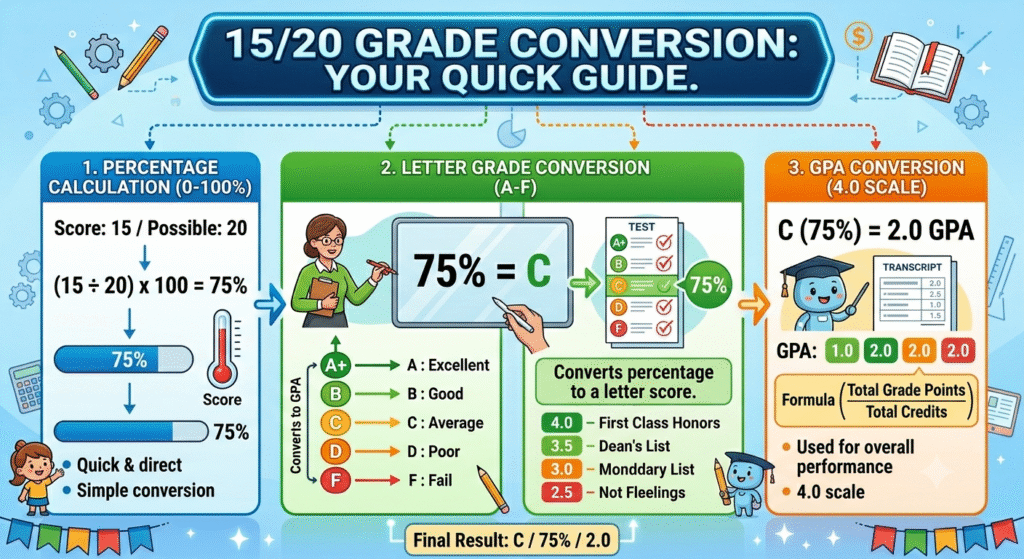
The first step in understanding any raw score is converting it to a percentage. The formula is straightforward:
Grade % = (Points Earned ÷ Total Points Possible) × 100
For 15/20:
(15 ÷ 20) × 100 = 75%
So a 15/20 score is exactly 75%. That’s your baseline for every other conversion in this article.
If you want to quickly calculate your grade percentage for other scores, the same formula always applies — divide earned points by total points, then multiply by 100.
What Letter Grade Is 15/20?
In the standard U.S. grading system, 75% earns a C — specifically a C or C+ depending on your school’s exact thresholds.
U.S. Letter Grade Scale
| Percentage | Letter Grade | GPA Value |
| 93–100% | A | 4.0 |
| 90–92% | A− | 3.7 |
| 87–89% | B+ | 3.3 |
| 83–86% | B | 3.0 |
| 80–82% | B− | 2.7 |
| 77–79% | C+ | 2.3 |
| 73–76% | C | 2.0 |
| 70–72% | C− | 1.7 |
| 67–69% | D+ | 1.3 |
| 63–66% | D | 1.0 |
| 60–62% | D− | 0.7 |
| Below 60% | F | 0.0 |
At 75%, a 15/20 score lands squarely in the C range (73–76%) under the most common U.S. scale. Some schools with a slightly different cutoff may place 75% at C+ (if their C+ range starts at 75 rather than 77).
Want to compare nearby scores? See what grade is 75%, what grade is 70%, and what grade is 80% to understand where your score fits in context.
Also worth noting: is 78 a C? — 78% is usually a C+, which is meaningfully higher than 75%. Understanding these distinctions matters when you’re near grade boundaries.
What GPA Is 15/20?
Since 15/20 equals 75%, which maps to a C on the letter grade scale, the corresponding unweighted GPA is 2.0.
GPA Conversion Table
| Percentage | Letter Grade | GPA |
| 97–100% | A+ | 4.0 |
| 93–96% | A | 4.0 |
| 90–92% | A− | 3.7 |
| 87–89% | B+ | 3.3 |
| 83–86% | B | 3.0 |
| 80–82% | B− | 2.7 |
| 77–79% | C+ | 2.3 |
| 73–76% | C | 2.0 |
| 70–72% | C− | 1.7 |
| 67–69% | D+ | 1.3 |
| 60–66% | D | 1.0 |
| Below 60% | F | 0.0 |
A 2.0 GPA is the minimum passing threshold at many colleges and universities — maintaining good standing often requires at least a 2.0 cumulative GPA. So while 75% is passing, it doesn’t leave much room for lower scores elsewhere.
For a full breakdown of how to calculate GPA from letter grades, or to understand how to calculate GPA with weighted courses, see those dedicated guides.
One common misconception: is 70 a 3.0 GPA? No — 70% earns roughly a C− and a 1.7 GPA. A 3.0 GPA corresponds to a B (83–86%). These are easy numbers to mix up without a reference table.
15/20 in Different Grading Systems Around the World
Here’s where things get interesting. The same score of 15/20 means very different things depending on which country or system you’re in.
International Grading Comparison for 15/20
| Country / System | Scale | 15/20 Equivalent | Meaning |
| USA | A–F / 4.0 GPA | C / 2.0 GPA | Average / Passing |
| France | 0–20 | 15/20 directly | Très bien (Very good) |
| UK | 0–100% | 75% = Upper 2:1 | Good degree class |
| Germany | 1.0–6.0 | ~2.0–2.5 | Gut (Good) |
| Canada | A–F / % | C / Passing | Satisfactory |
| Australia | HD/D/C/P/F | Credit (C) | Satisfactory |
| India | Percentage | 75% = First Div | Good standing |
The most notable contrast is in France, where 20 is the theoretical maximum and scores above 14 are considered very good. A 15/20 in the French system is a strong, above-average result — the equivalent of what an American student might call a B+. In the U.S., that same raw score only earns a C.
This is why grading scales matter: raw numbers without context can be deeply misleading, especially for international students or those applying to universities across borders.
Understanding Grading Scales: Why They Exist
A grading scale is the system a school uses to convert raw scores into standardized grades. Schools rely on them to:
- Communicate performance consistently across different subjects and instructors
- Enable fair comparison between students
- Meet transcript and accreditation standards
- Support academic decisions like scholarships, honors lists, and college admissions
Without a grading scale, a score of 15/20 or 75% has no agreed meaning. The grading scale is what makes the number actionable.
Here’s a brief overview of the main types used in schools today.
Types of Grading Scales
Percentage Grading Scale
The percentage scale converts every score to a value out of 100. It’s the foundation for all other conversions. As shown above, 15/20 becomes 75%.
This scale is intuitive, universally understood, and easy to calculate. It’s the most common system at the assignment level in U.S. schools.
Letter Grading Scale
Letter grades (A through F in the U.S.) translate percentages into symbols that communicate performance at a glance. A C on your transcript immediately tells a college admissions reader that the student performed at an average level in that course.
The standard U.S. scale maps 75% to a C. But letter grade cutoffs are not universal — some schools use a 10-point scale (90–100 = A, 80–89 = B, etc.) rather than the more granular scale shown above.
GPA Scale (4.0)
The Grade Point Average converts letter grades into a numerical average weighted by credit hours. A single 15/20 test score won’t directly determine your GPA, but it contributes to your course grade, which then factors into your cumulative GPA.
If a course is worth 3 credit hours and you finish with a C (2.0), those 6 grade points (3 × 2.0) become part of your GPA calculation.
Weighted vs. Unweighted GPA
An unweighted GPA treats all courses equally — an A in gym and an A in AP Physics both contribute 4.0 points. The maximum is 4.0.
A weighted GPA gives extra points for harder courses:
- Standard course: up to 4.0
- Honors course: up to 4.5
- AP or IB course: up to 5.0
So is a 4.0 GPA straight As? On an unweighted scale, yes. On a weighted scale, a student could have a 4.2 GPA with a mix of As and Bs in advanced courses.
Curious about what a 5.0 GPA means in the USA? That requires straight As in AP or IB coursework — the maximum on a weighted scale.
Standards-Based Grading
Some K–8 schools use a 1–4 mastery scale instead of traditional letter grades:
| Score | Meaning |
| 4 | Exceeds standard |
| 3 | Meets standard |
| 2 | Approaching standard |
| 1 | Below standard |
A 15/20 can’t be directly mapped to this scale without knowing the teacher’s rubric. However, 75% would typically fall between “approaching” and “meets” standard, depending on the subject.
Pass/Fail Grading
Some college courses use a simple P/F system. At most institutions, 60–70% is the minimum passing threshold. Since 75% is above that threshold in virtually every system, a 15/20 earns a Pass on a pass/fail scale.
Pass/fail grades typically don’t affect GPA, which can be useful for protecting your average in challenging elective courses.
How Does 15/20 Affect Your Course Grade?
A single score of 15/20 rarely defines your final grade — it’s one data point in a larger weighted average. How much it matters depends entirely on how much that test is worth in the overall course.
Example: Low-Weight Assignment
Course breakdown:
- Homework: 20% weight
- Quizzes: 30% weight
- Tests: 50% weight
If 15/20 was a quiz, it contributes 30% × 75% = 22.5 points toward your final grade. That’s meaningful but not dominant.
Example: High-Weight Test
If 15/20 was a major test worth 50% of your grade, and your homework average is 90% and quiz average is 85%:
Final Grade = (0.20 × 90) + (0.30 × 85) + (0.50 × 75) = 18 + 25.5 + 37.5 = 81% → B−
Even with a 75% on the heaviest component, strong performance in other categories can keep your grade at B−.
Use a weighted average grade calculator to run your own numbers. Understanding what the weight of a test grade is in your specific syllabus makes all the difference in how you prioritize study time.
How to Calculate Your Grade After Getting 15/20
Once you have your 15/20 score, here’s how to figure out your updated course standing:
Step 1: Convert to Percentage
15 ÷ 20 × 100 = 75%
Step 2: Check the category weight
Find your syllabus. If this quiz is worth 20% of your course grade, note that weight.
Step 3: Update your running average
Use the formula for calculating grades in class by multiplying each category’s average by its weight and summing.
Step 4: Calculate what you need going forward
If you want to finish the course with a B (83%), use the what grade do I need calculator to find out exactly what scores you need on remaining work.
For a complete walkthrough, see how to calculate a grade after a test and how to calculate your final grade.
Is 15/20 a Good Grade?
The honest answer: it depends on context.
| Context | Is 15/20 Good? |
| France (20-point scale) | Yes — très bien, above average |
| U.S. high school | Average — C, meets minimum expectations |
| Competitive college program | Below target — most programs want B or better |
| Pass/fail course | Yes — comfortably passing |
| Graduate school | Often insufficient — many programs require B (3.0) minimum |
| K–12 quiz or homework | Fine — but worth improving before major exams |
For many students, a C (75%) is a signal to review the material before the next exam — not a crisis, but not a comfort zone either.
Here’s a related question worth considering: is a C+ better than a C? Yes — a C+ (2.3 GPA) versus a C (2.0 GPA) is a meaningful difference in competitive programs, even if the grade symbols look similar.
How 15/20 Fits Into Broader GPA Health
Effect on Cumulative GPA
One C (2.0) in a pool of mostly Bs and As won’t destroy your GPA, but it does pull the average down.
Will one C hurt my GPA? If your cumulative GPA is currently 3.4 and you’re 30 credit hours in, adding a 3-credit C (2.0) drops it to roughly 3.27. Recoverable — but notable.
If you’re starting out and every grade counts equally, a C in an early course has more lasting impact. That’s why tracking your grade average throughout the semester — not just at the end — is essential.
Can You Recover?
Can I raise my GPA quickly? Yes, with the right strategy:
- Prioritize high-credit courses where improvement has the most mathematical impact
- Retake failed or low-grade courses if your school allows grade replacement
- Use weighted GPA opportunities like AP and honors courses to earn bonus points
And if you’re wondering whether a 3.5 GPA is good for college — yes, it is. Staying above 3.0 after receiving a C requires focused performance in subsequent coursework.
Common Mistakes Students Make With Scores Like 15/20
Mistake 1: Assuming 75% is “fine” without checking the course average
If the class average is 85%, a 75% puts you below most of your peers. Context matters.
Mistake 2: Not accounting for assignment weight
A 75% on a 5% homework assignment is very different from a 75% on a 40% midterm. Always check how to calculate total grade with weights applied.
Mistake 3: Ignoring borderlines
75% lands just above the C/C− boundary. If your school’s C starts at 73%, you passed comfortably. If C+ starts at 75%, you might be right on the edge. Clarify your school’s exact cutoffs.
Mistake 4: Forgetting the international context
Students transferring from France or other 20-point scale countries sometimes assume their strong 15/20 history translates to an American A. It doesn’t — 75% is a C in the U.S. system. This can come as an unpleasant surprise on a U.S. transcript.
Mistake 5: Not projecting ahead
Rather than passively accepting a C, use a semester grade calculator to see what you can realistically achieve by the end of the term and plan accordingly.
Mistake 6: Confusing raw score with overall grade
Getting 15/20 on one test is not the same as having a C in the course. Your overall score depends on all graded components combined.
Real-World Scenarios: 15/20 in Action
Scenario A: High School Quiz
Maria scores 15/20 on a biology quiz worth 10% of her course grade. Her other grades are strong (two tests at 88% and 91%). Her weighted course grade remains around 88% — a solid B+. The 15/20 quiz barely moves the needle.
Scenario B: College Midterm
James scores 15/20 on a midterm worth 35% of his grade. His homework average is 82% (20% weight) and participation is 95% (10% weight). With finals worth 35%:
Running grade so far (65% of course completed):
(0.35 × 75) + (0.20 × 82) + (0.10 × 95) = 26.25 + 16.4 + 9.5 = 52.15 out of 65
James needs to check how to calculate his final grade to see what score on the final (35%) will get him to a B (83%+). Plugging in:
Required final = (83 − 52.15) ÷ 35 × 100 = 88%
He needs an 88% on the final — challenging but achievable.
Scenario C: French Student in the U.S.
Sophie grew up in France where 15/20 means “très bien.” Applying to a U.S. university, her transcript shows 15/20 across several subjects. The admissions office converts these to 75% each — a C average. Sophie’s academic record looks much weaker than it actually is. This is a real issue that requires official transcript evaluation through services like WES.
Tips for Improving a 15/20 Score
A 75% isn’t a failing grade, but most students want to push it higher. Here’s how:
1. Identify exactly where you lost points On a 20-point assignment, losing 5 points is a 25% loss. Were they all in one section? A pattern of errors in the same topic area signals a specific knowledge gap.
2. Rework missed problems before moving on Don’t just note what you got wrong — redo those problems from scratch without looking at the answer. This is the most effective study technique for test improvement.
3. Understand how much the next assessment is worth Check how to grade assignments and your syllabus to identify which upcoming assessments carry the most weight. Invest effort proportionally.
4. Use AP or honors curves where available How are AP tests graded? AP exams use a 1–5 scale separate from your course grade, but taking AP courses boosts your weighted GPA even with a B performance.
5. Ask your teacher about curving Some teachers apply a grade curve when scores are generally low. If the class average was 13/20 and you scored 15/20, a curve might push your grade up significantly.
6. Target the grade boundary strategically If you need a B (83%) to meet a scholarship requirement, and you’re currently at 75%, calculate exactly what you need on remaining work using a final grade calculator. Working toward a specific number is more effective than vague “do better” goals.
Grading Scale Comparison Table
| System | Scale | 15/20 Equivalent | Performance Level |
| U.S. Percentage | 0–100% | 75% | Average (C) |
| U.S. Letter Grade | A–F | C | Passing |
| U.S. GPA (4.0) | 0.0–4.0 | 2.0 | Minimum standing |
| Weighted GPA (5.0) | 0.0–5.0 | 2.0 (standard) | Below target for AP |
| French (20-pt scale) | 0–20 | 15 = Très Bien | Very good |
| UK Honours | 0–100% | 75% = Upper 2:1 | Good degree |
| German | 1.0–6.0 | ~2.3 | Gut (Good) |
| Australian | HD/D/C/P/F | Credit | Satisfactory |
| Pass/Fail | P/F | Pass | Passes |
| Standards-Based | 1–4 | ~2.5–3 | Approaching/Meets |
Key Takeaways
- 15/20 = 75% — calculated by dividing 15 by 20 and multiplying by 100.
- In the U.S. system, 75% earns a C and a 2.0 GPA on an unweighted scale.
- In the French system, 15/20 is considered very good — a significant difference in interpretation.
- A 2.0 GPA is the minimum for academic good standing at most U.S. colleges.
- Whether 15/20 is “good” depends on your course, country, grade level, and academic goals.
- One C won’t ruin a strong GPA, but consistent C-level performance limits academic opportunities.
- Use weighted grade formulas to understand exactly how a 15/20 score affects your overall course grade.
- Always verify your school’s exact letter grade cutoffs — thresholds vary by institution.
Frequently Asked Questions (FAQ)
Q1: What is 15 out of 20 as a percentage?
15 out of 20 equals 75%. Divide 15 by 20 and multiply by 100 to get the percentage.
Q2: What letter grade is 15/20?
In the U.S., 75% is a C on the standard letter grade scale (73–76% = C). Some schools may classify it as a C+ if their cutoff starts at 75%.
Q3: What GPA is 15/20?
A score of 75% corresponds to a C, which equals a 2.0 GPA on the standard unweighted 4.0 scale.
Q4: Is 15/20 a passing grade?
Yes, in virtually all grading systems, 75% is a passing grade. Most schools set the passing threshold between 60% and 70%.
Q5: Is 15/20 good in the French grading system?
Yes — in France, the grading scale runs from 0 to 20. A 15/20 is considered très bien (very good) and is above average. This is a major difference from the U.S. interpretation.
Q6: How does 15/20 affect my GPA?
A single score of 15/20 (75%) won’t directly set your GPA — it contributes to your course grade, which then feeds into your cumulative GPA based on credit hours. One C in a 3-credit course adds 6 grade points (3 × 2.0) to your GPA calculation.
Q7: What do I need on the final exam if I scored 15/20 on the midterm?
It depends on your target grade and the weight of each component. Use the formula: Required Score = (Target Grade − Current Weighted Score) ÷ Final Weight. A final grade calculator simplifies this quickly.
Q8: Is 15/20 the same as a B in other grading systems?
Not in the U.S. — 75% is a C. However, in the UK, 75% falls in the Upper Second Class (2:1) category, which is closer to a B. In France, it’s closer to an A−. The interpretation varies significantly by country.
Q9: How do I convert 15/20 to a 4.0 GPA?
Convert to percentage first: 15 ÷ 20 × 100 = 75%. Then use the GPA scale: 73–76% = C = 2.0 GPA.
Q10: What score out of 20 do I need to get a B?
To earn a B (83%), you need at least 83% of 20 = 16.6 points, which rounds to 17 out of 20. For a B+ (87%), you’d need at least 17.4, or effectively 18 out of 20.
Conclusion
A score of 15/20 is a 75% — a C in the U.S. grading system and a 2.0 GPA. It’s a passing grade, but it sits right at the average boundary, and its significance shifts dramatically depending on your country, institution, and academic program.
For French students, 15/20 is a genuine achievement. For American students aiming for scholarships, honors programs, or competitive graduate schools, it’s a signal to study harder and target the 17–18/20 range in future assessments.
The most important step after receiving any grade is to understand what it means in your specific context, calculate its impact on your overall course grade, and decide what to do next. Use the calculators and formulas in this guide to stay ahead of your academic standing — don’t wait for the final report card to find out where you are.