
Whether you are a high school student anxious about your GPA, a teacher managing dozens of assignments, or a parent trying to understand your child’s report card, knowing how to calculate grades quickly is one of the most practical academic skills you can have. Grading is not just about scores — it shapes college admissions decisions, scholarship eligibility, and academic confidence.
This guide explains every major grading system used in 2026, walks you through step-by-step calculation methods, and shows you exactly how to convert between scales. By the end, you will know how to read any grade, calculate any average, and make informed decisions about your academic path.
What Is a Grading Scale?
A grading scale is a standardized system that converts raw scores or academic performance into a meaningful representation — typically a letter, number, or percentage. Schools use grading scales so that:
- Students clearly understand where they stand academically
- Teachers apply consistent evaluation criteria across all students
- Colleges and universities can compare applicants from different schools
- Parents receive transparent feedback about their child’s progress
Without a grading scale, a score of 72 out of 100 is just a number. With a scale, it becomes a C — passing, but with room for improvement. The scale gives the score context, weight, and academic meaning.
Why Schools Use Grading Scales
Grading scales serve several important functions in education:
Standardization ensures that all students are evaluated on the same criteria, making comparisons fair and meaningful within and across schools.
Motivation gives students clear, achievable targets. Knowing that an 87 is a B+ encourages students to push toward the next milestone.
Communication creates a common language between teachers, students, parents, and institutions. A transcript with letter grades tells a college admissions office exactly what it needs to know.
Accountability holds both students and educators to measurable outcomes.
Understanding why grading scales exist helps you use them to your advantage rather than feeling controlled by them.
The Most Common Grading Scales Explained
H2: Percentage Grading Scale
The percentage grading scale is the foundation of most grading systems. It expresses performance as a portion of total possible points.
Formula:
Grade (%) = (Points Earned ÷ Total Points Possible) × 100
Example: You scored 38 out of 50 on a quiz. (38 ÷ 50) × 100 = 76%
If you want to know what grade is 75% or what grade is 70%, a quick percentage lookup tells you where you stand immediately.
Standard Percentage Grading Chart:
| Percentage Range | Letter Grade | GPA Points |
| 93–100% | A | 4.0 |
| 90–92% | A− | 3.7 |
| 87–89% | B+ | 3.3 |
| 83–86% | B | 3.0 |
| 80–82% | B− | 2.7 |
| 77–79% | C+ | 2.3 |
| 73–76% | C | 2.0 |
| 70–72% | C− | 1.7 |
| 67–69% | D+ | 1.3 |
| 63–66% | D | 1.0 |
| 60–62% | D− | 0.7 |
| Below 60% | F | 0.0 |
Quick Tip: Wondering whether 89.5 rounds to an A or a B? Most schools round 89.5 up to 90, which earns an A−. Always check your institution’s rounding policy.
Letter Grading Scale
The letter grading scale (A through F) is the most widely recognized system in the United States and many other countries. Each letter grade represents a performance band — a range of percentage scores or academic achievement levels.
Standard U.S. Letter Grade Scale:
| Letter | Meaning | Typical GPA |
| A+ | Exceptional | 4.0 |
| A | Excellent | 4.0 |
| A− | Near Excellent | 3.7 |
| B+ | Above Average | 3.3 |
| B | Good | 3.0 |
| B− | Slightly Above Avg | 2.7 |
| C+ | Slightly Below Avg | 2.3 |
| C | Satisfactory | 2.0 |
| C− | Below Satisfactory | 1.7 |
| D | Poor but Passing | 1.0 |
| F | Failing | 0.0 |
A common student question is whether a C is better than a C− grade — and yes, every fraction of a GPA point matters, especially in competitive programs. Similarly, many students debate whether 70 is a C or a D — the answer depends entirely on your school’s scale.
To accurately calculate a GPA from letter grades, you convert each letter grade to its GPA point equivalent and then average those values weighted by credit hours.
GPA Grading Scale
GPA (Grade Point Average) converts all your letter grades into a single number, usually on a 0.0–4.0 scale in the United States. It is the most commonly used metric for college admissions, scholarships, and academic standing.
GPA Conversion Table:
| Letter Grade | Percentage | GPA (4.0 Scale) |
| A+ | 97–100% | 4.0 |
| A | 93–96% | 4.0 |
| A− | 90–92% | 3.7 |
| B+ | 87–89% | 3.3 |
| B | 83–86% | 3.0 |
| B− | 80–82% | 2.7 |
| C+ | 77–79% | 2.3 |
| C | 73–76% | 2.0 |
| C− | 70–72% | 1.7 |
| D+ | 67–69% | 1.3 |
| D | 65–66% | 1.0 |
| F | Below 65% | 0.0 |
A frequently asked question: is a 4.0 GPA straight A’s? On an unweighted scale, yes — a 4.0 means all A grades. On a weighted scale, however, a 4.0 may include some B’s in advanced courses.
Also worth noting: is 70 a 3.0 GPA? No — a 70% typically equates to a C or C−, which is approximately 1.7–2.0 GPA points, not 3.0.
How to Calculate GPA:
GPA = Σ (Grade Points × Credit Hours) ÷ Total Credit Hours
Example:
| Course | Grade | GPA Points | Credits | Quality Points |
| English | A | 4.0 | 3 | 12.0 |
| Math | B+ | 3.3 | 4 | 13.2 |
| History | B | 3.0 | 3 | 9.0 |
| Biology | C+ | 2.3 | 4 | 9.2 |
| Total | 14 | 43.4 |
GPA = 43.4 ÷ 14 = 3.10
To go deeper, use a dedicated tool to calculate your grades in class or calculate your semester grade with full weighting applied.
Weighted GPA vs. Unweighted GPA
This distinction confuses many students and parents, yet it has a significant impact on how transcripts are read.
Unweighted GPA
An unweighted GPA treats all courses equally, regardless of their difficulty level. Every A earns 4.0 points, whether it is in a standard class or an Advanced Placement (AP) course.
- Scale: 0.0 to 4.0
- Advantage: Straightforward and easy to calculate
- Disadvantage: Does not reflect academic rigor
Weighted GPA
A weighted GPA awards extra points for harder courses. AP, IB (International Baccalaureate), and Honors classes typically add 0.5 to 1.0 extra GPA points.
- Scale: 0.0 to 5.0 (sometimes higher)
- Advantage: Rewards students who challenge themselves
- Disadvantage: Varies widely between schools, making direct comparisons harder
Weighted vs. Unweighted GPA Comparison:
| Course Type | Grade | Unweighted GPA | Weighted GPA |
| Regular | A | 4.0 | 4.0 |
| Honors | A | 4.0 | 4.5 |
| AP/IB | A | 4.0 | 5.0 |
| Regular | B | 3.0 | 3.0 |
| Honors | B | 3.0 | 3.5 |
| AP/IB | B | 3.0 | 4.0 |
If you want to know what a 5.0 GPA means in the USA, it means you earned A grades exclusively in weighted AP or IB courses — the highest possible achievement on most weighted scales.
Learn how to calculate GPA with weighted courses using our step-by-step tool. You might also wonder: is a 3.5 GPA good for college? In most cases, yes — a 3.5 is competitive at a wide range of universities.
Standards-Based Grading (SBG)
Standards-based grading evaluates students against specific learning standards rather than averaging scores across all assignments. Instead of a single letter grade, students receive a score on each learning objective.
Typical SBG Scale:
| Score | Meaning |
| 4 | Exceeds the standard |
| 3 | Meets the standard |
| 2 | Approaching the standard |
| 1 | Does not yet meet the standard |
SBG is increasingly common in K–8 education. It gives a more nuanced picture of where a student excels and where targeted support is needed. The challenge is that many parents and students accustomed to letter grades find the transition confusing at first.
Pass/Fail Grading
In pass/fail (P/F) systems, a student either meets the minimum threshold to pass or does not. There is no letter grade, no GPA impact in most schools, and no partial credit.
- Common threshold: Typically 60–70% depending on the institution
- Used in: College electives, professional certifications, graduate seminars, and some standardized evaluations
- Advantage: Reduces grade anxiety on exploratory or enrichment courses
- Disadvantage: Provides no signal about how well a student performed beyond the minimum
A common point of confusion: is a 60 an F or a D? In pass/fail systems, 60 may be a passing grade. In traditional letter grading, it often falls in the D− range, depending on the school’s scale.
International Grading Systems
Grading varies significantly around the world. Understanding international scales matters for students studying abroad, transferring between countries, or applying to global universities.
International Grading Scale Comparison:
| Country/Region | Scale | Highest Grade | Passing Grade | U.S. Equivalent |
| United States | A–F / 0–4.0 | A / 4.0 | D / 1.0 | — |
| United Kingdom | 0–100 / Class | First Class | Third Class | A = 70%+ |
| Germany | 1–6 | 1 (Sehr gut) | 4 (Ausreichend) | A = 1–1.5 |
| France | 0–20 | 20 | 10 | A = 16–20 |
| Canada | A–F / % | A+ | D | Similar to U.S. |
| Australia | HD/D/C/P/F | HD (85%+) | Pass (50%) | A = HD |
| India | 0–100 / CGPA | 100 / 10.0 | 35–40% | A = 75%+ |
| China | 0–100 | 100 | 60 | A = 90–100 |
| Japan | 0–100 / ABCD | S (90–100) | C (60–70%) | A = S grade |
When converting international grades for U.S. applications, services like World Education Services (WES) or ECE evaluate transcripts and apply an equivalent scale. Always verify the conversion method your target institution prefers.
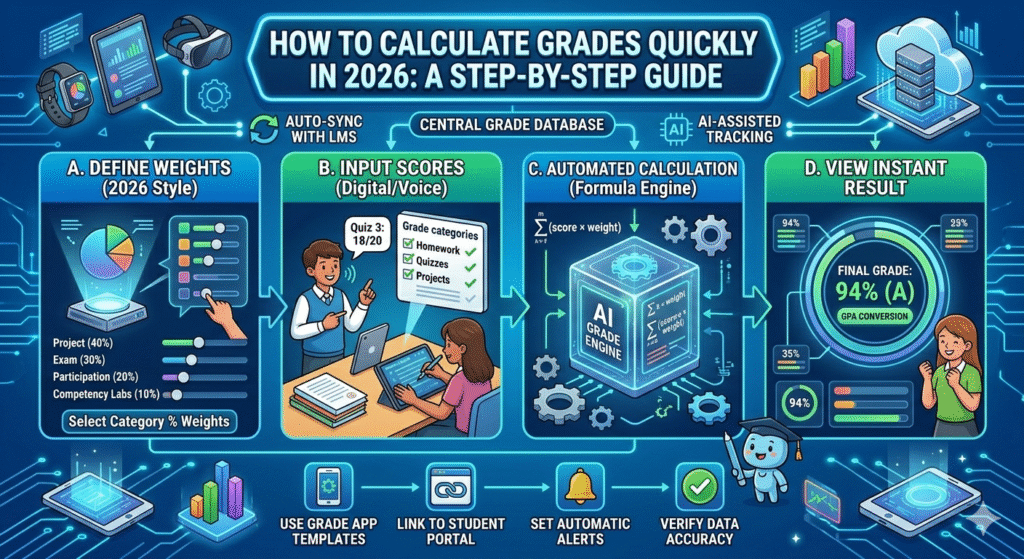
How Grading Scales Affect GPA and Academic Performance
Grading scales are not neutral — they directly shape academic trajectories.
One grade can move the needle. Many students ask: will one C hurt my GPA? The honest answer is: it depends on how many total credit hours you have completed. Early in your academic career, one C has a larger proportional effect. Later, it is diluted by more credits.
Borderline grades carry real stakes. The difference between 78 being a C vs. a C+ may seem minor, but across a four-year program it compounds. For graduate school applications, even a 0.1 difference in GPA can matter.
Weighted courses amplify high performance. A student who takes AP courses and earns B’s can sometimes outperform a student taking standard courses and earning A’s — purely on the weighted GPA scale. Understanding how AP tests are graded is part of that picture; learn more about how AP tests are graded to plan your course load strategically.
Grade recovery is possible but requires planning. Students often wonder: can I raise my GPA quickly? The answer depends on how many credits remain and what grades you earn going forward. A GPA boost calculator can map out exactly what you need.
How to Calculate Grades Using Different Scales
Calculating a Percentage Grade
Step 1: Add up all points earned. Step 2: Add up all total possible points. Step 3: Divide earned by possible, then multiply by 100.
Example: 3 assignments, scores of 18/20, 45/50, and 27/30.
- Total earned: 18 + 45 + 27 = 90
- Total possible: 20 + 50 + 30 = 100
- Grade = (90 ÷ 100) × 100 = 90% (A−)
Use our grade percentage calculator for instant results.
Calculating a Weighted Grade Average
When different assignments count for different portions of your final grade, you need a weighted average.
Formula:
Final Grade = Σ (Score × Weight) ÷ Σ Weights
Example:
| Category | Score | Weight |
| Homework | 85% | 20% |
| Midterm Exam | 78% | 30% |
| Final Exam | 91% | 35% |
| Participation | 95% | 15% |
Calculation:
- (85 × 0.20) + (78 × 0.30) + (91 × 0.35) + (95 × 0.15)
- = 17 + 23.4 + 31.85 + 14.25
- = 86.5% (B)
For full guidance, see how to calculate a weighted average grade or calculate your grade average across all coursework.
Calculating a Final Grade
To figure out what score you need on a final exam to reach your target grade, use the final grade formula:
Required Exam Score = (Target Grade − Current Grade × (1 − Exam Weight)) ÷ Exam Weight
Example: Your current grade is 82%, the final exam is worth 30%, and you want a 90%.
- (0.90 − 0.82 × 0.70) ÷ 0.30
- = (0.90 − 0.574) ÷ 0.30
- = 0.326 ÷ 0.30
- = 108.7% — you would need extra credit or a near-perfect score.
Use our final grade calculator to run this instantly, or check what grade you need on upcoming assessments.
Calculating Individual Test and Assignment Grades
For a single assignment, the formula is straightforward. If you scored 9 out of 11, that is 82% — a B−. If you scored 15 out of 20, that is 75% — a C.
When figuring out how much a test grade is worth, always check your syllabus. A test worth 40% of your final grade impacts your average far more than a quiz worth 5%.
To understand the weight of a test grade in your overall average, multiply the test percentage score by its category weight and add it to the weighted scores from other categories.
You can also learn how to calculate a grade after a test to immediately see where you stand before official results are posted.
Grading Assignments
For teachers, grading assignments consistently requires a clear rubric. Use the point-based method: assign each criterion a point value, score each student, then convert to a percentage. Learn more about how to grade assignments using structured rubrics that save time and reduce bias.
Teachers can also apply curve grading methods when an exam proves harder than expected — adjusting the score distribution without changing individual performance rankings.
Calculating Your Total Grade and Overall Score
At the end of a semester, calculating your total grade requires combining all weighted category scores. If you need help understanding how to calculate your overall score across all subjects, use a running weighted calculator throughout the semester — not just at the end.
For semester-end planning, our how to calculate final grades guide breaks down the process with examples for every common grading structure.
Common Grading Conversion Methods
Percentage to Letter Grade
Simply match your percentage to the letter grade chart above. Most U.S. schools use the standard chart, though some schools use a stricter or more lenient scale. A 93 is typically an A; an 80 is typically a B−.
Letter Grade to GPA Points
Match each letter grade to its 4.0-scale equivalent using the conversion table earlier in this guide.
GPA to Percentage (Approximate)
Multiply GPA by 25 for a rough percentage estimate. A 3.0 GPA ≈ 75%. This is an approximation, not a precise formula — use it for rough orientation only.
Percentage to GPA (Approximate)
| Percentage | GPA Equivalent |
| 93–100% | 4.0 |
| 85–92% | 3.5–3.9 |
| 77–84% | 3.0–3.4 |
| 70–76% | 2.0–2.9 |
| 60–69% | 1.0–1.9 |
| Below 60% | 0.0 |
For what grade 80% represents, including its letter grade and GPA equivalent, see what grade is 80%.
Common Mistakes Students Make When Interpreting Grades
1. Confusing percentage with GPA points. A 90% is not a 3.6 GPA — it is typically a 3.7 (A−). The conversion tables above show the correct mappings.
2. Ignoring assignment weights. Treating a 5-point homework and a 200-point midterm as equally important can give you a completely false picture of where your grade stands.
3. Assuming all schools use the same scale. A C at one school might start at 73%; at another it might start at 70%. Always verify your institution’s specific grading policy.
4. Forgetting to account for rounding. Whether an 89.5 rounds to 90 or stays at 89 can be the difference between a B+ and an A−. Always know the policy.
5. Not tracking grades continuously. Many students only check their grades right before finals, leaving little time to course correct. Track after every major assignment using a how to calculate final grades tool.
6. Misreading standards-based grades. A “3” in SBG means you are meeting the standard — it is not equivalent to a C. Parents and students new to SBG sometimes panic unnecessarily.
7. Overlooking the impact of extra credit. Extra credit can provide a meaningful buffer — but only if you understand how it is factored into your weighted average.
Tips for Improving Your Grades
Start with your syllabus. Understand exactly how each category is weighted. Focus your energy on high-weight items — exams and major projects — before low-weight items like participation grades.
Use grade tracking tools. Regularly use a grade average calculator so you always know your current standing. Surprises at the end of the semester are almost always avoidable.
Communicate with teachers early. If you are struggling, speak up during the first half of the semester — not the last week. Many teachers offer extra credit, makeup work, or tutoring resources before the final.
Prioritize high-impact assignments. Use a what is the weight of a test grade calculator to identify which upcoming tasks carry the most grade weight, then plan your study schedule accordingly.
Retake or replace low grades where possible. Some schools allow grade replacement policies for retaken courses. Even one replaced grade can meaningfully improve your cumulative GPA.
Take strategic course loads. Balance advanced courses with standard ones to protect your GPA while still building an impressive transcript. A B in an AP course (weighted) can sometimes equal or outperform an A in a standard course.
Plan for grade recovery. If your GPA has slipped, use a can I raise my GPA quickly tool to model exactly what grades you need in remaining courses to hit your target.
Key Takeaways
- Grading scales translate raw scores into meaningful academic indicators — percentages, letter grades, and GPA are three different expressions of the same performance.
- The standard U.S. GPA scale runs from 0.0 to 4.0, with weighted scales extending to 5.0 for honors, AP, and IB courses.
- Weighted grades reward academic rigor, but they vary by school — always check whether a college uses weighted or unweighted GPA in admissions.
- International grading systems differ widely, and official evaluation services are often needed for cross-country conversions.
- One or two grades rarely define your trajectory — but consistent grade tracking helps you make course corrections before it is too late.
- The fastest way to calculate any grade is to use the percentage formula (Points Earned ÷ Total Points × 100) and match it to your school’s grading chart.
- Understanding assignment weights is essential — knowing which tasks have the greatest impact on your final grade is more valuable than simply studying harder across the board.
Frequently Asked Questions (FAQ)
1. What is the quickest way to calculate a grade percentage?
Divide the points you earned by the total possible points, then multiply by 100. For example, 42 out of 50 = (42 ÷ 50) × 100 = 84%. Use our grade percentage calculator to do this instantly for any score combination.
2. How do I calculate my final grade before the semester ends?
Add up all your current assignment scores, apply their category weights, and compare to your target grade. Then use the final exam grade formula to find out what score you need on remaining assessments. Our what grade do I need calculator does all of this automatically.
3. What is the difference between weighted and unweighted GPA?
An unweighted GPA treats all courses equally on a 0–4.0 scale. A weighted GPA awards additional points (usually 0.5–1.0) for honors, AP, or IB courses, resulting in a scale that typically goes up to 5.0. Colleges often recalculate GPA using their own formula, so both matter.
4. Is a 70% a passing grade?
In most U.S. high schools and colleges, 70% is a C− and is considered passing — though some programs require a minimum of 73% or 75% for a course to count toward a major. See what grade is 70 for a full breakdown.
5. How are AP courses graded and do they affect GPA?
AP courses use a 1–5 exam scale administered by the College Board. In terms of high school GPA, an AP course typically adds 1.0 extra point to the grade on a weighted scale — an A in AP earns 5.0 rather than 4.0. Read a full explanation of how AP tests are graded.
6. Can one bad test grade ruin my semester grade?
It depends on the test’s weight. A test worth 40% of your grade has a significant impact; a quiz worth 5% does not. Use our guide on how much a test grade is worth to calculate the exact impact of any single assessment.
7. What does a 3.5 GPA mean for college admissions?
A 3.5 GPA is considered good and is competitive at a wide range of universities, including many selective schools. It signals consistently strong performance. Learn whether a 3.5 GPA is good for college in the context of your target schools.
8. How do international students convert their grades to a U.S. GPA?
International students typically use credential evaluation services like WES or ECE, which compare your country’s grading scale to the U.S. 4.0 scale. The conversion table in this article provides general reference points, but always use an accredited evaluator for official applications.
9. What is standards-based grading and how is it different from traditional grading?
Standards-based grading (SBG) rates students on individual learning objectives using a 1–4 scale, rather than assigning a single averaged grade. It is more diagnostic — telling you specifically which skills you have mastered — but it does not directly translate to a GPA in the traditional sense.
10. How do I calculate a grade average across multiple classes?
Add up all the grade points (GPA equivalents) for each course, multiply each by the number of credit hours, sum those products, and divide by total credit hours. Use our grade average calculator for a fully automated calculation.
Conclusion
Grades are more than numbers — they are a map of your academic journey. Whether you are a student trying to hit a 3.5 GPA, a teacher designing a fair assessment structure, or a parent supporting a child through a challenging semester, understanding grading scales gives you the power to make informed, strategic decisions.
The core principle is simple: know your scale, track your weights, and calculate continuously. Do not wait until the end of the semester to discover where you stand. Use the formulas in this guide, apply the conversion tables, and take advantage of the free tools at testgradescalculator.com to stay ahead at every step.