If you have ever looked at a report card and wondered why one school uses percentages while another uses letters — or why two students with the same percentage end up with different GPAs — you are not alone. Grading scales sit at the heart of every academic system, yet most students, parents, and even teachers rarely pause to understand how they actually work.
This guide covers every major grading scale used in schools and universities today. You will learn exactly how each system is structured, how grades are calculated under each scale, how they compare to one another, and how to avoid the common mistakes people make when reading results.
What Is a Grading Scale?
A grading scale is a structured system that converts raw academic performance — test scores, assignments, projects, and participation — into a standardized measure that can be communicated clearly. Think of it as a translation layer: it turns “the student answered 43 out of 50 questions correctly” into something immediately meaningful, whether that is 86%, a letter B, a 3.0 GPA, or a “Meets Standards” rating.
Schools adopt formal grading scales for three core reasons:
- Consistency. Everyone in the same institution operates by the same rules, so a grade carries the same meaning across classrooms and teachers.
- Communication. Parents, universities, and employers can quickly understand academic performance without reading every assignment.
- Accountability. Defined benchmarks motivate students and give teachers a defensible basis for every grade they assign.
Understanding which scale is in use — and what the numbers actually mean — is essential before you can calculate your final grade accurately or plan a strategy to improve your standing.
1. The Percentage Grading Scale
How It Works
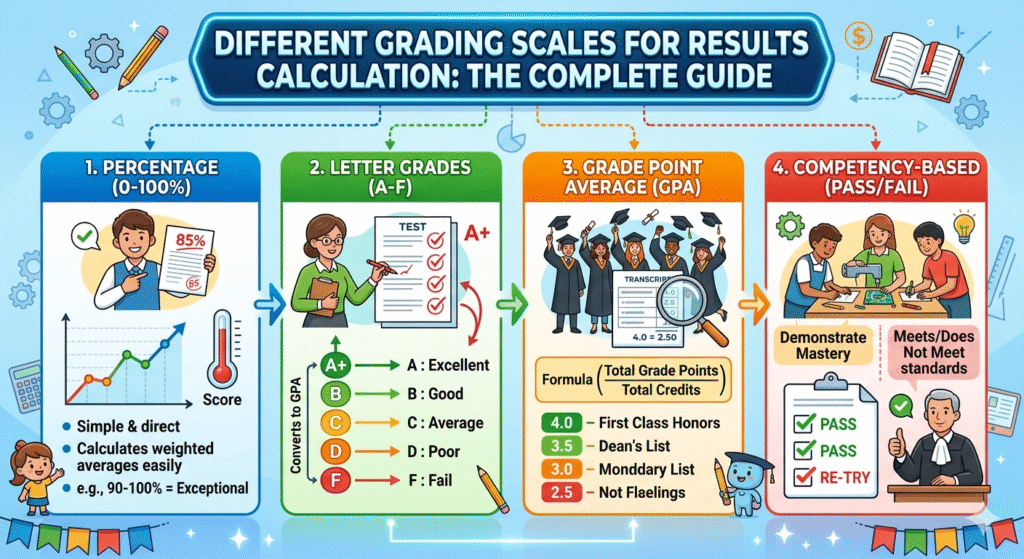
The percentage grading scale is the most transparent system in widespread use. A raw score is divided by the total possible points and then multiplied by 100.
Formula:
Grade Percentage = (Points Earned ÷ Total Points Possible) × 100
Example: A student scores 38 out of 50 on a quiz.
(38 ÷ 50) × 100 = 76%
Want to go further and understand how to calculate grade percentage across multiple assessments? The same logic applies when you weight different assignments.
Standard Percentage Ranges
| Percentage Range | Performance Level |
| 90 – 100% | Excellent / A |
| 80 – 89% | Good / B |
| 70 – 79% | Average / C |
| 60 – 69% | Below Average / D |
| Below 60% | Failing / F |
Where It Is Used
Percentage grading dominates primary and secondary schools in the United States, Canada, India, Pakistan, and much of the Middle East. It is also the default scale displayed on most online grade-tracking platforms because students find it intuitive.
Key Limitation
Percentage alone does not tell you how difficult the course was. A 78% in an AP Physics class and a 78% in an introductory elective represent very different levels of academic effort. This is one reason GPA systems and weighted scales were introduced.
2. The Letter Grading Scale
How It Works
Letter grades compress percentage ranges into alphabetical categories. The standard US system maps as follows:
| Letter Grade | Percentage Range | Performance Description |
| A+ | 97 – 100% | Outstanding |
| A | 93 – 96% | Excellent |
| A− | 90 – 92% | Near Excellent |
| B+ | 87 – 89% | Very Good |
| B | 83 – 86% | Good |
| B− | 80 – 82% | Above Average |
| C+ | 77 – 79% | Slightly Above Average |
| C | 73 – 76% | Average |
| C− | 70 – 72% | Slightly Below Average |
| D+ | 67 – 69% | Below Average |
| D | 63 – 66% | Barely Passing |
| D− | 60 – 62% | Minimum Pass |
| F | Below 60% | Failing |
Grades like 75% map to a specific letter, 70% has its own letter designation, and 80% sits at a clear boundary between B and B+. These cutoff questions matter enormously for GPA calculations. For instance, a common question is whether 89.5% rounds up to an A or stays a B — and the answer depends on your school’s rounding policy.
Similarly, many students ask whether 70% is a C or a D, and the answer varies slightly by institution, though 70% is most commonly treated as the floor for a C.
3. The GPA (Grade Point Average) Scale
What GPA Measures
GPA is a numerical average of all your course grades, expressed on a scale (most commonly 0.0 to 4.0 in the US). It strips away the variation between individual assignment percentages and gives a single, cumulative academic snapshot.
Standard 4.0 GPA Conversion Table
| Letter Grade | Percentage | GPA Points |
| A+ | 97 – 100% | 4.0 |
| A | 93 – 96% | 4.0 |
| A− | 90 – 92% | 3.7 |
| B+ | 87 – 89% | 3.3 |
| B | 83 – 86% | 3.0 |
| B− | 80 – 82% | 2.7 |
| C+ | 77 – 79% | 2.3 |
| C | 73 – 76% | 2.0 |
| C− | 70 – 72% | 1.7 |
| D+ | 67 – 69% | 1.3 |
| D | 63 – 66% | 1.0 |
| D− | 60 – 62% | 0.7 |
| F | Below 60% | 0.0 |
A natural follow-up question is whether a 4.0 GPA actually means straight A’s — technically yes on an unweighted scale, but weighted scales can push GPA above 4.0.
How to Calculate GPA
To calculate your unweighted GPA:
- Convert each course grade to its GPA point value.
- Multiply each point value by the number of credit hours for that course.
- Sum all the weighted point values.
- Divide by the total number of credit hours.
Formula:
GPA = Σ (Grade Points × Credit Hours) ÷ Σ Credit Hours
Example:
| Course | Grade | GPA Points | Credits | Points × Credits |
| English | A | 4.0 | 3 | 12.0 |
| Math | B+ | 3.3 | 4 | 13.2 |
| History | C+ | 2.3 | 3 | 6.9 |
| Biology | B | 3.0 | 3 | 9.0 |
| Total | 13 | 41.1 |
GPA = 41.1 ÷ 13 = 3.16
You can also learn to calculate a GPA from letter grades using tools that handle this math automatically.
One grade can shift your GPA more than people expect. Will one C hurt your GPA? Yes — but the impact depends on how many total credit hours you have completed. A single C in your first semester is more damaging than one in your final year.
4. Weighted GPA vs. Unweighted GPA
This is one of the most misunderstood distinctions in academic grading.
Unweighted GPA
An unweighted GPA treats every course equally. A 4.0 is the maximum, regardless of whether the course was introductory or advanced. This is still the standard at many high schools and most grade-level tracking systems.
Weighted GPA
A weighted GPA gives bonus points for more rigorous coursework:
| Course Level | A Grade Value | B Grade Value |
| Regular | 4.0 | 3.0 |
| Honors | 4.5 | 3.5 |
| AP / IB / Dual Enroll | 5.0 | 4.0 |
This means a student who earns a B in an AP course (4.0 weighted) can have a higher weighted GPA than a student who earns an A in a regular course (4.0 unweighted). Want to understand what a 5.0 GPA means in the USA? It is only achievable under a weighted system.
Understanding how to calculate GPA with weighted courses requires knowing your school’s bonus point policy before you begin.
Why Colleges Care
Most college admissions offices recalculate GPAs on an unweighted scale to compare applicants fairly. However, they do note the rigor of your course selection. Is a 3.5 GPA good for college? At most institutions, yes, especially if it comes from a challenging course load.
5. Standards-Based Grading (SBG)
What It Is
Standards-Based Grading shifts focus from cumulative point accumulation to demonstrated mastery of specific learning targets. Instead of receiving a single number or letter for the entire course, students receive separate scores for each skill or standard.
Typical SBG Scales
| Score | Label |
| 4 | Exceeds Standards / Advanced |
| 3 | Meets Standards / Proficient |
| 2 | Approaching Standards |
| 1 | Below Standards |
| 0 | Insufficient Evidence |
Where SBG Is Used
SBG is most common in K–8 schools across the United States, Canada, and parts of Europe. It is gaining traction in middle schools and some progressive high schools. Teachers who use SBG focus on growth over time rather than a single snapshot.
Advantages and Drawbacks
SBG gives detailed diagnostic information — both teachers and students know exactly which skills need work. The drawback is that it does not translate directly into GPA, which can create confusion when students transition to traditional high school or university systems.
6. Pass/Fail Grading
How It Works
Pass/Fail (also called Satisfactory/Unsatisfactory or Credit/No Credit) is binary: you either demonstrate sufficient mastery or you do not. There are no letter grades or GPA points assigned.
Common Cutoffs
Most schools set the passing threshold at 60% or 70%, though some graduate programs require 75% or higher to receive a Pass.
When Pass/Fail Is Applied
- Elective or exploratory courses
- Clinical rotations and internships
- First-year college transition courses
- Self-selected Pass/Fail elections available at many universities
Impact on GPA
A “Pass” typically does not factor into GPA calculations, which is both an advantage (it does not drag your GPA down) and a disadvantage (it does not boost it either). Students sometimes ask whether a 60% is an F or a D under traditional grading — and the same percentage that earns a D in a letter-grade class might earn a Pass under a Pass/Fail scale.
7. International Grading Systems
Academic grading is far from universal. If you are studying abroad, transferring internationally, or applying to a foreign university, understanding how grades convert is essential.
International Grading Scale Comparison Table
| Country / Region | Grading Scale | Top Grade | Passing Grade |
| United States | 0–4.0 GPA / A–F | 4.0 / A | D (1.0) / 60% |
| United Kingdom | First–Third Class | First (70%+) | Third (40–50%) |
| Germany | 1–6 (1 = best) | 1.0 | 4.0 |
| France | 0–20 | 20 | 10 |
| India | Percentage / CGPA | 100% / 10.0 | 33–40% |
| Australia | HD, D, C, P, F | HD (≥85%) | P (50–64%) |
| Canada | Varies by province | A+ / 4.3 GPA | D / 50–55% |
| Japan | 0–100 (S/A/B/C/F) | S (90–100) | C (60–69%) |
| China | 0–100 / 4.0 GPA | 4.0 / 100 | 60 |
| Pakistan | % / Letter / CGPA | A+ / 4.0 | D / 50% |
| Brazil | 0–10 | 10 | 5 |
Common Grade Conversion Methods
When transferring credits internationally, institutions typically use one of two approaches:
Direct Equivalency: The receiving institution maps your foreign grade to the nearest equivalent on their own scale. For example, a UK “First” is generally treated as equivalent to a US “A.”
WES (World Education Services) Conversion: A widely-used formula maps international grades to a 4.0 scale using official conversion charts published by credential evaluation services.
If you are calculating coursework that spans multiple scoring systems, the process of how to calculate your total grade becomes more involved, but the principle remains: convert everything to a common scale first, then compute your average.
8. How Grading Scales Affect GPA and Academic Performance
The Scale Determines the Meaning
Two students can earn exactly the same percentage and end up with different GPAs depending on whether their school uses a traditional 4.0 scale, a plus/minus system, or a weighted scale. For example:
- Without plus/minus: An 87% earns a B = 3.0 GPA
- With plus/minus: An 87% earns a B+ = 3.3 GPA
That 0.3 difference compounds across multiple semesters into a meaningful GPA gap. This also explains why understanding how much a single test grade is worth and the weight of a test grade in your final average matter so much before finals season.
Cumulative vs. Semester GPA
Most universities track both a semester GPA (covering only one term) and a cumulative GPA (covering your entire academic history). If one semester goes poorly, can you raise your GPA quickly? The answer depends on how many total credit hours you have completed — the more you have, the slower any single semester moves your cumulative average.
9. How to Calculate Grades Using Different Scales
Calculating a Percentage Grade from Raw Scores
Percentage = (Points Earned / Total Points Possible) × 100
For a 9 out of 11 on a quiz: what grade is 9/11? → (9 ÷ 11) × 100 = 81.8% → B−
For 15 out of 20: what grade is 15/20? → (15 ÷ 20) × 100 = 75% → C
Calculating a Weighted Average Grade
When different assignments carry different weights (e.g., tests count more than homework), you use a weighted average formula:
Weighted Grade = Σ (Assignment Grade × Weight) ÷ Σ Weights
Example:
| Component | Grade | Weight |
| Homework | 88% | 20% |
| Midterm | 74% | 30% |
| Final Exam | 82% | 50% |
Weighted Grade = (88×0.20) + (74×0.30) + (82×0.50)
= 17.6 + 22.2 + 41.0
= 80.8% → B−
This is the core concept behind how to calculate weighted average grades and how to calculate grades in class when your syllabus lists category weights.
Calculating Semester and Final Grades
Your semester grade typically combines graded assignments during the term plus a final exam (often worth 15–30% of the semester grade). Use the weighted average formula above, replacing components with your semester’s specific breakdown. This is covered in detail in our guides on how to calculate your semester grade and how to calculate a final grade.
If you have already received most of your grades and want to know what you need on the final exam, the what grade do I need calculator does exactly that.
Understanding Test Grade Weight in Context
Not all tests carry the same weight. AP exams, for example, are scored on a 1–5 scale, and how AP tests are graded involves a complex conversion from raw scores to scaled scores. Knowing how to calculate a grade after a test when the test is curved adds another layer — you need to know the curve adjustment before you can finalize the result.
10. Grading Scale Comparison at a Glance
| Scale Type | Best For | GPA Impact | Nuance Level |
| Percentage | Elementary / Secondary schools | Indirect | High |
| Letter Grade (A–F) | High school / University (US) | Direct | Medium |
| 4.0 GPA | US Colleges / Graduate Schools | Is the GPA | Medium |
| Weighted GPA (5.0) | Honors / AP / IB high schools | Boosted | High |
| Standards-Based | K–8 / Progressive schools | None | High |
| Pass / Fail | Electives / Graduate rotations | None | Low |
| International scales | Country-specific systems | Varies | Very High |
11. Common Mistakes Students Make When Interpreting Grades
Mistake 1: Assuming All C Grades Are Equal
A C in a regular class and a C in an advanced course mean very different things on a weighted GPA scale. Before assuming the worst, check whether your school applies weighting. You may also want to understand whether a C is better than a C+ grade — counterintuitively, a straight C can sometimes be preferable depending on your school’s grading thresholds and how they affect your GPA.
Mistake 2: Ignoring Rounding Policies
Whether 78% is a C or a C+ depends on your school’s exact cutoffs. Is 78% a C? At most schools, yes — but some institutions place the C+/C boundary at 78, not 77, which means the same score could earn a different letter depending on where you study.
Mistake 3: Miscalculating Grade Averages
Many students add up all their percentages and divide by the number of assignments without accounting for weight differences. This produces an inaccurate grade. Always calculate your grade average correctly using weights.
Mistake 4: Not Knowing How to Grade Assignments Before Submission
Before submitting work, knowing how to grade assignments — or at least understanding the rubric — helps students self-assess and identify gaps early.
Mistake 5: Confusing Cumulative and Semester GPA
Your semester GPA might be lower than your cumulative GPA if you had a rough term, but it does not wipe out prior work. Equally, one outstanding semester will not catapult a low cumulative GPA. Understanding how to calculate your overall score across all semesters gives you a realistic picture.
Mistake 6: Assuming a 70% Is Always Passing
In some schools and some graduate programs, a 70% is below the threshold for passing. Always check your institution’s specific policy on what constitutes satisfactory academic progress.
12. Tips for Improving Your Grades Across Any Scale
- Know your weights. Before a single assignment is graded, understand how much each component contributes to your final score. Spend your time proportionally.
- Track your running grade. Do not wait until finals to calculate where you stand. Calculate how to calculate grades in class regularly throughout the semester.
- Target the high-weight assessments. If your final exam is worth 40% of your grade, mastering that content is more efficient than polishing homework that counts for 10%.
- Understand grade curves. Some teachers apply a curve to the entire class. Learning how to curve test grades can help you understand whether your raw score will change before it becomes official.
- Ask about borderline grades. If you are sitting at 89.5%, there is a real question of whether that rounds to an A or stays a B. Many teachers have explicit policies; ask before the semester ends.
- Use extra credit strategically. Extra credit helps most when it is applied to a heavily weighted component. A few bonus points on a final exam move your grade more than the same points on a quiz.
- Re-examine your study method after each test. Your test grade is immediate feedback. If you scored lower than expected, calculate what you need on the next assessment and adjust your preparation accordingly.
Key Takeaways
- Grading scales are structured systems that convert raw academic performance into standardized measures (percentages, letters, GPA points, or mastery descriptors).
- The percentage scale is the most transparent; the 4.0 GPA scale is the most influential for college admissions and graduate opportunities.
- Weighted GPA systems can push averages above 4.0 and reward academic rigor; most colleges recalculate on an unweighted basis for fair comparison.
- Standards-based grading measures skill mastery rather than cumulative points and is common in elementary and middle schools.
- International grading scales vary enormously — a grade that passes in one country may be failing in another.
- The biggest grade-related mistakes come from ignoring weights, misreading rounding policies, and confusing semester GPA with cumulative GPA.
- Strategic study habits — knowing your weights, tracking your running grade, and focusing on high-value assessments — work under any grading scale.
Frequently Asked Questions (FAQ)
1. What is the most commonly used grading scale in the United States?
The most widely used system combines percentage grades with letter grades (A–F) at the K–12 level, while colleges and universities primarily use the 4.0 GPA scale. Most high schools use both simultaneously: a percentage determines a letter grade, and that letter grade converts to GPA points.
2. How do I convert a percentage to a GPA?
Convert the percentage to a letter grade using your school’s scale, then map that letter to its GPA equivalent. For example, 85% → B → 3.0 GPA on a standard 4.0 scale, or 3.3 GPA if your school uses B+ for 85%.
3. Is a 70% a passing grade everywhere?
Not universally. Most US high schools treat 70% as the minimum for a C. Many colleges require a C (73%+) to receive credit. Graduate programs frequently require 75% or 80% as their passing floor. Always check your specific institution’s academic standards.
4. What is the difference between weighted and unweighted GPA?
An unweighted GPA maxes out at 4.0 and treats all courses equally. A weighted GPA awards bonus points for advanced, honors, AP, or IB courses, allowing GPAs above 4.0 (commonly 4.5 or 5.0 for an A in an AP class).
5. How does standards-based grading differ from traditional grading?
Traditional grading averages all assignment scores into a single cumulative grade. Standards-based grading evaluates each learning objective independently, so a student might score a 4 (Exceeds Standards) in writing but a 2 (Approaching Standards) in mathematical reasoning. It gives more specific feedback but does not produce a GPA.
6. How does an international student convert their grades to a US GPA?
International students typically use credential evaluation services like WES (World Education Services) or ECE (Educational Credential Evaluators). These organizations apply official conversion tables to translate foreign grade scales into a US-equivalent GPA.
7. Can one bad grade ruin my GPA?
A single poor grade has more impact early in your academic career when you have fewer total credit hours. Later in your studies, one low grade is diluted by many others. The more credits you have completed, the less any single grade shifts your cumulative GPA.
8. What is a Pass/Fail grade worth in terms of GPA?
A Pass grade earns credit hours but contributes zero GPA points — it neither raises nor lowers your GPA. A Fail grade also earns no credit hours, but some institutions do count it as 0.0 in GPA calculations. Check your school’s specific policy.
9. Why do some schools use a 10-point grading scale instead of the standard cutoffs?
Some institutions use a “10-point scale” where each letter spans exactly 10 percentage points (A = 90–100, B = 80–89, etc.). Others use narrower bands. Neither is universally correct — what matters is knowing which scale your school applies.
10. How do AP and IB grades convert to a GPA?
AP exams are scored 1–5 and do not directly convert to GPA, but AP courses taken during the school year earn weighted GPA credit. An A in an AP course typically earns 5.0 on a weighted scale. IB courses operate similarly. For detailed scoring mechanics, see the guide on how AP tests are graded.
Conclusion
Grading scales are more than administrative tools — they directly shape how academic achievement is perceived, how GPAs are built, and how opportunities like college admissions and scholarships are distributed. Whether you are a student trying to understand your report card, a parent decoding your child’s transcript, or a teacher designing a fair assessment system, knowing the mechanics behind each scale gives you a genuine advantage.
The key insight is that no single grading scale tells the whole story. A percentage without context, a letter grade without knowing the rubric, or a GPA without knowing whether it is weighted or unweighted can all mislead. Combine them with the right calculation tools and a clear understanding of each system, and grades become a useful, navigable part of academic life rather than a source of confusion.