
If you just scored 18 out of 20 on a test or assignment, you’re probably wondering: how good is this, really? The short answer is — it’s excellent. But the full picture is far more interesting. Understanding what 18/20 means across different grading systems, countries, and academic contexts can help students, teachers, and parents make smarter decisions about learning and performance.
This guide breaks down everything you need to know: what grading scales are, how they work, how 18/20 translates into percentages, letter grades, and GPA, and how to use this knowledge to keep improving.
What Is an 18/20 Grade? The Core Calculation
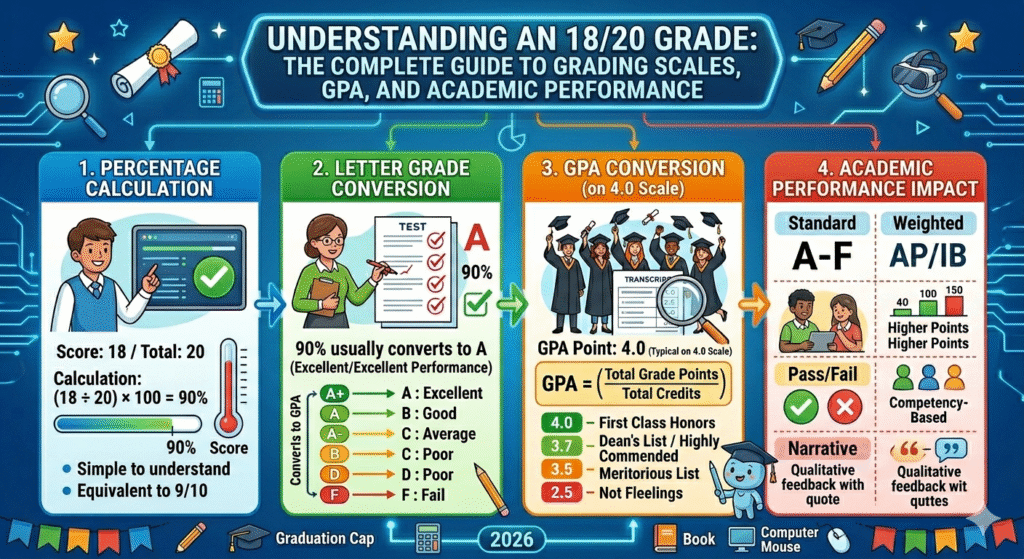
An 18/20 grade means a student earned 18 points out of a possible 20. Converting this to a percentage is straightforward:
Formula: (Points Earned ÷ Total Points) × 100
(18 ÷ 20) × 100 = 90%
A 90% is a strong academic result by virtually any standard. In the United States, it falls squarely in the A range. In France and Belgium — countries that commonly use a 20-point scale — an 18/20 is considered near-exceptional, since those systems are notoriously difficult to ace.
If you want to go deeper on how to calculate grade percentage, the math applies across all scoring systems.
What Are Grading Scales and Why Do Schools Use Them?
A grading scale is a standardized system that translates raw scores or performance levels into a meaningful, communicable result — a percentage, a letter, a number, or a descriptor like “Proficient.” Schools, colleges, and universities use grading scales for several important reasons:
- Consistency: Every student’s work is measured against the same benchmark, making comparisons fair.
- Communication: A letter grade or percentage communicates academic standing quickly to students, parents, admissions officers, and employers.
- Motivation: Defined thresholds give students clear targets to aim for.
- Accountability: Grading systems create a record of academic achievement that institutions can rely on for decisions about promotion, graduation, and eligibility.
Different institutions — and different countries — use different scales. This is why knowing how to convert between them matters enormously, especially for students who transfer schools, apply abroad, or compare their performance internationally.
The Six Major Grading Scales Explained
1. Percentage Grading Scale
The percentage scale is the most universally understood system. Every score is expressed as a value from 0% to 100%. Here’s how 18/20 and other common fractions map to percentages:
| Score | Percentage |
| 20/20 | 100% |
| 19/20 | 95% |
| 18/20 | 90% |
| 17/20 | 85% |
| 16/20 | 80% |
| 15/20 | 75% |
| 14/20 | 70% |
| 13/20 | 65% |
Curious about other specific fractions? See what grade is 15/20 or explore what grade is 9/11 on a test for more examples.
2. Letter Grading Scale
The letter grade system is the dominant standard in the United States and Canada. It groups percentage ranges into letter categories, each carrying an intuitive meaning.
| Percentage Range | Letter Grade | Interpretation |
| 93–100% | A | Excellent |
| 90–92% | A– | Excellent |
| 87–89% | B+ | Above Average |
| 83–86% | B | Good |
| 80–82% | B– | Good |
| 77–79% | C+ | Average |
| 73–76% | C | Average |
| 70–72% | C– | Below Average |
| 67–69% | D+ | Poor |
| 60–66% | D | Barely Passing |
| Below 60% | F | Failing |
At 90%, 18/20 earns an A– or A in most US institutions, depending on the school’s exact cutoffs. Some schools set the A threshold at 90%, while others begin at 93%.
Wondering about boundary cases? Check out is 89.5 an A or B — the answer might surprise you.
For clarity on related grades, see what grade is 70, what grade is 75, and what grade is 80.
3. GPA Grading Scale
GPA — Grade Point Average — is the most widely used measure of cumulative academic performance in the United States. Most institutions use a 4.0 scale, where each letter grade corresponds to a point value.
| Letter Grade | Percentage | GPA Points |
| A+ | 97–100% | 4.0 |
| A | 93–96% | 4.0 |
| A– | 90–92% | 3.7 |
| B+ | 87–89% | 3.3 |
| B | 83–86% | 3.0 |
| B– | 80–82% | 2.7 |
| C+ | 77–79% | 2.3 |
| C | 73–76% | 2.0 |
| C– | 70–72% | 1.7 |
| D | 60–69% | 1.0 |
| F | Below 60% | 0.0 |
Since 18/20 = 90%, it converts to an A– (3.7 GPA points) under the standard scale. Across multiple courses, this is an outstanding contribution to your cumulative GPA.
For more detail on GPA questions, see is 70 a 3.0 GPA, is a 3.5 GPA good for college, or is a 4.0 GPA straight A’s. You can also learn more about how to calculate a GPA from letter grades.
4. Weighted GPA vs. Unweighted GPA
This distinction matters a great deal for students in honors, AP, or IB courses.
Unweighted GPA treats all classes equally. An A in AP Calculus and an A in standard English both earn 4.0 points. The maximum is 4.0.
Weighted GPA rewards students who take more challenging courses. An A in an AP class might earn 5.0 points instead of 4.0. The maximum is typically 5.0.
| Course Type | Unweighted A | Weighted A |
| Standard | 4.0 | 4.0 |
| Honors | 4.0 | 4.5 |
| AP / IB | 4.0 | 5.0 |
So if you scored 18/20 on an AP exam — yielding a 90% — your weighted contribution could be a 4.7 or 5.0 depending on the scale your school uses. Learn more about how to calculate GPA with weighted courses and what is a 5.0 GPA in the USA.
Curious how AP tests specifically work? Read about how AP tests are graded.
5. Standards-Based Grading
Standards-based grading (SBG) shifts focus from accumulating points to demonstrating mastery of specific learning targets. Instead of a percentage or letter grade, students receive scores like:
| Score | Meaning |
| 4 | Exceeds Standard |
| 3 | Meets Standard |
| 2 | Approaching Standard |
| 1 | Does Not Yet Meet Standard |
A score of 18/20 would typically reflect a “4” or “Exceeds Standard” in this system — the student has gone beyond basic requirements and shown deep understanding.
SBG is common in K–8 education and is gaining ground at the high school level as schools seek more nuanced feedback than a single letter or percentage.
6. Pass/Fail Grading
Some courses, especially electives, research credits, or introductory college courses, use a simple Pass/Fail system. The threshold varies:
- Most institutions set the passing mark at 60% or 70%
- Some graduate programs require 80% to pass
At 90%, an 18/20 easily satisfies a Pass/Fail requirement in virtually every academic setting. If you’re unsure about borderline grades, review is a 60 an F or D and is 70 a C or D.
International Grading Systems: How Does 18/20 Compare Worldwide?
Grading is not universal. A score of 18/20 means very different things in different countries.
| Country | Scale | Equivalent to 90% | Notes |
| United States | A–F (4.0 GPA) | A / A– | Top academic tier |
| France / Belgium | 0–20 | 18/20 | Near-exceptional; 16+ is already very rare |
| Germany | 1–6 (1 = best) | 1 or 2 | Excellent to Good |
| United Kingdom | Percentage / Degree Class | First Class (70%+) | 90% is far above First threshold |
| India | Percentage | Distinction (75%+) | 90% earns Distinction in most universities |
| Canada | Letter / Percentage | A | Similar to the US system |
| Australia | HD / D / C / P / F | High Distinction (85%+) | 90% is a High Distinction |
| Japan | S / A / B / C / F | S (90%+) | Highest honor grade |
This context is important. French students who score 18/20 are performing at an elite level within a system where even strong students rarely exceed 16/20. Meanwhile, a 90% in a US high school class is solid but more commonly achieved.
How Grading Scales Affect GPA and Academic Performance
Every grade you earn has downstream effects on your GPA — and your GPA affects scholarship eligibility, college admissions, graduate school applications, and sometimes even employment. Here’s how it works in practice.
Your GPA is a weighted average of your grade points across all courses. If a single test is worth 30% of your final grade and you score 18/20 (90%), that test contributes 0.30 × 90 = 27 percentage points toward your final course grade. A strong 18/20 on a high-stakes exam can lift your entire semester result.
To understand exactly how much a single test moves the needle, read how much is a test grade worth and what is the weight of a test grade.
Wondering if a single lower grade could hurt you? See will one C hurt my GPA and can I raise my GPA quickly for realistic answers.
Common Grading Conversion Methods
Method 1: Direct Percentage Conversion
Divide points earned by total points, then multiply by 100.
Example: 18 ÷ 20 × 100 = 90%
Method 2: Percentage to Letter Grade
Look up 90% in your school’s grading scale. Most schools: A– or A.
Method 3: Percentage to GPA Points
Use the standard 4.0 table above. 90% → A– → 3.7 GPA points.
Method 4: Weighted Average
If you have multiple assessments with different weights:
(Quiz × 0.20) + (Midterm × 0.30) + (Final × 0.50) = Final Grade
For a detailed walkthrough, see how to calculate weighted average grades and how to calculate grades in class.
Method 5: Grade Curving
Some teachers adjust scores upward when a class average falls below expectations. If a teacher adds 5 points to every score and you started at 18/20, you’d hit the maximum. Learn how how to curve test grades works in practice.
How to Calculate Your Grade Step by Step
Calculating a Single Test Grade
- Note the raw score and total points (e.g., 18 out of 20).
- Divide: 18 ÷ 20 = 0.90
- Multiply by 100: 0.90 × 100 = 90%
- Match to your school’s letter/GPA scale.
For broader course-level calculations, use the grade after a test calculator.
Calculating a Course or Semester Grade
- List each component (homework, quizzes, exams) and its weight.
- Multiply each grade by its weight.
- Add all weighted values together.
Example:
- Homework (20%): 85% → 0.20 × 85 = 17
- Midterm (30%): 88% → 0.30 × 88 = 26.4
- Final (50%): 90% → 0.50 × 90 = 45
- Total: 17 + 26.4 + 45 = 88.4% → B+
More detail: how to calculate semester grade and how to calculate final grades.
Calculating Your GPA
- Assign GPA points to each letter grade.
- Multiply GPA points by course credit hours.
- Divide total quality points by total credit hours.
Example:
- Biology (3 credits, A–): 3 × 3.7 = 11.1
- Math (4 credits, B+): 4 × 3.3 = 13.2
- English (3 credits, A): 3 × 4.0 = 12.0
- Total quality points: 36.3 ÷ 10 credits = 3.63 GPA
See how to calculate grade average and how to calculate final grade for more.
What Grade Do You Need to Maintain Your Average?
If you know your current grade and want to find out what you must score on an upcoming final, use the what grade do I need calculator.
How to Grade Assignments Accurately
Teachers and instructors can also benefit from understanding grading scales when designing rubrics and scoring assessments. Consistency in how assignments are graded directly affects students’ understanding of their performance. For a structured guide, see how to grade assignments.
Common Mistakes Students Make When Interpreting Grades
1. Confusing the system being used
A 15/20 in a French grading context is actually a good score (75%), but in a US percentage context, 75% is a C. Always know which scale applies. Check out is 78 a C for a concrete example of how grading thresholds affect interpretation.
2. Ignoring course weight
A 90% in a 1-credit elective contributes far less to your GPA than a 90% in a 4-credit core class. Always factor in credit hours. How do I calculate total grade explains this clearly.
3. Mixing up weighted and unweighted GPA
When comparing GPAs — for college applications or scholarships — make sure you’re comparing the same type. A 3.9 weighted GPA is not equivalent to a 3.9 unweighted GPA.
4. Not accounting for rounding rules
Some schools round 89.5% up to 90% (an A–); others don’t. This boundary can change your GPA points. See is 89.5 an A or B.
5. Assuming pass/fail doesn’t affect GPA
At some schools, a failing grade in a pass/fail course still harms your GPA. Know your institution’s specific policy.
6. Underestimating the value of consistent B+ performance
Students often chase A grades at the expense of balance. A consistent 88–90% across all courses is often more sustainable — and cumulatively stronger — than spiking on some tests and crashing on others. See is C better than C+ grade for insight on grade distinctions.
7. Not tracking how overall score is calculated
Many students don’t know how their overall course grade is assembled until it’s too late to recover. Always ask at the start of a course how grades are weighted. How do I calculate my overall score is a useful reference.
Tips for Improving Your Grades
Study Smart, Not Just Hard
Spaced repetition — reviewing material at increasing intervals — is far more effective than last-minute cramming. Tools like Anki, Quizlet, and structured study schedules can dramatically improve retention.
Review Graded Work Immediately
When you get a marked paper or test back, go through every error while the material is fresh. Understanding why you lost 2 points on an 18/20 is more valuable than celebrating the 18.
Use Formative Assessments Strategically
Quizzes, practice tests, and homework aren’t just box-ticking exercises — they’re rehearsals. Students who treat low-stakes assignments seriously consistently outperform those who don’t.
Talk to Your Teacher
Most students never ask for feedback. A conversation with your teacher about where you lost marks is one of the highest-return actions you can take. It shows initiative and gives you a precise improvement roadmap.
Know Your Cutoffs Early
Know exactly what percentage you need for the grade you want. Then use the what grade do I need calculator to work backward from your goal.
Balance Difficult and Manageable Courses
If you’re stacking AP and honors classes, be realistic about your bandwidth. Two high-quality A–s often beat a mixed bag of As and Cs from an overloaded schedule.
Key Takeaways
- 18/20 = 90%, which is an A or A– under the US letter grade system and approximately 3.7 GPA points.
- In France, Belgium, and other countries using a 20-point scale, 18/20 is considered near-exceptional.
- Grading scales include percentage, letter, GPA, weighted GPA, standards-based, and pass/fail systems — and international equivalents vary widely.
- Your grade on a single test or assignment affects your semester grade proportionally to how much weight it carries.
- Understanding grading systems empowers students to set realistic goals, track progress accurately, and advocate for themselves academically.
- Common mistakes include ignoring course weight, confusing grading systems, and not tracking overall score calculations.
Frequently Asked Questions (FAQ)
What letter grade is 18 out of 20?
An 18/20 equals 90%, which translates to an A– or A depending on the school’s grading scale. Most US institutions assign an A– at 90–92% and an A at 93–100%.
Is 18/20 a good grade?
Yes, 18/20 is an excellent grade. It places a student in the top academic tier in virtually every grading system worldwide — from the US letter scale to the French 20-point system.
What GPA is 18 out of 20?
At 90%, an 18/20 corresponds to approximately 3.7 GPA points (an A–) on the standard 4.0 scale. In a weighted GPA system for AP or honors courses, it could contribute up to 4.7 or 5.0 points.
How do I convert 18/20 to a percentage?
Divide 18 by 20 and multiply by 100: (18 ÷ 20) × 100 = 90%. This formula works for any score — just replace 18 and 20 with your actual numbers.
Is 18/20 the same in all countries?
The raw fraction is the same everywhere, but its academic meaning varies. In France, 18/20 is near-exceptional. In the US, 90% is an A. In the UK, 90% is well within First Class Honours. In Australia, it qualifies as a High Distinction.
What is 18 out of 20 as a GPA in a weighted system?
If the course is an AP or honors class with a 5.0 weighted scale, a 90% (A–) might earn you 4.5 weighted GPA points depending on your institution’s policy.
How does 18/20 affect my semester grade?
It depends on the assignment’s weight. If a test is worth 40% of your course grade and you scored 90%, it contributes 36 percentage points to your final average. Learn more with the how to calculate semester grade guide.
Can I raise my GPA if my other grades are lower?
Yes, but how much depends on how many credits you’ve already completed and how much lower your other grades are. Read can I raise my GPA quickly for a realistic breakdown of what’s possible.
What is the passing grade in most US high schools?
Most US high schools require a minimum of 60–70% to pass. At 90%, 18/20 comfortably exceeds this threshold. See is a 60 an F or D for more context on minimum passing standards.
What does standards-based grading say about 18/20?
On a standards-based 1–4 scale, a 90% typically earns a 4 (Exceeds Standard), indicating the student has demonstrated mastery beyond the core expectations of the learning objective.
Conclusion
An 18/20 grade is more than just a number — it’s a meaningful signal of academic mastery, strong preparation, and the ability to perform consistently under assessment conditions. Whether you’re a student tracking progress, a parent interpreting a report card, or a teacher designing fair grading rubrics, understanding what 18/20 means across different systems gives you a clearer picture of real learning.The key is context: a 90% in a rigorous AP Physics class means something different from 90% in a standard elective, just as 18/20 in France reflects a different level of competition than the same score in the US. Use the tools, tables, and calculators on testgradescalculator.com to make sense of any score — and to build toward the grades you’re aiming for.