
A 91% typically converts to a 3.7 GPA on the standard unweighted 4.0 scale, corresponding to an A–. It’s a genuinely excellent score, sitting just two percentage points below the cutoff for a full A. Whether that 3.7 tells the whole story, though, depends heavily on one thing: whether your school uses a weighted or unweighted GPA scale — a distinction that can change the actual number significantly.
This guide breaks down exactly what a 91% means in GPA terms, how close it sits to the next tier, and how weighting changes the picture entirely.
Key Takeaways
- A 91% converts to a 3.7 GPA (A–) on the standard unweighted scale — just two points below a full A.
- On a weighted scale (Honors, AP, IB), that same 91% can convert to as much as 4.7 GPA points — actually higher than an unweighted straight-A student’s 4.0.
- In French and Belgian systems, the equivalent (~18.2/20) is labeled “Très Bien” — Very Good, bordering on Excellent.
What Is a 91 in GPA?
On the standard US grading scale, a 91% falls into the A– range (90–92%), which corresponds to 3.7 GPA points on the unweighted 0.0–4.0 scale. It’s an excellent score by nearly any measure — well above the typical class average and just barely short of the 93% threshold most schools use for a full A.
To see the exact formula behind this conversion, check how to calculate a GPA from letter grades — the same process applies whether you’re converting one grade or averaging several together.
Quick Reference: 91% in GPA at a Glance
| Metric | Value |
|---|---|
| Score | 91% |
| US Letter Grade | A– (in most US schools) |
| Standard GPA (Unweighted) | 3.7 |
| Weighted GPA (Honors) | 4.2 |
| Weighted GPA (AP/IB) | 4.7 |
| French/Belgian Equivalent | ~18.2/20 — Très Bien |
| Distance to a Full A (93%) | 2 percentage points |
The Percentage Grading Scale
The percentage grading scale converts raw scores into a value between 0% and 100%, making it easy to see exactly where 91% sits.
Standard US Percentage Ranges
| Percentage | Letter Grade | Description |
|---|---|---|
| 90–100% | A | Excellent (91% falls here) |
| 80–89% | B | Above Average |
| 70–79% | C | Average |
| 60–69% | D | Below Average |
| Below 60% | F | Failing |
Under this simplified 5-tier scale, 91% is comfortably within the A range. It’s the more detailed 13-tier scale below where the real precision — and the A–/A distinction — becomes relevant.
The Letter Grading Scale
The letter grading scale (A, B, C, D, F) is the most common system in American K–12 schools and universities, with plus and minus grades adding precision at the top of the scale too.
Standard Letter Grade Scale
| Letter Grade | Percentage Range | GPA Points | Meaning |
|---|---|---|---|
| A+ | 97–100% | 4.0 | Exceptional |
| A | 93–96% | 4.0 | Excellent |
| A– | 90–92% | 3.7 | Near Excellent (91% falls here) |
| B+ | 87–89% | 3.3 | Very Good |
| B | 83–86% | 3.0 | Good |
| B– | 80–82% | 2.7 | Mostly Good |
| C+ | 77–79% | 2.3 | Slightly Above Average |
| C | 73–76% | 2.0 | Average |
| C– | 70–72% | 1.7 | Slightly Below Average |
| D+ | 67–69% | 1.3 | Below Average |
| D | 63–66% | 1.0 | Poor |
| D– | 60–62% | 0.7 | Very Poor |
| F | Below 60% | 0.0 | Failing |
A 91% places right in the middle of the A– range — comfortably above the 90% floor and two points shy of the 93% ceiling. If you’re curious about nearby boundary cases, is 89.5 an A or B covers the score sitting just below this range, where rounding policy becomes genuinely important.
How Close Is 91% to a Full A?
This is worth understanding clearly: a 91% is neither borderline nor far from the top. It sits two whole percentage points below the 93% cutoff for a full A, and two points above the 89% ceiling of a B+. In practical terms:
- It’s not a rounding risk. Unlike a score sitting right at 89.5% or 92.9%, a 91% is safely in the middle of the A– band — there’s no realistic rounding scenario that would push it into B+ territory.
- It’s a real, achievable target away from a full A. Two percentage points is a meaningful but very attainable gap — often just one or two extra correct answers on a typical test.
- GPA-wise, the jump from A– to A doesn’t actually move the needle. Both A– (3.7) and A (4.0) are already excellent scores; the practical GPA difference (0.3 points) is smaller than almost any other adjacent-tier jump on the scale.
The GPA Grading Scale
GPA (Grade Point Average) is a numerical summary of academic performance. In the US, the standard unweighted GPA runs on a 0.0 to 4.0 scale.
How GPA Is Calculated
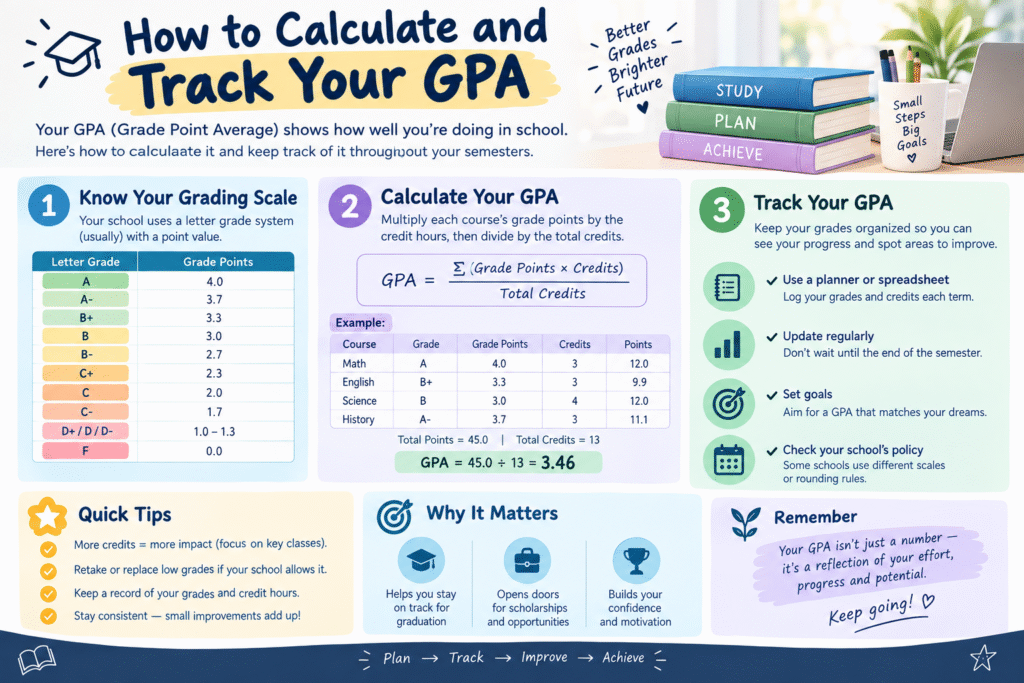
GPA is calculated by assigning grade points to each letter grade, multiplying by the number of credit hours, summing the totals, and dividing by total credit hours.
Formula: GPA = Sum of (Grade Points × Credit Hours) ÷ Total Credit Hours
Example:
- English (3 credits): A– = 3.7 → 11.1 points
- Math (4 credits): A = 4.0 → 16.0 points
- Science (3 credits): B+ = 3.3 → 9.9 points
- Total: 37.0 ÷ 10 credits = 3.70 GPA
A 91% on its own converts to 3.7 GPA points. Use a GPA calculator to see exactly how a 91% averages together with your other grades across a full course load.
Weighted GPA vs. Unweighted GPA: Why 91% Can Mean Very Different Numbers
This is the single most important distinction for understanding “91 in GPA” fully.
Unweighted GPA
On the standard unweighted scale, a 91% (A–) is always worth exactly 3.7 GPA points, regardless of how difficult the course was.
Weighted GPA
A weighted GPA adds bonus points for Honors, AP, and IB courses:
| Course Type | Grade | Unweighted GPA | Weighted GPA |
|---|---|---|---|
| Standard | A– | 3.7 | 3.7 |
| Honors | A– | 3.7 | 4.2 |
| AP/IB | A– | 3.7 | 4.7 |
Here’s the striking part: a 91% in an AP or IB course, weighted, actually produces a higher GPA value (4.7) than a perfect, unweighted 4.0 straight-A average. This is exactly why comparing GPAs across students without knowing whether they’re weighted or unweighted can be misleading — see is a 4.0 GPA straight A’s and what is a 5.0 GPA in the USA for the full picture of how these bonus-point systems work.
To fully understand how this applies to your own transcript, see how to calculate GPA with weighted courses.
International Grading Systems
Grading systems vary around the world. A 91% is viewed favorably almost everywhere, though the specific labels differ.
Grading Scale Comparison Table
| Country/System | Scale | Equivalent to 91% | Description |
|---|---|---|---|
| United States | A–F / 0–4.0 GPA | A– / 3.7 GPA | Excellent |
| France / Belgium | 0–20 | ~18.2/20 | Très Bien (Very Good, near Excellent) |
| United Kingdom | 0–100 | 70%+ = First Class | Distinction-level |
| Germany | 1–6 (1 = best) | ~1 (Sehr Gut) | Very Good |
| Canada | A–F / % | A– | Excellent |
| Australia | HD, D, C, P, F | High Distinction | Exceptional |
| India | Percentage / CGPA | Distinction | Excellent |
| China | 0–100 | 91 | Excellent |
| Japan | S, A, B, C, F | A | Excellent |
| Mexico | 0–10 | ~9.1 | Excellent |
Notice that a 91% earns top-tier labels almost universally — “Très Bien” in France, “Sehr Gut” in Germany, and High Distinction in Australia all reflect the same genuinely excellent underlying performance.
How GPA Affects Academic Performance
An A– has a strongly positive effect on a cumulative GPA, especially compared to lower grades.
The Compounding Effect of Grades
| Scenario | GPA |
|---|---|
| 4 A’s and 1 A– | 3.94 |
| 5 A– grades | 3.7 |
| 4 A’s and 1 B | 3.8 |
An A– barely dents an otherwise strong transcript — the gap between an A– (3.7) and a full A (4.0) is much smaller than the gap between an A– and any grade below a B+. If you’re focused on GPA optimization for is a 3.5 GPA good for college purposes, a 91% average is already well within — and above — that competitive range.
Common Grading Conversion Methods
Method 1: Percentage to Letter Grade
Match the percentage directly to the letter grade chart.
Example: 91% → A–
Method 2: Percentage to GPA Points
Match the percentage to the GPA scale. 91% → A– → 3.7 GPA points
Method 3: Letter Grade to GPA
Use a standard conversion table (see GPA Conversion Table below).
Method 4: Weighted GPA Calculation
Weighted average grades factor in course difficulty bonuses on top of the base percentage-to-GPA conversion.
Formula: Weighted GPA = Base GPA Value + Course-Level Bonus
GPA Conversion Table
| Letter Grade | Percentage | GPA (Unweighted) | GPA (Weighted – Honors) | GPA (Weighted – AP/IB) |
|---|---|---|---|---|
| A+ | 97–100% | 4.0 | 4.5 | 5.0 |
| A | 93–96% | 4.0 | 4.5 | 5.0 |
| A– | 90–92% | 3.7 | 4.2 | 4.7 |
| B+ | 87–89% | 3.3 | 3.8 | 4.3 |
| B | 83–86% | 3.0 | 3.5 | 4.0 |
| B– | 80–82% | 2.7 | 3.2 | 3.7 |
| C+ | 77–79% | 2.3 | 2.8 | 3.3 |
How to Calculate and Track Your GPA
Calculating Your Overall GPA
Use a GPA calculator, college GPA calculator, or cumulative GPA calculator to see exactly how a 91% factors into your overall average alongside your other grades.
Calculating a Single Course Grade
Use how to calculate final grades to see how a 91% on one assignment or test affects your overall course grade, factoring in category weights.
Knowing What’s Needed for a Full A
Use a what grade do I need calculator to see exactly what score on upcoming work would push a 91% average up to the 93% threshold for a full A.
Mistakes People Make When Interpreting a 91% in GPA
Mistake 1: Assuming 91% Always Equals 3.7 GPA
That’s true only on an unweighted scale. On a weighted scale, the same 91% in an AP or IB course can be worth as much as 4.7 GPA points — always check which scale applies before comparing GPAs.
Mistake 2: Overvaluing the Difference Between an A– and a Full A
The GPA gap between a 3.7 and a 4.0 is smaller than almost any other adjacent-tier difference on the scale. Chasing that last 2 percentage points is worthwhile, but it shouldn’t come at the cost of overall balance across other coursework.
Mistake 3: Comparing a Weighted GPA Directly to an Unweighted One
A 4.7 weighted GPA from a 91% AP grade and a 4.0 unweighted GPA from a straight-A standard course load aren’t measuring the same thing. Always confirm which scale is being used before drawing conclusions.
Mistake 4: Ignoring Course Weighting Within a Single Class
A test worth 50% of your grade matters far more than a small assignment worth 5%. Understanding how much a test grade is worth helps you see how a single 91% actually shapes your final course grade.
Mistake 5: Assuming Every School’s GPA Scale Matches Exactly
Some schools use slightly different percentage cutoffs or GPA values for A–. Always verify your specific institution’s official conversion chart rather than assuming the standard scale applies universally.
Tips for Pushing a 91% Toward a Full A
A 91% is already excellent. Here’s how to close the small remaining gap:
1. Identify the Specific Points Lost
On a strong score like this, the gap is usually a handful of small, specific errors rather than a conceptual gap. Pinpointing them is far more efficient than broad review.
2. Confirm Your School’s Exact A/A– Cutoff
Some schools set the boundary at 93%, others at 92% or 94%. Knowing the exact number tells you precisely how much room exists before the next tier.
3. Track Your Running Average
Use how to calculate final grades regularly so you always know exactly how close you are to a full A rather than estimating.
4. Know What You Need on Remaining Work
Use a what grade do I need calculator to calculate the exact score needed on upcoming assignments to move a 91% average up to 93% or higher.
5. Understand Whether Weighting Already Maximizes Your GPA
If this 91% is in an AP or IB course, it may already be contributing a 4.7 — higher than a full unweighted 4.0 — to your weighted GPA. Confirm this before assuming more effort is strictly necessary for GPA purposes specifically.
Key Takeaways
- A 91% converts to a 3.7 GPA (A–) on the standard unweighted scale — an excellent result, two points below a full A.
- On a weighted scale, the same 91% can be worth as much as 4.7 GPA points in an AP or IB course — higher than an unweighted 4.0.
- In French and Belgian systems, 91% converts to roughly 18.2/20, labeled “Très Bien.”
- The GPA gap between an A– (3.7) and a full A (4.0) is smaller than almost any other adjacent-tier gap on the scale.
- Internationally, 91% is viewed as excellent almost everywhere — Distinction, Sehr Gut, and Très Bien all describe the same underlying performance.
- Whether “91 in GPA” means 3.7 or something higher depends entirely on whether the scale is weighted — always confirm before comparing.
Frequently Asked Questions
A 91% typically converts to a 3.7 GPA, corresponding to an A– on the standard unweighted 4.0 scale.
In the United States, a 91% is typically an A–, falling in the 90–92% range on the standard 13-tier scale.
No, though they’re close. A 91% (A–) is worth 3.7 GPA points, while a 93% (A) is worth the full 4.0 — a 0.3 point difference, smaller than most other adjacent-tier gaps.
Yes, significantly. In a weighted Honors course, 91% is worth about 4.2 GPA points; in a weighted AP or IB course, it’s worth 4.7 — higher than an unweighted 4.0.
Just two percentage points, assuming a 93% cutoff (the most common threshold). It’s a real but very achievable gap, often closed with just one or two additional correct answers on a test.
Yes, very good. A 3.7 GPA is considered excellent and highly competitive for the large majority of college admissions, scholarships, and graduate programs.
Roughly equivalent to 18.2/20, which falls within “Très Bien” (Very Good, bordering Excellent) territory — a genuinely top-tier score under France’s stricter grading scale.
Yes. A 91% (A–) in an AP or IB course, weighted, converts to 4.7 GPA points — mathematically higher than a perfect, unweighted straight-A 4.0 average.
Barely. A single A– among several A’s has a very small effect — for example, four A’s and one A– still averages to a 3.94 GPA, only a fraction below perfect.
Convert each grade to its GPA value, multiply by credit hours, sum the results, and divide by total credit hours. Use a GPA calculator to run this calculation accurately with your actual courses and credits.
Conclusion
A 91% typically converts to a 3.7 GPA, corresponding to an A– on the standard unweighted scale — a genuinely excellent result sitting just two percentage points below a full A. The real complexity isn’t the base conversion, though; it’s understanding whether weighting applies. The same 91% can be worth 3.7, 4.2, or 4.7 GPA points depending entirely on course rigor, and that distinction matters enormously when comparing GPAs across students or schools.
Whether a 91% needs to become a 93% depends on your specific goals — competitively, the practical difference between an A– and a full A is small, since both sit near the very top of the scale.
Use GPA calculators to see your exact number under both weighted and unweighted scales, and focus your remaining effort on the small, specific gaps that matter most. A 91% is already an excellent foundation, and closing the final stretch to a full A is a realistic, achievable goal.