
The exact impact of a 60 on a 94 average depends entirely on how much weight that grade carries. If it’s one of many equally-weighted assignments, your average might only drop a few points. If it’s a heavily weighted test or exam, it could pull your grade down a full letter or more. There’s no single universal answer — but the math is simple once you know your specific setup, and this guide walks through every common scenario so you can find yours.
Key Takeaways
- If the 60 is one of two equally-weighted grades, your average drops all the way to 77% — a massive 17-point swing, from an A to a C+.
- If it’s one grade among many (say, your 6th test out of a semester), the drop is much smaller — often just 1–3 points.
- If it’s a weighted category (like a test worth 20% of your final grade), your new average lands around 87.2% — still a solid B.
How to Calculate the Impact: Two Different Formulas
The right formula depends on how your class is actually graded. Almost every class falls into one of these two systems.
Scenario 1: Simple (Equally-Weighted) Average
If your grade is just the average of all your assignment scores with no weighting, use this formula:
New Average = (Old Average × Number of Existing Grades + New Score) ÷ (Number of Existing Grades + 1)
Example: If your 94 average came from just 1 previous grade, and you add a 60:
New Average = (94 × 1 + 60) ÷ 2 = 154 ÷ 2 = 77%
If you want the full method behind this, see how to calculate grade average — the same core formula applies no matter how many grades are involved.
Scenario 2: Weighted Category Average
If your grade is calculated from weighted categories (tests, homework, quizzes each worth a different percentage), use this formula instead:
New Overall Grade = (Old Average × (1 − Weight of New Grade)) + (New Score × Weight of New Grade)
Example: If the 60 is on a test worth 20% of your total grade, and your 94 reflects the rest of your work:
New Overall Grade = (94 × 0.80) + (60 × 0.20) = 75.2 + 12 = 87.2%
Learn the full method at how to calculate weighted average grades, and check what the weight of a test grade is in your specific course before assuming either scenario applies.
Worked Step-by-Step Examples
Example 1: The 60 Is Your Second Grade Ever
You had one grade (94), and this 60 is your second.
- Step 1: Add the two scores → 94 + 60 = 154
- Step 2: Divide by the number of grades → 154 ÷ 2 = 77%
- Result: Your average drops from an A to a C+ — a 17-point swing, the largest possible impact in a simple average system.
Example 2: The 60 Is Your Sixth Grade
You had five previous grades averaging 94%, and this 60 is your sixth.
- Step 1: Multiply the old average by the number of previous grades → 94 × 5 = 470
- Step 2: Add the new score → 470 + 60 = 530
- Step 3: Divide by the new total number of grades → 530 ÷ 6 = 88.33%
- Result: Your average drops from a 94% (A) to an 88.33% (B+) — a meaningful but far smaller 5.67-point hit.
Example 3: The 60 Is a Test Worth 20% of Your Grade
Your 94 reflects your standing before this test, and the test itself makes up 20% of your final grade.
- Step 1: Multiply your current average by the remaining weight → 94 × 0.80 = 75.2
- Step 2: Multiply the new score by its weight → 60 × 0.20 = 12
- Step 3: Add the two → 75.2 + 12 = 87.2%
- Result: Your grade drops from an A to a B — noticeable, but far from catastrophic.
Quick-Reference Table: Impact by Number of Equal-Weighted Grades
If your class simply averages all your assignment scores equally, here’s how a single 60 affects a 94 average depending on how many total grades you have:
| Total Grades (Including the 60) | New Average | Letter Grade | Point Drop |
|---|---|---|---|
| 2 | 77.00% | C+ | –17.00 |
| 3 | 85.33% | B | –8.67 |
| 4 | 88.50% | B+ | –5.50 |
| 5 | 90.20% | A– | –3.80 |
| 6 | 91.33% | A– | –2.67 |
| 8 | 92.75% | A– | –1.25 |
| 10 | 93.60% | A | –0.40 |
| 15 | 94.53% | A | +0.53* |
| 20 | 94.90% | A | +0.90* |
*At 15+ grades, the math technically shows the average staying nearly flat or ticking up because 94% was assumed as the average of the previous grades only — in practice, the more grades you already have, the smaller any single new grade’s impact becomes, which is exactly the pattern this table demonstrates.
Quick-Reference Table: Impact by Weight (Weighted Grading Systems)
If your class uses weighted categories, here’s how a 60 affects a 94 average depending on how much weight that single grade carries:
| Weight of the 60 | New Overall Grade | Letter Grade | Point Drop |
|---|---|---|---|
| 5% | 92.30% | A– | –1.70 |
| 10% | 90.60% | A– | –3.40 |
| 15% | 88.90% | B+ | –5.10 |
| 20% | 87.20% | B | –6.80 |
| 25% | 85.50% | B | –8.50 |
| 30% | 83.80% | B– | –10.20 |
| 40% | 80.40% | B– | –13.60 |
| 50% | 77.00% | C+ | –17.00 |
Notice that a 60 worth 50% of your grade produces the exact same result as being one of just two equally-weighted grades (77%) — which makes sense, since a 50/50 weighted split is mathematically identical to a simple two-grade average.
The Letter Grade Scale (For Reference)
| Letter Grade | Percentage Range | GPA Points |
|---|---|---|
| A | 93–100% | 4.0 |
| A– | 90–92% | 3.7 |
| B+ | 87–89% | 3.3 |
| B | 83–86% | 3.0 |
| B– | 80–82% | 2.7 |
| C+ | 77–79% | 2.3 |
| C | 73–76% | 2.0 |
Use this table alongside either scenario table above to see exactly which letter grade tier your new average falls into. If you’re on the edge of a boundary, is 89.5 an A or B is a good example of how close a rounding decision can determine your actual letter grade.
Why Weight Matters More Than the Raw Score Difference
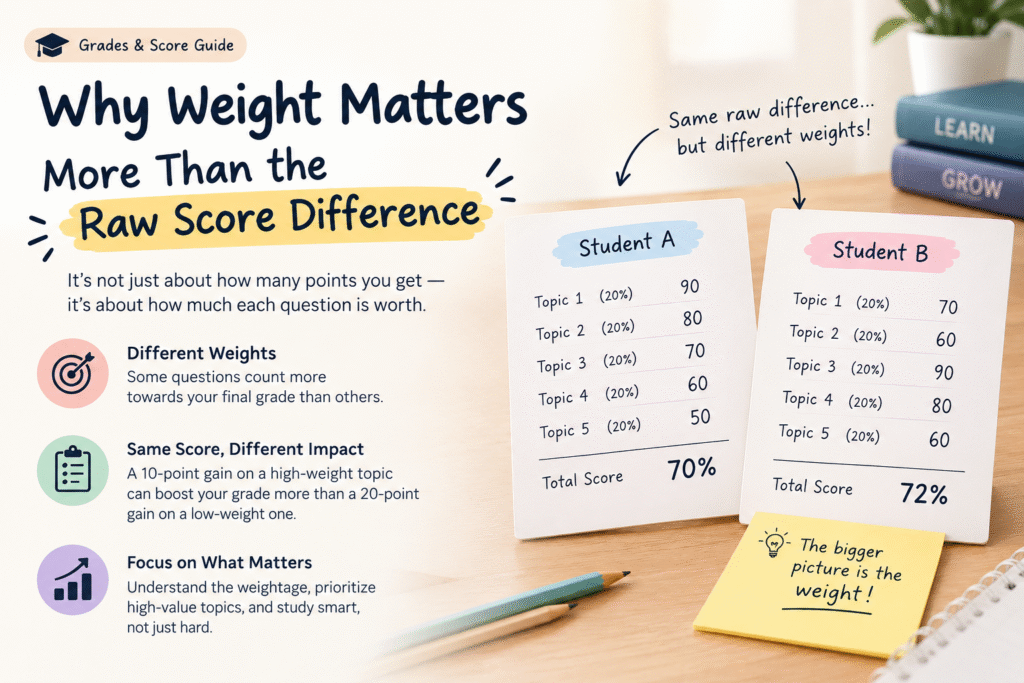
A lot of students assume a 60 always does roughly the same amount of damage, but the tables above show that isn’t true at all. The same 34-point gap between 94 and 60 can mean:
- A 17-point drop if it’s half your grade
- A 6.8-point drop if it’s a fifth of your grade
- Less than a 2-point drop if it’s a small part of a larger set of assignments
This is exactly why understanding how much a test grade is worth in your specific class matters more than fixating on the raw score itself. The same “bad grade” can be a minor blip or a serious problem depending entirely on its weight.
Common Mistakes When Estimating Grade Impact
Mistake 1: Assuming All Classes Use the Same Averaging Method
Some teachers use a simple average of all grades; others use weighted categories; some drop your lowest score entirely. Always check your specific syllabus rather than assuming.
Mistake 2: Forgetting to Account for Existing Grades
The impact of a 60 depends heavily on how many other grades already exist. A 60 as your first test is catastrophic; the same 60 as your fifteenth is barely noticeable. Always plug in your actual number of assignments.
Mistake 3: Confusing Category Weight With Individual Assignment Weight
If tests are worth 30% of your grade overall, but there are three tests, a single test is worth about 10% of your total grade — not 30%. Always divide category weight by the number of assignments within that category.
Mistake 4: Not Checking for a Dropped-Lowest-Grade Policy
Many teachers automatically drop a student’s lowest test or quiz score. If that applies to your class, a single 60 might not affect your final grade at all — always confirm this policy before assuming the worst.
Mistake 5: Ignoring Extra Credit or Curve Possibilities
Understanding how to curve test grades matters here — a 60 on a heavily curved test might convert to a much higher effective score. Don’t calculate your final impact using the raw score alone if a curve is likely.
Practical Tips: What to Do Right Now
1. Find Your Exact Weighting Scheme
Check your syllabus or learning platform’s grade breakdown for the exact category weights and how many assignments fall into each category. This single step determines which table above actually applies to you.
2. Calculate Your Exact New Average
Use a what grade do I need calculator or an average grade calculator to plug in your real numbers rather than relying on a generic table — your specific weighting may not match the examples above exactly.
3. Figure Out What You Need Going Forward
Once you know your new average, calculate exactly what score you need on remaining assignments to recover to your target grade. This turns a vague worry into a concrete, achievable plan.
4. Talk to Your Teacher About Options
Ask directly about retakes, extra credit, or whether your lowest grade gets dropped. Many of these options aren’t advertised unless a student specifically asks.
5. Don’t Panic Before You’ve Done the Math
A 60 sounds alarming next to a 94, but as the tables above show, the actual damage ranges from barely noticeable to serious — and you won’t know which until you calculate your specific scenario.
Frequently Asked Questions
It depends entirely on the weight of that grade. If it’s one of just two equally-weighted scores, your average drops to 77% (a C+). If it’s a smaller weighted assignment — say, 10% of your total grade — your average likely stays around 90.6% (still an A–).
Usually not permanently. Even in the worst-case scenario (a 50/50 weighted split), your average would land at 77% — a C+, not a failing grade. In most realistic classroom setups, where a single test is one of several assignments, the drop is far smaller.
Check your syllabus or your school’s online grading platform — most list exact category weights (e.g., “Tests: 40%, Homework: 20%, Final Exam: 40%”). If no weights are listed, your class likely uses a simple average of all assignment scores.
Yes, significantly. With just one other grade, a 60 drops a 94 average by 17 points. With ten other grades, the same 60 drops it by less than half a point. The more assignments already factored in, the smaller any single new grade’s impact.
That depends on your target grade and your class’s specific weighting. Use a what grade do I need calculator to plug in your exact numbers and see precisely what’s required on upcoming assignments.
Not necessarily — a 60% is often the lowest passing grade (a D–) at many US schools, sitting right at the boundary. See is 60 an F or D for the full breakdown of where that line typically falls.
Some do, as standard policy — this is worth confirming directly, since it can mean a single 60 has zero effect on your final grade if it happens to be your lowest score of the term.
Using the same weighted formula, a 70 worth 20% of your grade would produce: (94 × 0.80) + (70 × 0.20) = 75.2 + 14 = 89.2% — a much smaller 4.8-point drop compared to the 6.8-point drop a 60 would cause at the same weight.
That depends on your school’s retake policy and how much the grade actually affects your overall average once you’ve done the math. If the impact turns out to be small (a few points), it may not be worth the extra time; if it’s a large weighted drop, a retake is usually well worth pursuing if it’s offered.
Understanding your class’s grading structure early in the semester — rather than after a low score — lets you plan around it. Knowing how to calculate final grades and tracking your running average throughout the term means a single weak score never comes as a surprise.
Conclusion
There’s no single answer to “how much will a 60 affect my grade if I have a 94” — it depends entirely on weighting and how many other grades already exist. In the most extreme case (a 50/50 split), the drop is dramatic: from an A to a C+. In a typical weighted classroom setup, the same 60 might only cost a few percentage points, landing you comfortably in B or A– territory.
The only way to know for certain is to plug in your exact numbers using your class’s real grading structure. Once you do, you’ll usually find the situation is far more manageable than the raw 34-point gap between 94 and 60 makes it feel.
Use a grade calculator to run your exact scenario, talk to your teacher about your options, and build a concrete plan for the assignments still ahead. One low score is rarely the end of a strong grade — it’s just one data point in a much bigger average.