Thinking about grad school? You’re in good company. About 19.4 million students were enrolled in U.S. colleges in Fall 2025, and roughly one in six of them (16.3%) were working toward a graduate degree. Healthcare is the biggest draw, with nearly 24% of grad students pursuing advanced degrees in that field, followed by business and education.
But before you apply, one number tends to cause the most stress: your GPA. What’s the minimum you need? Does your overall GPA matter, or just your major? And if you’re a little short, are you out of luck?
The good news is that GPA requirements aren’t a mystery. With a few simple calculations, you can work out where you stand, what each program expects, and how much room you have to improve.
This guide walks you through it step by step, so you can plan your next move with confidence instead of guesswork.
Understand the GPA Requirements for Graduate School
Before calculating your target GPA, check what your chosen graduate program expects from applicants. Most US graduate programs use a 4.0 GPA scale, with 3.0 being a common minimum requirement. According to Research.com, competitive students often have GPAs between 3.3 and 3.7, depending on the field, degree level, and program selectivity.
Requirements can vary widely. Some schools consider your overall undergraduate GPA, while others focus more on grades in your major or your performance during the final years of college. Certain programs may also require prerequisite courses, relevant experience, or additional qualifications.
Start by reviewing the program’s official admissions page to understand its academic requirements. Remember, meeting the minimum GPA does not guarantee admission. If your GPA is below 3.0, strong recent coursework, relevant work experience, accepted test scores, and persuasive recommendations may still strengthen your application.
Calculate Your Current Cumulative GPA
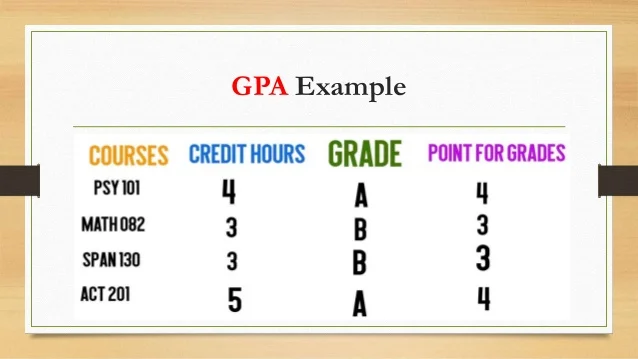
Your cumulative GPA represents your academic performance across the courses included in the calculation. On a typical 4.0 scale, letter grades correspond to numerical grade points. For example, an A might equal 4.0, a B might equal 3.0, and a C might equal 2.0. Exact conversions depend on your institution’s grading policy.
When courses carry different credit hours, you generally need a weighted calculation.
The formula is:
Cumulative GPA = Total quality points ÷ Total GPA credit hours
Quality points are calculated by multiplying the grade points earned in a course by its credit hours.
For example, suppose you completed three courses:
| Course | Credit hours | Grade points | Quality points |
| Course A | 3 | 4.0 | 12.0 |
| Course B | 3 | 3.0 | 9.0 |
| Course C | 2 | 3.5 | 7.0 |
| Total | 8 | 28.0 |
Your GPA would be 28 divided by 8, giving you a cumulative GPA of 3.50.
This calculation assumes the institution uses the stated grade-point values and includes all three courses in its GPA calculation. If you have transfer credits, repeated courses, or pass/fail grades, check your school’s rules before calculating your official GPA.
Work Out the GPA You Need to Reach Your Goal
Once you know your current GPA, compare it with your target. If your preferred program requires a 3.5 GPA and your current GPA is 3.2, you can calculate whether improving your grades in future courses could bring you closer to that goal.
For a simplified example, suppose you have completed 60 GPA credit hours with a GPA of 3.2. You plan to complete another 15 credit hours and want to reach a cumulative GPA of 3.3.
Your current quality points are:
60 × 3.2 = 192
To finish with a 3.3 GPA across 75 credit hours, you would need:
75 × 3.3 = 247.5 quality points
You would therefore need 55.5 quality points across the next 15 credit hours, equivalent to a GPA of 3.7 over those courses.
This example shows how to turn an academic goal into a measurable plan. The more credits you have already completed, the harder it can be to make large changes to your cumulative GPA.
You can use a GPA calculator to test different grade scenarios before the semester begins. Just remember that the result is an estimate unless the calculator follows your institution’s exact grading and credit policies.
Check the Academic Requirements for Your Intended Program
Your target GPA should match the program you actually want to enter, because graduate and professional qualifications judge academic performance differently. A master’s program may set an undergraduate GPA threshold, while a professional program may also ask for prerequisite courses or earlier qualifications.
Take the example of the FNP post-master’s certificate, designed for nurses who already hold a graduate nursing degree.
Wilkes University notes that this program may require an MSN or DNP degree with a 3.0 GPA, plus an unencumbered RN license. Other schools may add prerequisite coursework, so review each program’s criteria carefully and spot any gaps before you apply. Also keep admission requirements separate from certification or licensure requirements, which separate organizations may govern.
If published requirements are unclear, contact the admissions office. Ask whether the school looks at cumulative GPA, prerequisite GPA, or recent coursework separately. That tells you your real target, not a general benchmark.
Create an Academic Plan if Your GPA Is Below the Requirement
If your GPA falls below your target, focus on practical steps to improve your academic record. Start by reviewing upcoming courses, credit hours, and previous grades to identify where you need the most support. Regular revision, practice tests, and early feedback from instructors can help you address weak areas.
Adam Nguyen, founder and CEO of Ivy Link, a higher education and career advisory firm, explains that undergraduate GPA “is best thought of as a signal of academic readiness, and in some cases, a predictor of future performance. Its weight varies by program.”
If your GPA remains low, consider addressing it directly in your personal statement. Acknowledge past academic struggles, explain what changed, and highlight how you have grown since then. You can also ask an academic adviser about retaking courses or completing additional coursework.
These steps may strengthen your application, although they cannot guarantee admission or override a program’s minimum GPA requirement.
Consider Other Parts of Your Graduate School Application
GPA is important, but it may not be the only factor in an admissions decision. Depending on the program, schools may consider recommendation letters, personal statements, work experience, interviews, research experience, or entrance examination scores.
Meeting the minimum GPA can make you eligible to apply, but a strong application should also demonstrate why you are prepared for the program and how it supports your long-term goals.
Prepare your application well before the deadline. Gather transcripts, confirm prerequisite requirements, request recommendations early, and allow time to write a thoughtful personal statement.
Most importantly, use the admissions criteria published by your intended institution. A general GPA calculator can help with planning, but the program’s official rules determine how your academic record will be evaluated.
Frequently Asked Questions
What GPA do you need to get into graduate school?
There is no single GPA requirement for all graduate schools. Requirements vary by institution, program, and field. Check the official admissions criteria for each program you are considering, and remember that meeting the minimum does not guarantee acceptance.
Can you raise your cumulative GPA during your final semester?
Yes, provided you have remaining GPA-bearing credits. However, the amount your cumulative GPA can increase depends on your current GPA, the number of credits already completed, and the grades you earn in your remaining courses. Calculate a few scenarios to set a realistic target.
Do graduate programs consider cumulative GPA or grades in specific courses?
Some programs primarily evaluate cumulative GPA, while others also consider prerequisite grades, grades in major-related courses, or recent academic performance. The approach varies by institution, so review the admissions requirements or contact the program directly to confirm how your academic record will be assessed.
Statistics at a Glance
| U.S. college enrollment in Fall 2025 | About 19.4 million students |
| Students pursuing graduate degrees | 16.3% |
| Graduate students studying healthcare | Nearly 24% |
| Common minimum graduate school GPA | 3.0 on a 4.0 scale |
| GPA range often seen among competitive admitted students | 3.3–3.7 |
| GPA requirement for the cited FNP post-master’s certificate | 3.0 |
Calculating the GPA you need for graduate school helps turn a broad academic goal into a practical plan. Start by confirming the requirements of your preferred program, calculating your current cumulative GPA, and determining what grades you would need to reach your target.
If your GPA is below the requirement, explore realistic ways to improve it and seek guidance from academic advisers or admissions offices. By combining accurate calculations with early planning, you can make better-informed decisions about your education and prepare a stronger application.