A 1.7 GPA corresponds exactly to a C– average, roughly 70–72% on the standard percentage scale. Unlike GPAs that fall between two letter grade values, a 1.7 lines up precisely with C– — no rounding or approximation needed. What matters most about this specific number, though, isn’t just the letter grade: a 1.7 sits below the 2.0 threshold most schools use for “good academic standing,” which can carry real, practical consequences worth understanding clearly.
This guide explains exactly what a 1.7 GPA means, what it looks like in real courses, and — because this GPA sits in a genuinely consequential range — what steps actually work to move it back above that critical 2.0 line.
Key Takeaways
- A 1.7 GPA corresponds exactly to a C– average, roughly 70–72% on the percentage scale.
- A 1.7 falls below the 2.0 GPA threshold that most schools require for good academic standing, which can trigger academic probation or affect financial aid eligibility.
- A 1.7 GPA is a real signal worth acting on, but it’s genuinely recoverable with a clear, structured plan.
What Is a 1.7 GPA?
GPA (Grade Point Average) is calculated by converting each letter grade to a numeric value, multiplying by credit hours, summing the results, and dividing by total credit hours. A 1.7 GPA means that, averaged across all classes, a student’s grades work out to exactly 1.7 on the standard 0.0–4.0 scale — which happens to match the C– grade value precisely.
Quick Reference: 1.7 GPA at a Glance
| Metric | Value |
|---|---|
| GPA | 1.7 |
| Exact Letter Grade Match | C– |
| Approximate Percentage | ~70–72% |
| Above 2.0 “Good Standing” Threshold? | No — below it |
| Academic Probation Risk | Likely at many schools |
| Financial Aid (SAP) Risk | Likely at risk |
| Typical Scholarship Minimum (3.0)? | Well below |
The GPA Grading Scale
Here’s exactly where a 1.7 sits relative to the full standard scale:
Standard 4.0 GPA Scale
| Letter Grade | Percentage Range | GPA Points |
|---|---|---|
| A+ | 97–100% | 4.0 |
| A | 93–96% | 4.0 |
| A– | 90–92% | 3.7 |
| B+ | 87–89% | 3.3 |
| B | 83–86% | 3.0 |
| B– | 80–82% | 2.7 |
| C+ | 77–79% | 2.3 |
| C | 73–76% | 2.0 |
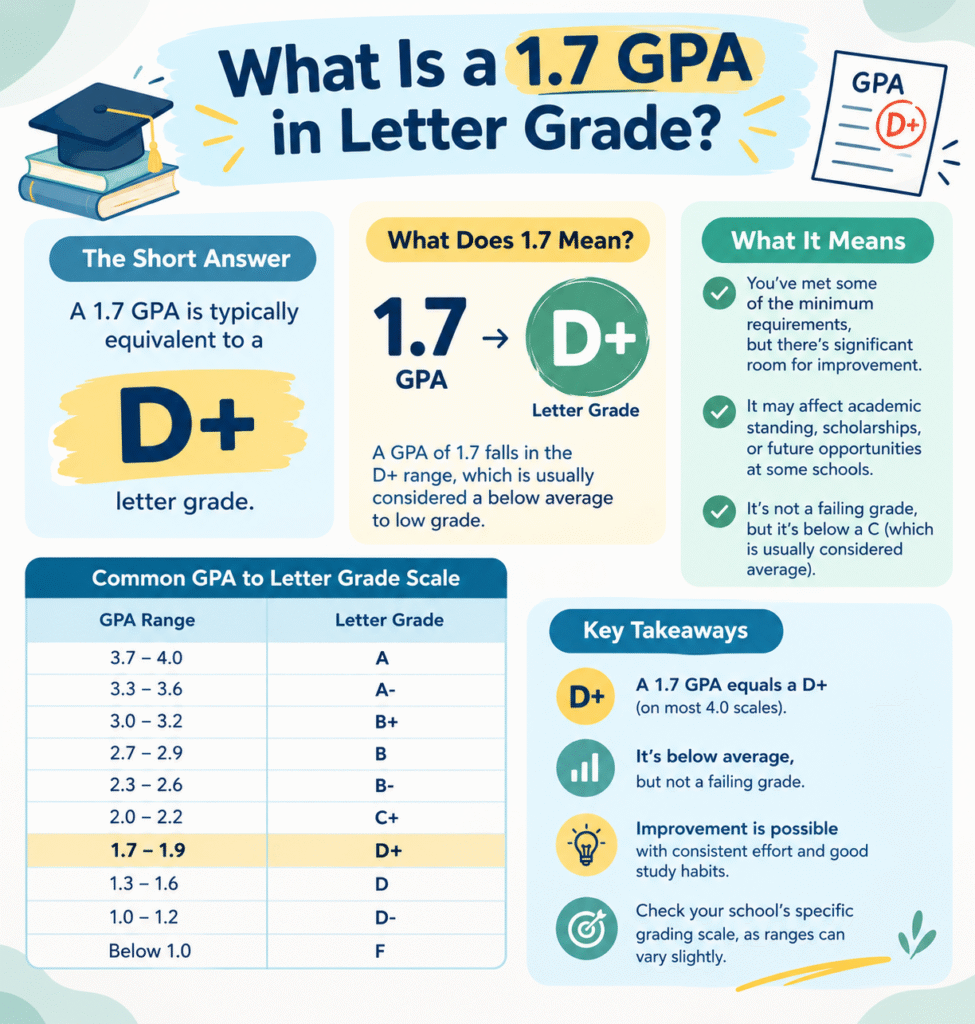
| C– | 70–72% | 1.7 (exact match) |
| D+ | 67–69% | 1.3 |
| D | 63–66% | 1.0 |
| D– | 60–62% | 0.7 |
| F | Below 60% | 0.0 |
Unlike a GPA that lands between two grade values, a 1.7 maps directly onto C– with no ambiguity. If you want the exact formula behind this, see how to calculate a GPA from letter grades — the same weighted-average process applies whether you’re checking one grade or several.
How a 1.7 GPA Actually Gets Calculated
Because GPA is an average, a 1.7 can result from many different combinations of grades — not necessarily a straight run of C–’s.
Example 1: Two Classes
- Class 1: D– = 0.7
- Class 2: B– = 2.7
- Average: (0.7 + 2.7) ÷ 2 = 1.7 GPA exactly
Example 2: Three Classes With Different Credit Hours
- English (3 credits): C– = 1.7 → 5.1 points
- Math (4 credits): D+ = 1.3 → 5.2 points
- Science (3 credits): C = 2.0 → 6.0 points
- Total: 16.3 ÷ 10 credits = 1.63 GPA (close to 1.7, illustrating how credit-weighted averages shift the result)
To calculate your own exact GPA, use a GPA calculator or cumulative GPA calculator rather than estimating — the specific mix of grades behind a 1.7 matters for figuring out the fastest path to raise it.
Why a 1.7 GPA Matters More Than It Might Seem
A 1.7 GPA is meaningfully different from GPAs above 2.0, for one specific reason: 2.0 is the most common threshold schools use to define “good academic standing.” Falling below it isn’t just a below-average grade pattern — it can trigger real institutional consequences.
What a Sub-2.0 GPA Can Affect
- Academic probation: Many schools automatically place students with a GPA below 2.0 on academic probation, which often comes with mandatory advising, reduced course loads, or other conditions.
- Financial aid eligibility: Federal Satisfactory Academic Progress (SAP) requirements typically require a minimum 2.0 cumulative GPA — a 1.7 puts financial aid genuinely at risk.
- Scholarship eligibility: Most merit-based scholarships require at least a 3.0, and many need-based aid packages also carry minimum GPA requirements around 2.0.
- Major or program eligibility: Some majors require students to maintain a minimum GPA (often 2.0 or higher) to remain declared in that program.
- Graduation requirements: Most degree programs require a cumulative GPA of at least 2.0 to graduate, regardless of individual course completion.
If you’re wondering whether one C will hurt your GPA enough to explain a 1.7, the honest answer is that it typically takes more than one class — a 1.7 usually reflects a pattern across several courses, which is actually useful to know, since it means there isn’t one single grade to “fix.”
Weighted GPA vs. Unweighted GPA
This distinction still matters, even at the lower end of the scale.
Unweighted GPA
On the standard unweighted scale, a 1.7 straightforwardly reflects a C–-range average across standard-difficulty courses.
Weighted GPA
If a school uses a weighted scale, a 1.7 weighted GPA in an AP-heavy schedule could reflect genuinely lower unweighted performance than it appears — because the weighting bonus is propping the number up somewhat. In practice, this matters less at the low end of the scale than the high end, since most students posting GPAs this low aren’t typically taking a heavy AP course load. Still, see how to calculate GPA with weighted courses if this applies to your situation.
International Grading Systems: What Does a 1.7 GPA Mean Elsewhere?
Since a 1.7 GPA corresponds to roughly 70–72%, here’s how that percentage compares internationally — and the contrast is genuinely striking.
International Comparison Table
| Country/System | Scale | Equivalent to ~71% | Description |
|---|---|---|---|
| United States | A–F / 4.0 GPA | C– / 1.7 GPA | Below good standing threshold |
| France / Belgium | 0–20 | ~14.2/20 | Bien (Good) |
| United Kingdom | 0–100 | 70%+ = First Class | Distinction-level |
| Germany | 1–6 (1 = best) | ~3 (Befriedigend) | Satisfactory |
| Australia | HD/D/C/P/F | Credit | Above Satisfactory |
| India | Percentage / CGPA | First Division | Good |
This is one of the sharpest contrasts in grading systems worldwide: the same underlying performance (roughly 71%) that puts a US student at risk of academic probation would be considered a genuinely good, even distinction-level result in France or the UK. This isn’t a reason to dismiss the US GPA concern — the consequences (probation, financial aid, scholarships) are tied to the US system specifically — but it’s a useful reminder that “1.7 GPA” reflects an institutional threshold as much as it reflects raw academic performance.
Common Grading Conversion Methods
Method 1: Letter Grade to GPA
Match each letter grade to its GPA value, then average across all courses (weighted by credit hours, if applicable).
Method 2: GPA to Approximate Percentage
Match the GPA value to the closest percentage band on the standard scale.
Method 3: Weighted GPA Calculation
Weighted average grades factor in credit hours or course difficulty bonuses to determine the final cumulative number.
Formula: GPA = Sum of (Grade Points × Credit Hours) ÷ Total Credit Hours
GPA Conversion Table
| Letter Grade | Percentage | GPA (Unweighted) | GPA (Weighted – AP/IB) |
|---|---|---|---|
| C+ | 77–79% | 2.3 | 3.3 |
| C | 73–76% | 2.0 | 3.0 |
| C– | 70–72% | 1.7 | 2.7 |
| D+ | 67–69% | 1.3 | 2.3 |
| D | 63–66% | 1.0 | 2.0 |
| D– | 60–62% | 0.7 | 1.7 |
| F | Below 60% | 0.0 | 0.0 |
How to Calculate and Track Your Own GPA
Calculating Your Overall GPA
Use a GPA calculator, college GPA calculator, or high school GPA calculator to see your exact current number rather than estimating.
Calculating Your Cumulative GPA Across Multiple Semesters
A cumulative GPA calculator factors in every semester’s grades and credit hours together — the number that actually matters for probation and financial aid decisions.
Tracking a Single Semester or Class
If you want to see how this semester alone is trending, use a semester grade calculator or an average grade calculator to check your running average before final grades post — catching a declining trend early matters most here.
Knowing What You Need to Raise Your GPA
Use a what grade do I need calculator to see exactly what grades in upcoming classes would move a 1.7 GPA back above 2.0.
Mistakes Students Make When Interpreting a 1.7 GPA
Mistake 1: Not Realizing How Close 1.7 Is to the 2.0 Threshold
The gap between a 1.7 and a 2.0 is genuinely small — often just one or two stronger grades in upcoming courses can close it. Treating the GPA as a fixed, distant problem rather than a near-term, solvable target can delay action unnecessarily.
Mistake 2: Assuming a 1.7 GPA Means Consistent C– Grades
A 1.7 is an average — it could reflect a mix of D’s and B’s, or a cluster of low grades balanced against a few stronger ones. Understanding the actual pattern behind the number is the first step to fixing it efficiently.
Mistake 3: Not Checking Academic Probation Criteria Directly
Probation thresholds and consequences vary significantly by school — some act at a single semester below 2.0, others look at cumulative GPA over multiple terms. Don’t assume; check your specific school’s academic standing policy directly.
Mistake 4: Ignoring the Financial Aid Timeline
Satisfactory Academic Progress reviews typically happen at set points (often end of semester or academic year), not continuously. Understanding your school’s specific SAP review schedule can clarify exactly how much time exists to improve a GPA before aid is actually affected.
Mistake 5: Overlooking How Credit Hours Affect Recovery Speed
A strong grade in a high-credit course raises a GPA faster than the same grade in a low-credit one. When planning a recovery strategy, prioritizing higher-credit upcoming courses can meaningfully speed up the timeline.
What to Do If You Have a 1.7 GPA
Because this GPA carries real institutional stakes, the right response is a concrete plan rather than general study advice alone.
1. Talk to an Academic Advisor Immediately
Advisors can clarify your school’s specific probation policy, SAP requirements, and any support programs available — information that’s far more useful than guessing.
2. Calculate Exactly What’s Needed to Reach 2.0
Use a what grade do I need calculator to map out precisely which grades in upcoming courses would bring your cumulative average back above the threshold.
3. Prioritize High-Credit Upcoming Courses
Since higher-credit courses move your GPA more per grade, focus extra study time on the classes where a strong grade will have the largest measurable impact.
4. Investigate Grade Replacement or Retake Policies
If is C better than C grade type distinctions matter for a specific past class, retaking a weak course under a grade replacement policy can raise a GPA meaningfully faster than new courses alone.
5. Use Academic Support Resources Proactively
Tutoring centers, writing centers, and academic coaching exist specifically for situations like this one, and they’re typically free. Going in with a specific target (raise cumulative GPA to 2.0 by next semester) makes these resources far more effective.
6. Understand That Recovery Is a Documented, Common Process
There are proven strategies for raising your GPA quickly, and academic probation recovery is something schools see regularly and have real support systems built around — this isn’t an unusual or unmanageable situation.
Key Takeaways
- A 1.7 GPA corresponds exactly to a C– average, roughly 70–72% on the standard percentage scale.
- A 1.7 falls below the 2.0 threshold most schools require for good academic standing, which can affect probation status, financial aid, and scholarship eligibility.
- Because GPA is an average, a 1.7 doesn’t mean consistent C– grades — it typically reflects a mix that’s well worth investigating specifically.
- The gap between a 1.7 and the critical 2.0 threshold is genuinely small and often closeable within a semester or two with focused effort.
- Internationally, the equivalent percentage (roughly 70–72%) is viewed far more favorably in several other grading systems — a reminder that the stakes here are institutional, not a reflection of an unusually poor underlying performance.
- Academic advisors and support resources exist specifically for GPA recovery — using them early makes a real difference.
Frequently Asked Questions
1. What letter grade is a 1.7 GPA?
A 1.7 GPA corresponds exactly to a C– on the standard scale, equivalent to roughly 70–72%.
2. Is a 1.7 GPA bad?
It’s below the 2.0 threshold most schools use for good academic standing, which does carry real consequences like potential academic probation and financial aid risk. It’s a serious signal worth acting on, but it’s a common, recoverable situation — not a permanent outcome.
3. What percentage is a 1.7 GPA?
Roughly 70–72%, corresponding directly to the C– band on the standard percentage scale.
4. Does a 1.7 GPA mean academic probation?
At many schools, yes — a cumulative GPA below 2.0 commonly triggers academic probation. Policies vary significantly by institution, so it’s worth checking your specific school’s academic standing requirements directly.
5. How do I raise a 1.7 GPA to a 2.0?
The exact number of stronger grades needed depends on how many credit hours are already factored into your GPA — the more credits already completed, the more new credit hours at higher grades it takes to move the average. Use a what grade do I need calculator to calculate your specific path.
6. Does a 1.7 GPA affect financial aid?
It can. Federal Satisfactory Academic Progress (SAP) rules typically require a minimum 2.0 cumulative GPA, so a 1.7 genuinely puts financial aid eligibility at risk. Contact your financial aid office directly to understand your specific situation and any appeal options.
7. Can I still graduate with a 1.7 GPA?
Not with a 1.7 as your final cumulative GPA — most degree programs require at least a 2.0 to graduate. However, a 1.7 partway through a program is very much recoverable before final graduation requirements are assessed.
8. Does a 1.7 GPA mean I got mostly D’s?
Not necessarily. A 1.7 could come from a mix of D’s and C’s, or from a combination of stronger and weaker grades that average out to the same number. The specific pattern behind the number matters for figuring out the fastest recovery path.
9. Is a 1.7 GPA the same everywhere in the world?
No — the underlying percentage (roughly 70–72%) is viewed very differently elsewhere. In France, for example, the equivalent score (around 14/20) is considered a good, above-average result. The consequences tied to a 1.7 GPA specifically are a feature of the US academic standing system, not a universal judgment on the performance itself.
10. What’s the fastest way to check my exact GPA and recovery plan?
Use a cumulative GPA calculator to see your precise current number, then a what grade do I need calculator to map out exactly what’s needed going forward — running the actual numbers is far more useful than estimating.
Conclusion
A 1.7 GPA corresponds exactly to a C– average, roughly 70–72% on the standard percentage scale. What sets this particular GPA apart from others isn’t the letter grade itself, but its position relative to the 2.0 threshold most schools use to define good academic standing — a line that carries real consequences for probation status, financial aid, and scholarship eligibility.
The most useful thing to understand is that this gap is genuinely closeable. A 1.7 GPA is a clear, actionable signal, not a fixed outcome, and schools have real support systems in place specifically for situations like this one.
Use GPA calculators to see your exact number and the specific path back above 2.0, talk to an academic advisor about your school’s specific policies, and prioritize the courses where improvement will move your GPA fastest. A 1.7 GPA is a starting point for a plan, not a final verdict on your academic trajectory.