Got a 12 out of 15 on a test or assignment and wondering what it actually means? You’re not alone. Fractional scores like 12/15 can feel ambiguous until you convert them into a percentage, letter grade, or GPA value the three formats that actually matter in academic settings.
This guide explains exactly what a 12/15 grade means, how to calculate it, how it fits into every major grading scale, and what it means for your GPA. Whether you’re a student, teacher, or parent, you’ll find clear answers here.
What Is 12/15 as a Percentage?
The first step with any fractional score is converting it to a percentage. The formula is simple:
Grade % = (Points Earned ÷ Total Points Possible) × 100
For 12 out of 15:
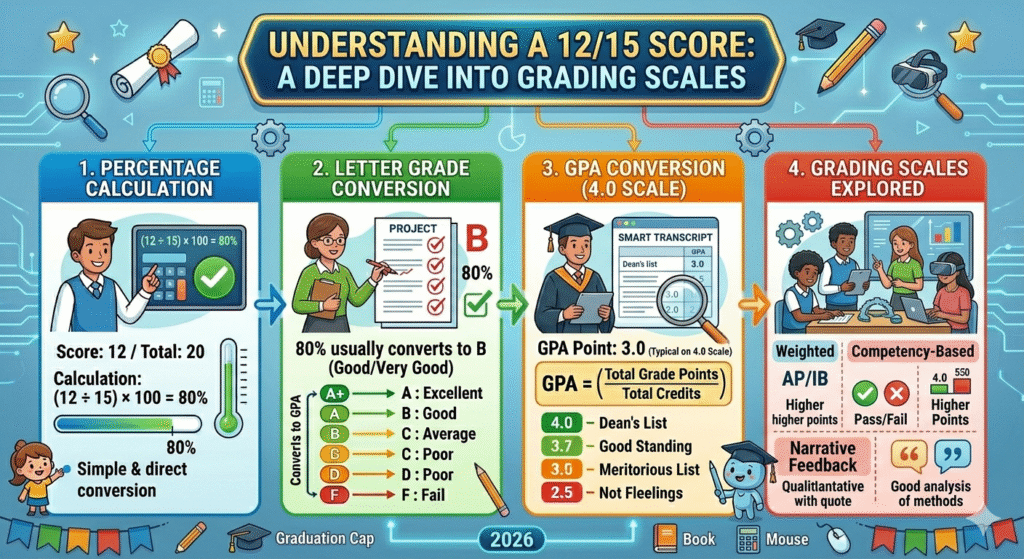
(12 ÷ 15) × 100 = 80%
A score of 12/15 equals exactly 80 percent. That’s a clean, straightforward number and a meaningful one academically.
To verify any similar scores quickly, use a grade percentage calculator. It handles the arithmetic instantly for any numerator and denominator.
What Letter Grade Is 12/15?
Once you have 80%, the next step is matching it to a letter grade. Most U.S. schools use the following standard scale:
Standard U.S. Letter Grade Scale
| Percentage Range | Letter Grade | GPA Points |
| 93–100% | A | 4.0 |
| 90–92% | A− | 3.7 |
| 87–89% | B+ | 3.3 |
| 83–86% | B | 3.0 |
| 80–82% | B− | 2.7 |
| 77–79% | C+ | 2.3 |
| 73–76% | C | 2.0 |
| 70–72% | C− | 1.7 |
| 67–69% | D+ | 1.3 |
| 63–66% | D | 1.0 |
| 60–62% | D− | 0.7 |
| Below 60% | F | 0.0 |
12/15 = 80% = B−
An 80% falls in the 80–82% band, earning a B on most standard scales. Some schools use a simplified scale where 80–89% is a flat B always check your syllabus to confirm the exact cutoffs at your institution.
For comparison:
- What grade is 75%? → C
- What grade is 80%? → B− (same band as 12/15)
- What grade is 70%? → C−
What GPA Is a 12/15 Score?
On the standard 4.0 unweighted GPA scale, 80% (B−) converts to 2.7 GPA points.
GPA Conversion Table
| Letter Grade | GPA Value | Percentage Equivalent |
| A | 4.0 | 93–100% |
| A− | 3.7 | 90–92% |
| B+ | 3.3 | 87–89% |
| B | 3.0 | 83–86% |
| B− | 2.7 | 80–82% |
| C+ | 2.3 | 77–79% |
| C | 2.0 | 73–76% |
| C− | 1.7 | 70–72% |
| D+ | 1.3 | 67–69% |
| D | 1.0 | 60–66% |
| F | 0.0 | Below 60% |
A 12/15 grade contributes 2.7 GPA points per credit hour for that assignment or course. To understand how this affects your overall standing, use a GPA from letter grades calculator.
A common misconception: is 70 a 3.0 GPA? No — a 70% earns roughly a C− (1.7 GPA). A 3.0 GPA corresponds to a B (83–86%). Keeping this distinction clear matters for scholarship applications, honor rolls, and graduate school eligibility.
Is 12/15 a Good Grade?
Context determines whether 80% is “good.” Here’s how to evaluate it across different scenarios:
Academic Context
| Setting | Is 80% Good? |
| High school | Generally yes — above average |
| Competitive college program | Acceptable, but room for improvement |
| Graduate school | Often the minimum passing threshold |
| Scholarship eligibility (3.5+ GPA) | Below the typical target |
| Pass/Fail course | Comfortably passing in most schools |
Honest Assessment
An 80% (B−) is a solid, passing grade that demonstrates competency. It’s not exceptional, but it’s meaningfully above average and puts you in good academic standing. If you’re aiming for a 3.5 GPA for college applications, you’d want to push scores like this into the B+ or A− range when possible.
For perspective on nearby scores:
- Is 78 a C? Yes — 78% is a C+, two full letter steps below 12/15.
- Is 89.5 an A or B? Depends on rounding policy — often treated as A−.
How Different Grading Systems Interpret 12/15
Percentage Grading Scale
As established: 12/15 = 80%. On a strict percentage scale, the score is recorded and compared directly as a number out of 100. This is the most transparent system — no interpretation needed.
Letter Grading Scale
80% earns a B− on most U.S. scales (80–82% band) or a flat B on simplified scales (80–89%). Always verify which system your school or professor uses, since the difference can affect your GPA by 0.3 points per course.
4.0 GPA Scale
- Strict scale: 2.7 (B−)
- Simplified scale: 3.0 (B)
When calculating your semester GPA, the credit-hour weight of the course matters. A 2.7 in a 4-credit course affects your GPA more than a 2.7 in a 1-credit course. Learn how to calculate GPA with weighted courses to account for this correctly.
Weighted GPA Scale (AP/Honors Courses)
If 12/15 comes from an AP or honors class, the GPA value gets a bonus:
| Course Type | Letter Grade | Weighted GPA |
| Standard | B− | 2.7 |
| Honors | B− | 3.2 |
| AP / IB | B− | 3.7 |
This is why students in challenging courses can maintain strong GPAs even with scores in the B range. Understand more about what a 5.0 GPA means in the USA — it’s only achievable through AP/IB coursework.
Is a 4.0 GPA straight As? On an unweighted scale, yes. But on a weighted scale, consistent B performance in AP classes can approach or exceed 4.0.
Standards-Based Grading
In schools using a 1–4 standards scale, 80% typically falls at a 3 out of 4 — meaning “meets the standard.” This system doesn’t translate directly to GPA but signals solid competency without exceeding expectations.
Pass/Fail Grading
In pass/fail courses, 80% comfortably earns a Pass at virtually every institution (most set the threshold at 60–70%). A pass doesn’t affect GPA but earns full credit hours.
How 12/15 Compares to Similar Scores
It helps to see 12/15 alongside nearby fractional scores:
| Score | Percentage | Letter Grade | GPA (Unweighted) |
| 15/15 | 100% | A | 4.0 |
| 14/15 | 93.3% | A | 4.0 |
| 13/15 | 86.7% | B | 3.0 |
| 12/15 | 80% | B− | 2.7 |
| 11/15 | 73.3% | C | 2.0 |
| 10/15 | 66.7% | D | 1.0 |
| 9/15 | 60% | D− | 0.7 |
| 8/15 | 53.3% | F | 0.0 |
For other common fractional scores, see:
- What grade is 15/20? → 75% = C
- What grade is 9/11 on a test? → 81.8% ≈ B−
How 12/15 Affects Your Course Grade
A single assignment score of 12/15 rarely determines your final grade on its own — it’s one piece of a weighted puzzle.
Understanding Assignment Weight
How much is a test grade worth? It depends entirely on the course syllabus. If this 12/15 score came from:
- A homework assignment worth 10% of your grade: minimal impact
- A quiz worth 20%: moderate impact
- A major test worth 40%: significant impact
What is the weight of a test grade relative to your total course grade? Check your syllabus — that number tells you exactly how much this 80% matters.
Calculating Your Running Course Grade
If you want to know how to calculate grades in class after receiving a 12/15, use the weighted average formula:
Course Grade = Σ (Category Weight × Category Average)
Example:
- Homework (20% weight): average 88%
- Quizzes (30% weight): your 12/15 = 80%
- Tests (50% weight): average 84%
Course Grade = (0.20 × 88) + (0.30 × 80) + (0.50 × 84) = 17.6 + 24.0 + 42.0 = 83.6% → B
Use a weighted average grade calculator to run these numbers without error.
To find your overall score or total grade across all assignments, you’ll need scores and weights for every category in the course.
What Grade Do You Need on Remaining Work?
If a 12/15 brought your score down from where you want it, the right question is: what do I need to earn from here?
Use the target grade formula:
Required Score = (Target Grade − Current Grade × (1 − Remaining Weight)) ÷ Remaining Weight
Example: Current grade is 80%. You want to finish at 85%. Your final exam is worth 30% of the grade.
Required = (0.85 − 0.80 × 0.70) ÷ 0.30 = (0.85 − 0.56) ÷ 0.30 = 0.29 ÷ 0.30 = 96.7%
You’d need about a 97% on the final to hit 85% overall. Use a what grade do I need calculator to run this scenario for your exact situation.
For a full breakdown, read:
How 12/15 Fits Into International Grading Systems
Students studying or transferring internationally need to understand how an 80% translates across different national systems:
International Grading Comparison for 80%
| Country | 80% Equivalent | Label / Category |
| USA | B− (2.7 GPA) | Good |
| UK | Upper Second Class | 2:1 (60–69% is 2:2; 70%+ is First) |
| Germany | 2.0 (gut) | Good |
| France | 16/20 | Très bien (very good) |
| India | First Division | 60%+ is first; 80% is distinction-level |
| Australia | Distinction (D) | 75–84% range |
| Canada | B / B+ | Good to very good |
Note that UK grading is counterintuitive for American students — an 80% in the UK is a First Class Honours, the highest band, because UK marking is famously compressed. In Germany, a “2” is the second-highest grade, not a low one.
How Grading Scales Work: A Quick Overview
For students new to grading terminology, here’s a brief orientation on the systems schools use.
Why Schools Use Grading Scales
Grading scales exist to standardize communication about academic performance. Without them, a score of “12 out of 15” would mean nothing in isolation — it needs context. Scales provide that context by anchoring raw scores to meaningful categories: passing or failing, excellent or needs improvement, eligible for honors or not.
They also enable cross-institutional comparisons. When a college admissions committee reads a transcript from any high school in the country, they can interpret a 3.8 GPA using a shared reference point.
Percentage Scale
The percentage scale converts every score to a 0–100 range, making comparison intuitive. As shown above, 12/15 → 80%.
Letter Grade Scale
Letters (A through F) provide quick shorthand for performance ranges. They’re the most commonly communicated grade format in U.S. education.
GPA Scale
The 4.0 GPA scale aggregates letter grades across courses, weighted by credit hours, into a single number that summarizes overall academic performance. Learn how to calculate your grade average across multiple courses.
For grading assignments as a teacher, a consistent rubric matters. Review best practices on how to grade assignments to ensure fairness across students.
Common Mistakes When Interpreting a 12/15 Grade
Even a straightforward score like 12/15 gets misread. Watch out for these errors:
1. Assuming all 80s are the same letter grade Some schools treat 80–89% as a flat B (3.0). Others break it into B− (80–82%), B (83–86%), and B+ (87–89%). The difference matters for GPA — a 2.7 vs. 3.0 is not trivial. Know which scale your school uses.
2. Ignoring the assignment’s weight An 80% on a 5-point quiz has nearly zero effect on your final grade. An 80% on a 100-point midterm worth 30% of the course is significant. Always factor in weight before reacting emotionally to a score.
3. Mistaking the score for a GPA value A score of 80% does not mean a 2.80 GPA or any direct GPA number. It earns a B− letter grade, which then maps to 2.7 GPA. These are different conversions — don’t skip a step.
4. Overlooking rounding in borderline cases Is C+ better than C? Yes — meaningfully so. Similarly, an 82.4% that rounds to 82% stays at B−, while 82.5% might round to 83% and earn a B (3.0). One rounding point can shift your GPA by 0.3.
5. Not knowing whether the score is curved Some instructors apply a curve after grading. If the class average on a test was 60%, a 12/15 (80%) might be the top score in the room — or it might be adjusted. Learn how to curve test grades to understand how this works.
6. Confusing weighted and unweighted GPA If this 12/15 came from an AP course, your GPA benefit is higher than the standard 2.7. Don’t compare your weighted GPA against a classmate’s unweighted GPA — they’re measuring different things.
Tips for Turning an 80% Into Something Higher
A B− is a foundation, not a ceiling. Here’s how to push a 12/15 performance toward 14/15 or 15/15 next time:
Review every missed point immediately Don’t wait. Look at the 3 points you lost right after getting the grade back. Identify whether the error was conceptual (didn’t understand the topic), careless (knew it but made an error), or time-related (ran out of time).
Calculate the impact before panicking — or coasting Use a final grade calculator to see how this score affected your overall standing. Sometimes an 80% on a low-weight quiz barely moves your grade. Sometimes it does. Know the number.
Target high-weight assignments next If tests are worth 50% of your grade, that’s where improvement pays off most. An extra 5 points on a major exam moves your grade more than a perfect score on every homework assignment.
Ask about grade recovery options Some courses offer test retakes, extra credit, or grade replacement policies. Can I raise my GPA quickly? Yes — especially if you’re early in the semester or have high-credit courses still to complete.
Track AP course opportunities strategically If how AP tests are graded interests you, note that strong AP exam scores (4 or 5) can earn college credit and effectively replace a future college course — removing one more variable from your GPA trajectory.
Address borderline grade situations proactively If you’re at 81.6% and need a B (83%), calculate exactly what you need on the remaining work. Is 70 a C or D? matters less than knowing your specific gap to the next grade tier. Use a what grade do I need calculator to set a precise target.
Understand GPA thresholds for your goals Will one C hurt my GPA? Possibly — but one B− won’t. Keep your current GPA in mind when evaluating whether an 80% is acceptable given your academic goals.
Grading Scale Comparison Table
| Scale Type | 12/15 Equivalent | Top Grade | Passing Grade |
| U.S. Percentage | 80% | 93%+ (A) | ~60% (D−) |
| U.S. Letter | B− | A | D |
| 4.0 GPA | 2.7 | 4.0 | 1.0 |
| Weighted GPA (AP) | 3.7 (B− in AP) | 5.0 | Varies |
| UK Honours | Upper Second/First | First (70%+) | Pass (40%+) |
| Australian | Distinction (D) | High Distinction (HD, 85%+) | Pass (50%+) |
| German | 2.0 (gut) | 1.0 (sehr gut) | 4.0 |
| Standards-Based | 3/4 | 4/4 | 2/4 |
| Pass/Fail | Pass | Pass | Pass (≥60%) |
Key Takeaways
- 12 out of 15 = 80% — calculated by dividing 12 by 15 and multiplying by 100.
- On the standard U.S. scale, 80% earns a B− letter grade and 2.7 GPA points.
- Some schools use a simplified scale where 80–89% = B (3.0) — always verify your institution’s specific cutoffs.
- In AP or honors courses, the same B− may be worth up to 3.7 weighted GPA points.
- An 80% is a solid, passing grade — above average in most academic contexts.
- Its impact on your final course grade depends entirely on how much weight this particular assignment carries.
- Use a grade calculator to track your running average and identify exactly what you need on upcoming work.
Frequently Asked Questions
Q1: What is 12 out of 15 as a percentage?
12 divided by 15, multiplied by 100, equals exactly 80%.
Q2: What letter grade is 12/15?
On the standard U.S. scale, 80% is a B−. On simplified scales where 80–89% is a flat B, it earns a B.
Q3: What GPA is a 12/15 score?
A 12/15 score (80%, B−) corresponds to 2.7 GPA points on the unweighted 4.0 scale. In an AP or honors course, it may earn up to 3.7 weighted GPA points.
Q4: Is 12/15 a passing grade?
Yes, definitively. 80% passes in every standard academic system — U.S. high school, college, graduate, and international institutions alike.
Q5: Is 12/15 a good grade?
It’s a solid grade that reflects competency. For most general coursework, it’s above average. For highly competitive programs targeting 3.5+ GPA, it falls slightly below the target range.
Q6: How does 12/15 affect my overall course grade?
It depends on the assignment’s weight in your syllabus. An 80% on a 10% homework category has minimal impact; on a 40% major test, it’s significant. Use a weighted average calculator to find your exact course grade.
Q7: What is 12/15 in the UK grading system?
80% in the UK falls within First Class Honours (70%+ is First). UK marking tends to be conservative, so 80% is an excellent result there.
Q8: How do I raise a B− to a B or B+?
Calculate exactly what score you need on remaining assignments using a what grade do I need calculator. Then focus your preparation on the highest-weight upcoming items.
Q9: Does a 12/15 hurt my GPA?
A 2.7 is below the 3.0 threshold often associated with academic honors, so it can drag down a higher GPA if repeated across many courses. One B− rarely causes lasting damage — especially if offset by stronger grades in higher-credit courses.
Q10: Is 80% the same as a 3.0 GPA?
No. 80% (B−) earns 2.7 GPA on a strict scale, or 3.0 on a simplified scale. A 3.0 GPA typically corresponds to a straight-B average (83–86%). Is a 60 an F or D? — at most schools, 60% is a D−, well below 80%.
Conclusion
A score of 12/15 translates to 80% a B− letter grade and 2.7 GPA on the standard unweighted scale. It’s a passing, above-average grade that reflects solid understanding of the material. Whether it’s “good enough” depends on your personal academic goals, the weight of the assignment, and the grading scale your school uses.
The most important next step after any score — whether it’s 12/15, 9/11, or 15/20 — is to calculate its real impact on your course grade, then decide whether you need to adjust your effort on upcoming work. Knowing your numbers puts you in control.Use the tools at testgradescalculator.com to calculate your running grade, project your final score, and set a specific target for every remaining assignment.