
Understanding a grade like 13/20 goes far beyond a simple score on a test. Whether you’re a student trying to interpret your results, a parent decoding a report card, or a teacher applying grading standards, knowing how grading scales work and how they translate across different systems is an essential academic skill.
This guide explains everything you need to know: what a 13/20 grade means, how grading scales work worldwide, how grades convert to percentages and GPA, and what practical steps you can take to improve your academic performance.
What Is a 13/20 Grade?
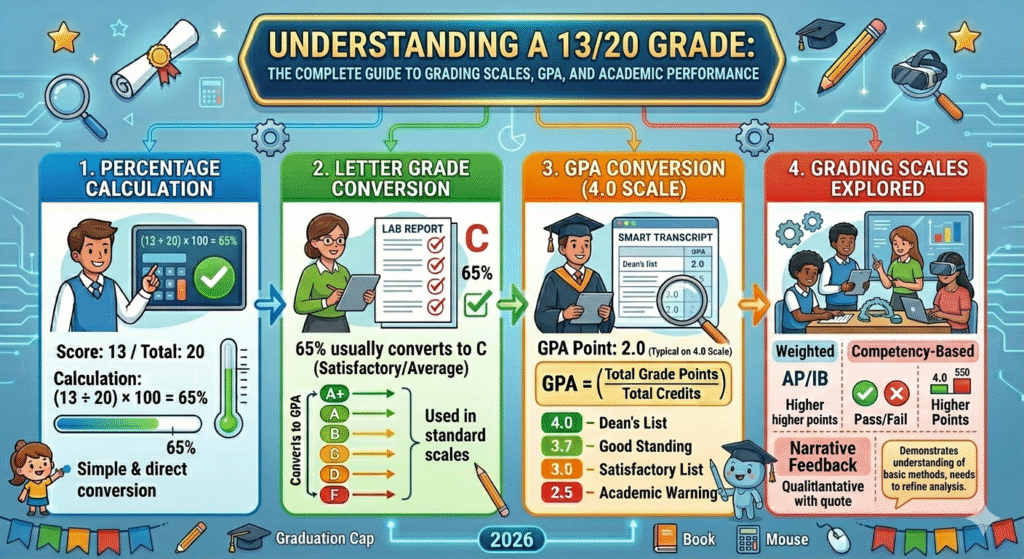
A 13/20 grade means a student earned 13 points out of a possible 20. To find the percentage, you divide the score by the total and multiply by 100:
Formula: (Score ÷ Total) × 100 = Percentage
(13 ÷ 20) × 100 = 65%
So a 13/20 is equal to 65%. In the United States letter grading system, 65% typically falls in the D range — technically passing in most schools but considered below average. In French and Belgian university systems, where the 20-point scale is standard, 13/20 is actually considered a respectable above-average score, since the average tends to cluster around 10–12.
This distinction matters enormously. The same raw score carries very different academic weight depending on which grading system is being used. That’s why understanding grading scales is so critical for students, parents, and educators alike.
Quick Reference: 13/20 at a Glance
| Metric | Value |
| Raw Score | 13 out of 20 |
| Percentage | 65% |
| US Letter Grade | D (in most US schools) |
| French/Belgian Grade | Good — Above Average |
| Standard GPA (US) | ~1.0 |
| Pass/Fail Status | Pass (in most systems) |
What Are Grading Scales and Why Do Schools Use Them?
A grading scale is a standardized system that translates a student’s academic performance into a measurable value — whether a letter, number, percentage, or descriptor like “Proficient.” Schools use grading scales for several important reasons:
- Consistency: A defined scale ensures that a teacher in one classroom applies the same standards as another.
- Communication: Grades communicate performance to students, parents, colleges, and employers in a clear, standardized way.
- Accountability: Scales create benchmarks that hold students responsible for meeting learning objectives.
- Comparison: Colleges and employers use grades to compare applicants from different schools and regions.
- Motivation: Clear targets give students goals to work toward.
Different institutions, countries, and educational levels use different grading scales — which is exactly why a score like 13/20 can mean very different things depending on the context.
The Percentage Grading Scale
The percentage grading scale is the most universally understood system. It converts raw scores into a value between 0% and 100%, making it easy to compare results across different tests and assignments.
How to Calculate Grade Percentage
The formula is straightforward:
(Points Earned ÷ Total Points Possible) × 100 = Grade Percentage
Example: If a student scores 13 out of 20 on a quiz: (13 ÷ 20) × 100 = 65%
If you want to understand how to calculate grade percentage in more complex situations — such as weighted assignments — the same core formula applies, just applied to weighted totals.
Standard US Percentage Ranges
| Percentage | Letter Grade | Description |
| 90–100% | A | Excellent |
| 80–89% | B | Above Average |
| 70–79% | C | Average |
| 60–69% | D | Below Average |
| Below 60% | F | Failing |
At 65%, a 13/20 score sits in the D range under this standard US scale — passing, but only just. If you’re wondering what grade is 70% or what grade is 75%, those scores land in the C range, which is considered average.
The Letter Grading Scale
The letter grading scale (A, B, C, D, F) is the most common grading system in American K–12 schools and universities. Each letter corresponds to a range of percentages and carries a specific academic meaning.
Standard Letter Grade Scale
| Letter Grade | Percentage Range | GPA Points | Meaning |
| A+ | 97–100% | 4.0 | Exceptional |
| A | 93–96% | 4.0 | Excellent |
| A- | 90–92% | 3.7 | Near Excellent |
| B+ | 87–89% | 3.3 | Very Good |
| B | 83–86% | 3.0 | Good |
| B- | 80–82% | 2.7 | Mostly Good |
| C+ | 77–79% | 2.3 | Slightly Above Average |
| C | 73–76% | 2.0 | Average |
| C- | 70–72% | 1.7 | Slightly Below Average |
| D+ | 67–69% | 1.3 | Below Average |
| D | 63–66% | 1.0 | Poor |
| D- | 60–62% | 0.7 | Very Poor |
| F | Below 60% | 0.0 | Failing |
A 13/20 (65%) places squarely in the D range under this system. If you’ve ever wondered about borderline cases — such as is 89.5 an A or B, or is 70 a C or D — the answer depends on your institution’s specific rounding policies.
The GPA Grading Scale
GPA (Grade Point Average) is a numerical summary of a student’s academic performance. In the US, the standard unweighted GPA runs on a 0.0 to 4.0 scale.
How GPA Is Calculated
GPA is calculated by assigning grade points to each letter grade, multiplying by the number of credit hours, summing the totals, and dividing by total credit hours.
Formula: GPA = Sum of (Grade Points × Credit Hours) ÷ Total Credit Hours
Example:
- English (3 credits): B = 3.0 → 9.0 points
- Math (4 credits): C = 2.0 → 8.0 points
- Science (3 credits): A = 4.0 → 12.0 points
- Total: 29.0 ÷ 10 credits = 2.9 GPA
To learn how to calculate a GPA from letter grades step by step, the process is the same regardless of how many courses are involved.
A 13/20 grade, at 65%, typically converts to a D (1.0 GPA points). If you’re asking is 70 a 3.0 GPA, the answer is no — 70% is generally a C, which equals 2.0 GPA points.
Weighted GPA vs. Unweighted GPA
This is one of the most commonly misunderstood areas of academic grading.
Unweighted GPA
An unweighted GPA treats all courses equally on a 4.0 scale, regardless of difficulty. An A in a standard class and an A in an AP class both earn 4.0 points.
Weighted GPA
A weighted GPA gives extra points for more rigorous courses:
| Course Type | Grade | Unweighted GPA | Weighted GPA |
| Standard | A | 4.0 | 4.0 |
| Honors | A | 4.0 | 4.5 |
| AP/IB | A | 4.0 | 5.0 |
This means a student taking all AP courses could have a weighted GPA above 4.0. If you want to understand how to calculate GPA with weighted courses, or whether a 4.0 GPA means straight A’s, the answer changes depending on whether weighted or unweighted scales are used.
Knowing what a 5.0 GPA is in the USA — which is only possible on a weighted scale — helps clarify why two students with “4.0 GPAs” may have had very different course loads.
Standards-Based Grading
Standards-Based Grading (SBG) evaluates students on their mastery of specific learning targets rather than accumulating points. Instead of letters or percentages, students receive scores like:
| Score | Descriptor |
| 4 | Exceeds Standard |
| 3 | Meets Standard |
| 2 | Approaching Standard |
| 1 | Below Standard |
SBG is increasingly popular in K–12 education because it provides more precise feedback about what a student actually knows. Under this system, a 13/20 doesn’t have a direct equivalent — the teacher would evaluate which specific standards the student met or missed.
Pass/Fail Grading
Some courses, especially electives, internships, and graduate seminars, use a Pass/Fail system. Students either meet the minimum threshold (Pass) or do not (Fail).
- Typical passing threshold in US schools: 60–70%
- A 13/20 (65%) would generally be a Pass under most Pass/Fail policies
- Pass/Fail grades typically do not affect GPA
This system reduces grade anxiety for elective courses while still holding students to a performance minimum.
International Grading Systems
Grading systems vary enormously around the world. A 13/20 means something very different depending on where you are.
Grading Scale Comparison Table
| Country/System | Scale | Equivalent to 65% | Description |
| United States | A–F / 0–4.0 GPA | D / 1.0 GPA | Below Average — Passing |
| France / Belgium | 0–20 | 13/20 | Above Average — Good |
| United Kingdom | Honours (1st, 2:1, 2:2, 3rd) | Third Class | Pass |
| Germany | 1–6 (1 = best) | ~4 | Sufficient (Ausreichend) |
| Canada | A–F / % | D | Pass (varies by province) |
| Australia | HD, D, C, P, F | Pass | Satisfactory |
| India | Percentage / CGPA | Second Division | Average |
| China | 0–100 | 65 | Pass |
| Japan | S, A, B, C, F | C | Pass |
| Mexico | 0–10 | ~6.5 | Pass (minimum is 6) |
This table makes clear why context matters so much. In France, 13/20 is genuinely a good grade. In the US, the same raw score as a percentage (65%) sits in failing-adjacent territory for many academic purposes.
Also worth noting: a score like 15/20 which equals 75% moves into C territory in the US but is considered quite strong in French-speaking systems.
How Grading Scales Affect GPA and Academic Performance
Every grade you earn feeds directly into your GPA, which in turn affects college admissions, scholarship eligibility, athletic participation, and career opportunities. Understanding this chain reaction is critical.
The Compounding Effect of Low Grades
A single D (from a 65% score) pulls your GPA downward, and the effect compounds over time. For example:
| Scenario | GPA |
| 4 A’s and 1 D | 3.4 |
| 4 A’s and 1 F | 3.2 |
| 4 B’s and 1 D | 2.6 |
If you’re worried about whether one C will hurt your GPA, the honest answer is: it depends on your other grades and how many credits are involved. A C in a 3-credit course has less impact than a D in a 6-credit course.
The good news: GPAs can recover. There are real strategies for raising your GPA quickly if you act early in a semester.
Common Grading Conversion Methods
Method 1: Percentage to Letter Grade
Divide raw score by total possible points, multiply by 100, then match to the letter grade chart.
Example: 13 ÷ 20 × 100 = 65% → D
Method 2: Percentage to GPA Points
Match the percentage to the GPA scale. 65% → D → 1.0 GPA points
Method 3: Letter Grade to GPA
Use a standard conversion table (see GPA Conversion Table below).
Method 4: Weighted Grade Calculation
Weighted average grades factor in the percentage weight of each assignment category:
Formula: (Category Score × Category Weight) + … = Weighted Grade
Example:
- Homework: 80% × 20% weight = 16
- Tests: 65% × 50% weight = 32.5
- Projects: 75% × 30% weight = 22.5
- Final Grade: 16 + 32.5 + 22.5 = 71% (C)
Understanding how much a test grade is worth and what the weight of a test grade is will help you prioritize your studying accordingly.
GPA Conversion Table
| Letter Grade | Percentage | GPA (Unweighted) | GPA (Weighted – AP/IB) |
| A+ | 97–100% | 4.0 | 5.0 |
| A | 93–96% | 4.0 | 5.0 |
| A- | 90–92% | 3.7 | 4.7 |
| B+ | 87–89% | 3.3 | 4.3 |
| B | 83–86% | 3.0 | 4.0 |
| B- | 80–82% | 2.7 | 3.7 |
| C+ | 77–79% | 2.3 | 3.3 |
| C | 73–76% | 2.0 | 3.0 |
| C- | 70–72% | 1.7 | 2.7 |
| D+ | 67–69% | 1.3 | 2.3 |
| D | 63–66% | 1.0 | 2.0 |
| D- | 60–62% | 0.7 | 1.7 |
| F | Below 60% | 0.0 | 0.0 |
How to Calculate Grades Using Different Scales
Calculating a Single Test or Assignment Grade
Use our step-by-step guide on how to calculate a grade after a test for quick post-assessment analysis.
Formula: (Points Earned ÷ Points Possible) × 100
Calculating Your Overall Class Grade
Your class grade is typically the weighted average of all assignment categories. To learn how to calculate grades in class, follow these steps:
- List every assignment category and its weight
- Calculate your average score in each category
- Multiply each average by its weight
- Sum all values for your overall grade
Calculating Your Semester or Final Grade
If you’re approaching the end of a term, knowing how to calculate your semester grade or how to calculate your final grade is essential for planning. You can also use a what grade do I need calculator to determine exactly what score you need on a final exam to reach your target grade.
Calculating Grade Average Across Multiple Classes
To find your grade average across all subjects, add all your grades together and divide by the number of classes — or use credit-weighted averaging for a more accurate GPA.
For a complete picture of how to calculate your total grade or how to calculate your overall score, the core principle is always the same: weighted averages drive the final number.
Calculating Specific Fraction Scores
If you’re scoring tests with unusual totals, knowing how specific fractions translate is helpful.
- 9/11 on a test = 81.8% → B/B+ range. Learn more about what grade is 9/11 on a test.
- 13/20 = 65% → D range in US systems
- 15/20 = 75% → C range. See what grade is 15/20.
For teachers who need to how to grade assignments fairly and consistently, using a pre-calculated grading scale chart prevents inconsistency.
Mistakes Students Make When Interpreting Grades
Even smart students misread their grades. Here are the most common mistakes and how to avoid them.
Mistake 1: Confusing Raw Scores with Percentages
A 13/20 is not 13%. It’s 65%. Always convert your raw score to a percentage before comparing to any standard grading scale.
Mistake 2: Ignoring Course Weighting
A test worth 50% of your grade has far more impact than a homework assignment worth 5%. Many students don’t realize how dramatically one bad test can shift their final grade. Always check how to calculate final grades with weights applied.
Mistake 3: Assuming All Schools Use the Same Scale
A 65% in one school may be a D, while at another it might be a C. Even within the US, grading scales vary. Never assume — always check your institution’s official scale.
Mistake 4: Misunderstanding Borderline Grades
Students often wonder if 78% is a C or whether 80% is a B or C. The answer depends entirely on your school’s specific scale. Some schools set the B range at 80–89%, others at 83–89%.
Mistake 5: Not Accounting for Curved Grades
If your teacher curves an exam, your effective grade may be higher than your raw score suggests. Understanding how to curve test grades helps you interpret adjusted results accurately.
Mistake 6: Misreading Pass/Fail Eligibility
Some students assume any passing score is “good enough” for every purpose. But a 65% Pass may disqualify you from honor rolls, scholarships, or prerequisite clearance. If you’re wondering is a 60 an F or D, that too depends on the institution.
Mistake 7: Underestimating the C Grade
Many students think a C is solidly fine, but whether C is better than C grade and what it means for GPA is worth understanding carefully — especially for graduate school applicants, where even C+ averages can raise flags.
Tips for Improving Your Grades
If a 13/20 (65%) isn’t where you want to be, these proven strategies can help you move the needle.
1. Understand Where Points Are Lost
Review your graded work carefully. Are mistakes clustered in one topic area? Is it test-taking anxiety, incomplete homework, or conceptual gaps? Targeted improvement beats generic studying.
2. Prioritize High-Weight Assignments
Since tests often carry the most weight, focus your energy there. Use a how much is a test grade worth calculator to see exactly which assignments move your grade the most.
3. Track Your Progress with Running GPA Calculations
Don’t wait until the end of the semester to check your grade. Use how to calculate grades in class regularly so you’re never surprised.
4. Ask for Help Early
Office hours, tutoring centers, and study groups are underutilized resources. A single concept clarified early can prevent cascading confusion throughout a course.
5. Study Smarter, Not Longer
Active recall, spaced repetition, and practice tests are proven to outperform passive re-reading. Spending 30 focused minutes beats 2 hours of distracted review.
6. Know What Grade You Need Going Forward
Use a what grade do I need calculator to figure out exactly what scores you need on remaining assignments to hit your target final grade. This removes guesswork and lets you study with a specific goal.
7. Understand AP Grading if Applicable
If you’re in advanced coursework, knowing how AP tests are graded and how AP scores convert to GPA gives you a more complete picture of your academic standing. If you’re wondering is a 3.5 GPA good for college, the answer is generally yes — but context (school selectivity, course rigor, trends) matters greatly.
Key Takeaways
- A 13/20 grade equals 65%, which is a D in the US letter grade system and typically a passing-but-below-average score.
- In French and Belgian academic systems, 13/20 is considered a good, above-average grade — context always matters.
- Grading scales vary widely: percentage, letter grade, GPA (weighted and unweighted), standards-based, and pass/fail systems all measure performance differently.
- A 65% converts to approximately 1.0 GPA points on an unweighted US scale.
- International grading systems interpret the same percentage very differently — a 65% may be a D in the US, a Pass in Australia, or “Sufficient” in Germany.
- Always understand the weighting of assignments before drawing conclusions about your overall standing.
- Proactive grade tracking and targeted improvement strategies are the most effective tools for academic recovery and growth.
Frequently Asked Questions
1. Is a 13/20 a passing grade?
Yes, in most academic systems a 13/20 (65%) is a passing grade. In the US, most schools require a minimum of 60–65% to pass. In French and Belgian universities, where 10/20 is the traditional pass mark, 13/20 is comfortably passing and considered above average.
2. What letter grade is 13 out of 20?
In the United States, 13/20 equals 65%, which is typically a D or D+ depending on your school’s scale. Some institutions with a lower threshold may classify it as a C-. Always verify your specific school’s grading policy.
3. What GPA is a 13/20?
A 13/20 (65%) corresponds to approximately a 1.0 GPA on the standard US unweighted 4.0 scale, equivalent to a D grade.
4. How do you calculate a grade percentage from a fraction?
Divide the numerator by the denominator, then multiply by 100. For 13/20: (13 ÷ 20) × 100 = 65%. This works for any score expressed as a fraction.
5. Why does 13/20 mean different things in different countries?
Because grading scales are not universal. In France and Belgium, the standard scale runs from 0 to 20, with 10 as the pass mark and 14–16 considered good. In the US, the same 65% percentage maps to a near-failing D. The raw number only makes sense in context of its system.
6. How does a 65% grade affect my GPA?
A 65% earns 1.0 GPA points (a D) on the standard unweighted US scale. If this is one of several courses, its impact on your cumulative GPA depends on the credit hours involved. A D in a 4-credit course pulls your GPA down more than a D in a 1-credit course.
7. What is the difference between weighted and unweighted GPA?
An unweighted GPA treats all courses on the same 4.0 scale. A weighted GPA adds extra points for honors, AP, or IB courses — allowing GPAs above 4.0. The same grade in an AP class earns more GPA points than in a standard class under a weighted system.
8. Can I raise my GPA after getting a 65% on an important test?
Yes, especially early in a semester. Your final grade depends on all assignments weighted together, so strong performance on remaining work can offset a low test score. Use a grade calculator to find out exactly what scores you need going forward.
9. Is a C grade better than a D?
Yes, definitively. A C (70–79%) earns 2.0 GPA points vs. 1.0 for a D (60–69%). Over multiple courses, this difference accumulates significantly. Consistently earning C’s will yield a 2.0 GPA, while D’s produce a 1.0 GPA — which can affect college admission, scholarships, and graduation eligibility.
10. What is a good grade on a 20-point scale?
In French and European systems using a 20-point scale, grades are interpreted roughly as: 16–20 = Excellent, 14–15 = Very Good, 12–13 = Good, 10–11 = Satisfactory (Pass), below 10 = Fail. By this standard, 13/20 is a solid, above-average score.
Conclusion
A 13/20 grade is a number that tells a very different story depending on which grading system you apply it to. In American schools, the 65% equivalent places it in the D range — passing, but a signal that improvement is needed. In French and Belgian education, that same 13/20 is a respectable mark above the average.
What truly matters is understanding the system you’re working within, knowing how your grades translate across scales, and taking deliberate steps to improve when your performance doesn’t match your goals. Grading systems are tools — not verdicts. A 65% today can become an 85% next semester with the right strategies in place.
Use grade calculators, track your weighted averages, know the GPA impact of each score, and focus your effort where it counts most. Academic performance is always improvable, and understanding how grades actually work is your first step toward improving them.