The most effective exam study techniques — backed by decades of cognitive science research — are active recall and spaced repetition. Popular habits like highlighting, rereading, and summarizing feel productive, but a major review of the research found they’re actually among the least effective methods for long-term retention. The techniques that consistently produce stronger results are less popular precisely because they feel harder in the moment.
This guide breaks down what actually works, how to build a study plan around it, and how to avoid the common habits that feel like studying but don’t move the needle on exam day.
Key Takeaways
- Active recall (testing yourself) and spaced repetition (spreading study sessions over time) are the two most well-supported techniques for exam performance.
- Popular methods like highlighting, rereading, and summarizing are backed by comparatively weak evidence, according to a major research review of learning techniques.
- Combining a few high-utility techniques with a realistic weekly schedule consistently outperforms cramming, even when total study time is the same.
What Actually Works: The Science of Studying
In 2013, a team of cognitive scientists published a comprehensive review of ten common study techniques, rating each based on the strength of the evidence supporting it. The findings surprised a lot of students: the techniques people use most often aren’t the ones the evidence supports most strongly.
Study Technique Effectiveness Table
| Technique | Utility Rating | Why It Works (or Doesn’t) |
|---|---|---|
| Practice Testing (Active Recall) | High | Forces retrieval from memory, which strengthens long-term storage far more than passive review |
| Distributed Practice (Spaced Repetition) | High | Spacing sessions over time exploits how memory naturally consolidates, beating single-session cramming |
| Interleaved Practice | Moderate | Mixing topics or problem types improves the brain’s ability to distinguish between concepts |
| Elaborative Interrogation | Moderate | Asking “why is this true?” builds deeper, more connected understanding |
| Self-Explanation | Moderate | Explaining material in your own words reveals gaps that passive review hides |
| Rereading | Low | Creates a false sense of familiarity without actually strengthening recall |
| Highlighting/Underlining | Low | Passive and easy to do without real engagement with the material |
| Summarization | Low | Helpful for some students, but evidence for exam performance specifically is weak |
| Keyword Mnemonic | Low | Works for specific vocabulary but doesn’t generalize well to broader exam content |
| Imagery for Text | Low | Limited evidence of benefit for most academic material |
The two standout techniques — practice testing and distributed practice — work because they force your brain to actively retrieve information rather than simply re-expose you to it. That extra effort is exactly why they feel harder than rereading, and exactly why they work better.
Worked Examples: Putting the Techniques Into Practice
Example 1: Applying Active Recall to a History Exam
Instead of rereading your notes on a chapter about World War I, close the notebook and try to write everything you remember from memory first. Then:
- Step 1: Compare what you wrote to your actual notes and flag every gap
- Step 2: Turn each gap into a specific question (“What caused the assassination that triggered the war?”)
- Step 3: Quiz yourself on those specific questions a day later, not immediately
- Step 4: Repeat the cycle, focusing more time on whatever you still get wrong
This is fundamentally different from rereading, because every step forces retrieval rather than recognition.
Example 2: Building a Spaced Repetition Schedule Three Weeks Before a Final
Rather than cramming the weekend before, spread review sessions out with increasing gaps between them:
| Session | Timing | Focus |
|---|---|---|
| 1 | 3 weeks before | First full pass through all material |
| 2 | 2 weeks before | Practice testing on weak areas identified in Session 1 |
| 3 | 10 days before | Interleaved practice mixing topics together |
| 4 | 4 days before | Focused review on remaining weak spots |
| 5 | 1 day before | Light review only — no new material |
Each session is spaced further apart early on and closer together near the exam, which matches how spaced repetition research suggests memory consolidation actually works.
Deep Dive: The Top Techniques Explained
Active Recall (Practice Testing)
Instead of reviewing material passively, actively test yourself on it — flashcards, practice questions, or simply trying to explain a concept from memory before checking your notes. This is consistently rated as the single most effective study technique in the research.
Spaced Repetition (Distributed Practice)
Spread study sessions out over days or weeks instead of concentrating them into one long session. Even when total study time is identical, spaced sessions produce stronger long-term retention than a single cram session — one of the most robust findings in learning science.
Interleaved Practice
Instead of studying one topic exhaustively before moving to the next, mix related topics or problem types together within a single session. This trains your brain to recognize which approach applies to which situation, a skill that pure block practice doesn’t build as effectively.
Elaborative Interrogation and Self-Explanation
For every fact or concept, ask “why is this true?” or “how does this connect to what I already know?” Explaining material in your own words — even to an empty room — reliably reveals gaps that simply rereading notes tends to hide.
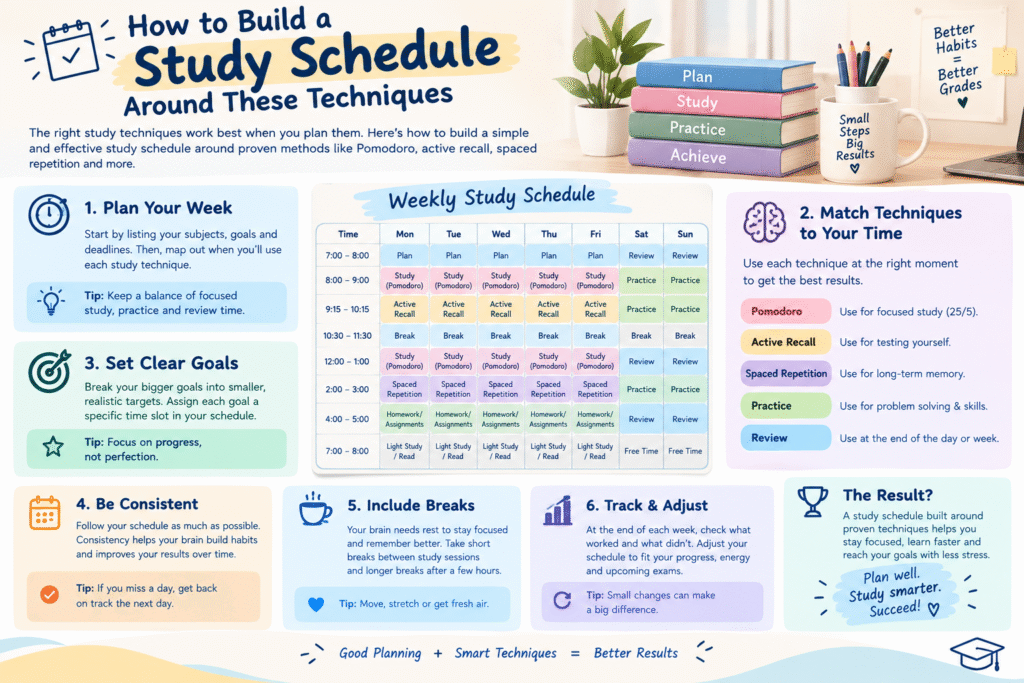
How to Build a Study Schedule Around These Techniques
Step 1: Identify Which Subjects Actually Need the Most Time
Not every class deserves equal study time. Understanding how much a test grade is worth and what the weight of a test grade is in each of your classes helps you prioritize study time toward the exams that will actually move your final grade the most.
Step 2: Check Your Current Standing Before You Start
Use how to calculate a grade after a test or how to calculate grades in class to see exactly where you stand in each course. A class where you’re already comfortably ahead needs less urgent attention than one where you’re right on a grade boundary.
Step 3: Know Exactly What Score You Need
Use a what grade do I need calculator to see precisely what score on an upcoming exam would secure your target final grade. A concrete number is far more motivating — and easier to plan around — than a vague goal of “doing well.”
Step 4: Space Out Sessions Using the Techniques Above
Build a calendar working backward from the exam date, prioritizing active recall and spaced repetition as described above, with more frequent, shorter sessions for your highest-priority subjects.
Common Mistakes Students Make When Studying for Exams
Mistake 1: Confusing Familiarity With Learning
Rereading notes makes material feel familiar, which can be mistaken for actually knowing it. Active recall exposes the difference immediately — and uncomfortably — which is exactly why it works better.
Mistake 2: Cramming the Night Before
Cramming can produce short-term recognition, but it consistently underperforms spaced practice for actual exam performance, especially on material that requires deeper understanding rather than simple memorization.
Mistake 3: Studying Every Subject Equally
Not all exams carry the same weight toward your final grade. Skipping the step of checking how much a test grade is worth means you might spend hours on a low-stakes quiz while under-preparing for a heavily weighted final.
Mistake 4: Multitasking While Studying
Splitting attention between studying and a phone, TV, or other distractions significantly weakens the encoding process that techniques like active recall depend on. Focused, distraction-free sessions — even shorter ones — outperform longer, divided-attention sessions.
Mistake 5: Ignoring Sleep
Memory consolidation happens substantially during sleep. Sacrificing sleep to fit in more cramming time is frequently counterproductive, since poor sleep undermines the very process that turns study time into long-term retention.
Mistake 6: Not Tracking Which Topics Are Actually Weak
Vague reviewing tends to spend equal time on material you already know and material you don’t. Active recall naturally surfaces your weak spots — use that information to redirect subsequent sessions specifically toward them.
Mistake 7: Treating All Study Time as Equally Valuable
An hour of focused active recall is worth more than several hours of passive rereading. If time is limited, prioritizing high-utility techniques over familiar, comfortable ones produces meaningfully better results per hour invested.
Exam-Day Tips
- Prioritize sleep the night before over last-minute cramming — a well-rested brain retrieves information more reliably than a tired one that crammed an extra hour.
- Eat something before the exam — stable blood sugar supports sustained concentration through a long test.
- Arrive early to avoid the added stress of rushing, which can interfere with recall under pressure.
- Read all instructions carefully before starting, and budget your time across sections based on point value rather than working strictly in order.
- Answer questions you’re confident about first, then return to harder ones — this builds momentum and ensures easy points aren’t lost to poor time management.
Key Takeaways
- Active recall and spaced repetition are the two most well-supported study techniques, according to a major review of the cognitive science research.
- Popular habits like rereading, highlighting, and summarizing are backed by comparatively weak evidence for exam performance specifically.
- Interleaved practice, elaborative interrogation, and self-explanation are moderately effective techniques worth combining with the top two.
- A study schedule built around checking assignment weight first ensures your study time is directed toward the exams that actually matter most to your final grade.
- Spacing sessions out over time consistently beats cramming, even when total study hours are identical.
- Sleep, focus, and distraction-free sessions meaningfully affect how well any of these techniques actually work.
Frequently Asked Questions
1. What is the most effective study technique for exams?
According to a major cognitive science review, practice testing (active recall) and distributed practice (spaced repetition) are the two most well-supported techniques for exam performance, outperforming more popular methods like rereading and highlighting.
2. Is highlighting an effective study technique?
Research suggests highlighting has comparatively low utility on its own. It’s passive and doesn’t require the active retrieval that techniques like practice testing do, which is why it doesn’t translate as reliably into stronger exam performance.
3. How far in advance should I start studying for an exam?
Spaced repetition research generally supports starting well before the exam — often two to three weeks for a major test — with sessions spaced further apart early on and closer together as the exam approaches, rather than concentrating all study time in the final days.
4. Is cramming ever effective?
Cramming can produce short-term recognition sufficient for very simple recall tasks, but it consistently underperforms spaced practice for deeper understanding and long-term retention, which matters most for cumulative or comprehensive exams.
5. What is active recall and how do I use it?
Active recall means testing yourself on material rather than simply reviewing it — for example, closing your notes and writing down everything you remember, then checking for gaps. Flashcards, practice questions, and self-quizzing are all forms of active recall.
6. How do I know which subjects to prioritize when studying for finals?
Check how much each test is worth toward your final grade in each class, and use a what grade do I need calculator to see where you’re closest to a grade boundary — those are the exams where additional study time will have the biggest measurable impact.
7. Does interleaving really work better than studying one topic at a time?
Research generally supports interleaved practice as moderately effective, particularly for material where distinguishing between similar concepts or problem types matters — math and science problem sets are common examples where interleaving shows a clear benefit.
8. How much sleep do I need before an exam?
While individual needs vary, most research points to sleep playing a significant role in memory consolidation — sacrificing substantial sleep for extra cramming time is often counterproductive, since it undermines the very process that turns studying into lasting recall.
9. Can I combine multiple study techniques together?
Yes, and it’s generally recommended. Active recall and spaced repetition form the foundation, but layering in interleaved practice and self-explanation for particularly difficult material can further strengthen understanding without much additional time investment.
10. How do I track whether my study techniques are actually working?
Use active recall itself as the test — if you can accurately answer practice questions without looking at your notes, the material is genuinely learned. You can also track your actual grade trends using how to calculate grades in class to see whether your study approach is translating into real results over time.
Conclusion
The most effective way to study for exams isn’t the most popular way. Active recall and spaced repetition — testing yourself and spreading sessions out over time — consistently outperform rereading, highlighting, and cramming, even though the latter feel more comfortable in the moment. That extra discomfort is actually the mechanism: forcing your brain to retrieve information, rather than simply re-expose it to information, is what builds durable, exam-ready memory.
The most efficient study plan combines these evidence-backed techniques with a clear sense of priority — knowing which exams carry the most weight, tracking your current standing, and directing your limited time toward what will actually move your final grade. Studying smarter, not just longer, is the difference that shows up on exam day.
Use grade calculators to identify your real priorities, build a spaced study schedule around active recall, and protect your sleep in the final days before a big test. The techniques that feel hardest in the moment are usually the ones doing the most work.