
Understanding a score like 4 out of 15 matters most when it’s lower than you’d hoped — and the first step is always getting a clear, accurate picture of exactly where it stands before figuring out what to do next.
This guide explains exactly what 4/15 means as a percentage, letter grade, and GPA, how far it actually is from passing, and what concrete steps genuinely help from here.
What Is 4 Out of 15 as a Percentage?
4 out of 15 means a student earned 4 points out of a possible 15. To find the percentage, you divide the score by the total and multiply by 100:
Formula: (Score ÷ Total) × 100 = Percentage
(4 ÷ 15) × 100 = 26.67%
So 4/15 is equal to 26.67% — a score that falls well below the typical passing threshold of 60%, earning an F in the standard US letter grading system. It’s a serious result, but it’s important to understand it clearly rather than avoid it: knowing exactly where you stand is the first real step toward addressing it.
Quick Reference: 4/15 at a Glance
| Metric | Value |
|---|---|
| Raw Score | 4 out of 15 |
| Percentage | 26.67% |
| US Letter Grade | F |
| French/Belgian Equivalent | ~5.3/20 — Insuffisant (Fail) |
| Standard GPA (US) | 0.0 |
| Pass/Fail Status | Fail |
| Distance to Passing (60%) | 5 more points needed (9/15) |
The Percentage Grading Scale
The percentage grading scale converts raw scores into a value between 0% and 100%, making it easy to see exactly where 4/15 stands.
Standard US Percentage Ranges
| Percentage | Letter Grade | Status |
|---|---|---|
| 90–100% | A | Passing — Excellent |
| 80–89% | B | Passing — Above Average |
| 70–79% | C | Passing — Average |
| 60–69% | D | Passing — Below Average |
| Below 60% | F | Failing (4/15 falls here) |
At 26.67%, a 4/15 score is well below the F threshold’s upper boundary, not just barely under it. This distinction matters for figuring out what kind of recovery plan actually makes sense — a score just under 60% and a score around 27% call for different approaches.
The Letter Grading Scale
The letter grading scale (A, B, C, D, F) is the most common grading system in American schools.
Standard Letter Grade Scale
| Letter Grade | Percentage Range | GPA Points |
|---|---|---|
| A+ / A / A– | 90–100% | 3.7–4.0 |
| B+ / B / B– | 80–89% | 2.7–3.3 |
| C+ / C / C– | 70–79% | 1.7–2.3 |
| D+ / D / D– | 60–69% | 0.7–1.3 |
| F | Below 60% | 0.0 |
Unlike every grade above it, F has no plus/minus sub-tiers on most scales — a 4/15 (26.67%) and a score of 55% are both simply “F,” even though they represent very different levels of understanding.
The GPA Grading Scale
GPA (Grade Point Average) is a numerical summary of academic performance. In the US, the standard unweighted GPA runs on a 0.0 to 4.0 scale.
How GPA Is Calculated
GPA is calculated by assigning grade points to each letter grade, multiplying by the number of credit hours, summing the totals, and dividing by total credit hours.
Formula: GPA = Sum of (Grade Points × Credit Hours) ÷ Total Credit Hours
Example:
- English (3 credits): F = 0.0 → 0.0 points
- Math (4 credits): B = 3.0 → 12.0 points
- Science (3 credits): A = 4.0 → 12.0 points
- Total: 24.0 ÷ 10 credits = 2.4 GPA
This example matters: even with one F, a strong overall GPA is still very achievable, depending on how the rest of your courses are going. To learn how to calculate a GPA from letter grades step by step, the process is the same regardless of how many courses are involved.
Weighted GPA vs. Unweighted GPA
This is worth knowing clearly: weighting does not help a failing grade.
Unweighted and Weighted GPA for an F
| Course Type | Grade | Unweighted GPA | Weighted GPA |
|---|---|---|---|
| Standard | F | 0.0 | 0.0 |
| Honors | F | 0.0 | 0.0 |
| AP/IB | F | 0.0 | 0.0 |
Unlike a passing grade, which gets a real GPA boost from Honors or AP weighting, an F stays at exactly zero no matter how difficult the course was. If you want to understand how weighting works for passing grades, see how to calculate GPA with weighted courses — but know that this specific benefit doesn’t apply once a score drops into failing territory.
International Grading Systems
Failing thresholds vary by country, though 4/15 (26.67%) falls well below the passing line in every major system.
International Comparison Table
| Country/System | Scale | Equivalent to 26.67% | Status |
|---|---|---|---|
| United States | A–F / 0–4.0 GPA | F / 0.0 GPA | Failing |
| France / Belgium | 0–20 | ~5.3/20 | Insuffisant (Fail) |
| United Kingdom | 0–100 | Below 40% | Failing |
| Germany | 1–6 (1 = best) | 6 (Ungenügend) | Failing |
| Australia | HD/D/C/P/F | Fail | Failing |
| China | 0–100 | 27 | Failing |
| Mexico | 0–10 | ~2.7 | Failing |
Unlike scores in the 55–65% range — which can be passing in some countries and failing in others — 26.67% is clearly below the failing threshold everywhere. This is useful context: it means the path forward is the same no matter which grading system applies.
Consequences of a Failing Grade Like This
- GPA: An F contributes zero points, which meaningfully lowers a GPA, though as the example above shows, a strong overall average is still achievable with solid grades elsewhere.
- Course credit: Most failing grades earn no credit, typically meaning the course needs to be retaken.
- Prerequisites: If this was a prerequisite course, it likely needs to be passed before moving on to the next course in the sequence.
- Financial aid: Federal Satisfactory Academic Progress rules typically require both a minimum GPA and a minimum pace of credit completion — a failing grade can affect both, so it’s worth checking with a financial aid advisor if this applies to you.
Common Grading Conversion Methods
Method 1: Percentage to Letter Grade
Divide raw score by total possible points, multiply by 100, then match to the letter grade chart.
Example: 4 ÷ 15 × 100 = 26.67% → F
Method 2: Percentage to GPA Points
Any percentage below 60% converts to exactly 0.0 GPA points, regardless of how far below 60% it falls.
Method 3: Weighted Grade Calculation
Weighted average grades factor in the percentage weight of each assignment category:
Formula: (Category Score × Category Weight) + … = Weighted Grade
Example:
- Homework: 70% × 20% weight = 14
- Tests: 26.67% × 50% weight = 13.34
- Projects: 65% × 30% weight = 19.5
- Final Grade: 14 + 13.34 + 19.5 = 46.84% (still an F)
This example matters, too: even with reasonably solid homework and project scores, one very low test can pull an overall grade down significantly if it’s heavily weighted — which is exactly why understanding how much a test grade is worth in your specific class is worth checking directly.
Calculating Specific Fraction Scores on a 15-Point Scale
On a 15-point test, each individual point is worth about 6.67 percentage points. Here’s the full picture across the scale, including several scores worth knowing:
| Score | Percentage | Letter Grade |
|---|---|---|
| 15/15 | 100.00% | A+ |
| 13/15 | 86.67% | B+ |
| 12/15 | 80.00% | B– |
| 11/15 | 73.33% | C |
| 10/15 | 66.67% | D+ / D |
| 9/15 | 60.00% | D– |
| 8/15 | 53.33% | F |
| 4/15 | 26.67% | F |
This table is genuinely useful for planning: 9/15 (60%) is the nearest passing score, meaning 5 additional correct answers on a retake or similar assessment would cross the passing line. For teachers who need to grade assignments fairly and consistently, seeing this full range helps put any single score into perspective against the rest of the scale.
Mistakes to Avoid When Interpreting a Score Like This
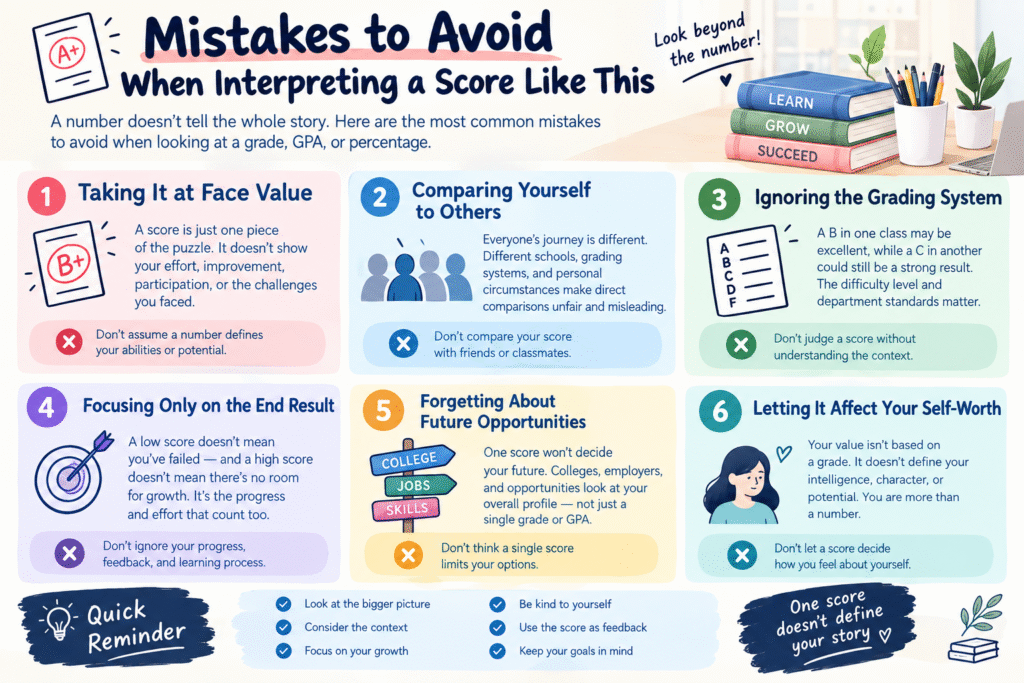
Mistake 1: Treating All F’s as the Same
An F simply means “below 60%” — a 55% and a 27% are both technically an F, but they call for different levels of response. Always look at the actual percentage, not just the letter grade, when deciding how to move forward.
Mistake 2: Assuming Weighting or a Curve Automatically Helps
Weighting doesn’t raise the GPA value of an F, and while a curve might help, it’s never guaranteed — always confirm directly with your instructor rather than assuming either will resolve the score on its own.
Mistake 3: Not Checking Retake, Withdrawal, or Grade Replacement Options
Most schools offer some combination of these options. A withdrawal before the deadline, a retake with grade replacement, or an incomplete for extenuating circumstances can all meaningfully change the outcome — but only if you ask.
Mistake 4: Waiting Too Long to Address It
The sooner a low score like this is addressed — through tutoring, a conversation with the instructor, or a clear study plan — the more options are typically still available, including retake windows and withdrawal deadlines.
Mistake 5: Assuming One Low Score Defines the Whole Course or Semester
As the weighted example above shows, a single score — even a very low one — doesn’t automatically determine a final course grade or semester GPA. The actual impact depends entirely on weighting and what else is factored in.
What to Do Next
A score like 4/15 is a clear, serious signal — and also a genuinely actionable one. Here’s a constructive way to approach it:
1. Talk to Your Instructor as Soon as Possible
Understanding exactly what happened — and what options exist, like a retake, extra credit, or partial credit review — is the most useful first step, and many of these options aren’t offered unless a student asks directly.
2. Identify the Actual Gap
Was it a misunderstanding of the material, a missed deadline, or something else entirely? Knowing the real cause changes what kind of help — tutoring, a different study approach, or a conversation about workload — will actually address it.
3. Check the Weight of This Specific Assessment
Use a what grade do I need calculator to see exactly how this score affects your overall course grade, and what’s realistically needed on remaining work to recover.
4. Use Available Academic Support
Tutoring centers, office hours, and study groups exist specifically for situations like this, and they’re typically free. Going in with a specific, identified gap makes these resources far more effective.
5. Build a Concrete Plan for What’s Next
Rather than a vague goal of “doing better,” use how to calculate grades in class to map out specifically what’s needed on upcoming assignments to move the course average back into passing territory.
Key Takeaways
- 4 out of 15 equals 26.67%, a failing grade (F) well below the standard 60% passing threshold.
- It converts to 0.0 GPA points, and weighting (Honors, AP, IB) does not change this — an F stays at zero regardless of course difficulty.
- The nearest passing score on this same 15-point scale is 9/15 (60%) — just 5 more points away.
- A single low score like this doesn’t automatically determine a final course grade — the actual impact depends on how it’s weighted against everything else.
- Retake, withdrawal, and grade replacement options exist at most schools and are worth exploring immediately rather than assuming the grade is final.
- Addressing a score like this early — through tutoring, a conversation with the instructor, or a concrete recovery plan — keeps the most options available.
Frequently Asked Questions
1. What is 4 out of 15 as a percentage?
4 divided by 15 equals 0.2667, which multiplied by 100 gives 26.67%. This is the standard formula for converting any fraction score into a percentage.
2. Is 4 out of 15 a failing grade?
Yes. At 26.67%, this falls well below the standard 60% passing threshold used by most US schools, earning an F.
3. What GPA is 4 out of 15?
An F, including a 4/15 (26.67%), earns 0.0 GPA points on the standard unweighted 4.0 scale — the lowest possible value, unaffected by course weighting.
4. How many more points would I need to pass with a 4/15?
You’d need 9/15 (60%) to reach the standard passing threshold — 5 more points than the current score.
5. Does a single 4/15 score ruin my grade in the class?
Not necessarily. As the weighted example in this guide shows, a single score’s real impact depends on how much weight it carries relative to your other assignments. It’s worth calculating the actual effect rather than assuming the worst.
6. Can I retake a test or assignment I scored a 4/15 on?
Often, yes — many teachers offer retakes, extra credit, or partial credit reviews, though this varies by instructor and school policy. It’s always worth asking directly rather than assuming it isn’t an option.
7. Does a low score like this affect financial aid?
It can, particularly if it affects your GPA or pace of credit completion enough to fall below your school’s Satisfactory Academic Progress requirements. If you’re concerned, checking directly with a financial aid advisor is the most reliable way to understand your specific situation.
8. Is 4/15 the same as any other common failing score?
In terms of GPA impact, yes — any percentage below 60% converts to the same 0.0 GPA points. The percentage itself still matters for understanding how far there is to go, even though the GPA effect is identical to any other F.
9. What is 4 out of 15 in the French grading system?
Roughly equivalent to 5.3/20, which falls well below France’s typical 10/20 pass mark — a clearly failing result under that system as well, described as “Insuffisant.”
10. What’s the fastest way to see how this score affects my overall grade?
Use a what grade do I need calculator to calculate your exact course standing and what’s needed on remaining assignments, rather than estimating. Seeing the real numbers is usually far less alarming than the raw score alone suggests.
Conclusion
4 out of 15 is 26.67% — a clearly failing grade, well below the standard passing threshold. It’s a serious result, but a genuinely actionable one: the nearest passing score on this same scale is just 5 points away, weighting doesn’t make an F worse than it already is, and most schools offer real options — retakes, extra credit, or grade replacement — for exactly this kind of situation.
The most useful next step isn’t dwelling on the raw score, but calculating its actual effect on your overall course grade and building a specific, concrete plan from there. A single score, however low, is rarely the final word on a course or a semester.
Use grade calculators to see the real impact, talk to your instructor about your options, and focus your next effort on the specific gap that caused this result. Recovery from a score like this is common, well-supported by most schools, and very achievable with a clear plan.