Getting a score of 11 out of 15 on a quiz, test, or assignment raises a fair question: is this good, average, or something to worry about? The short answer is that 11/15 equals 73.33%, which typically lands in the C or C+ range under the standard U.S. grading scale. But that one number tells only part of the story.
Grading scales vary by country, institution, and even individual instructors. A 73% might be perfectly fine in one context and fall short of requirements in another. This guide explains exactly where an 11/15 grade stands, how it converts across every major grading system, and what you can do to push that score higher.
How to Calculate an 11/15 Grade as a Percentage
The formula for converting any fraction score to a percentage is straightforward:
Percentage = (Points Earned ÷ Total Points) × 100
For 11/15:
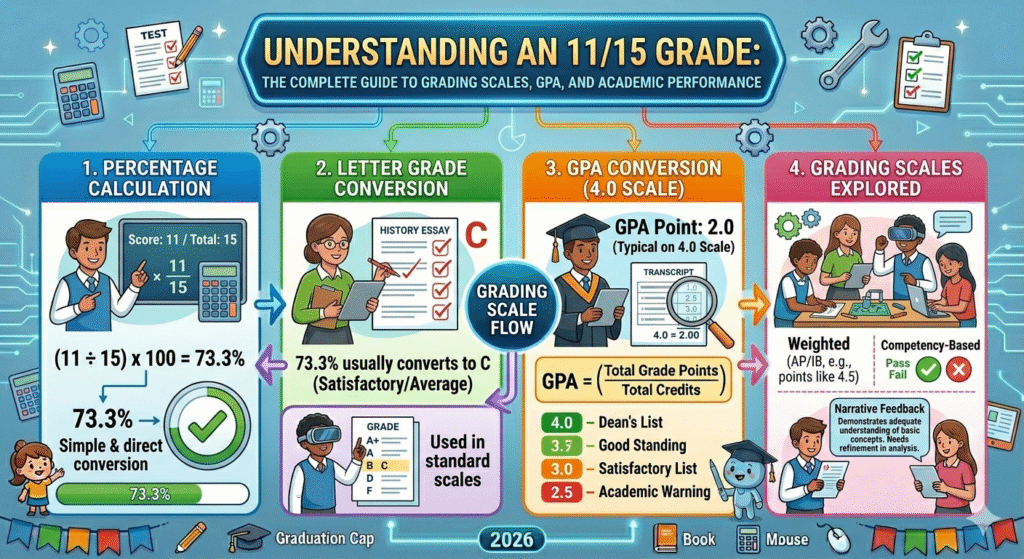
(11 ÷ 15) × 100 = 73.33%
That’s it. Whenever you need to calculate a grade percentage from a raw score, this formula applies universally — whether you scored 11/15 on a pop quiz or 44/60 on a midterm.
Similarly, if you want to find out what grade is 15/20 or compare your score on another assignment, the same division-then-multiply approach works every time.
What Letter Grade Is 11/15? (73.33% Explained)
Once you have the percentage, matching it to a letter grade depends on which grading scale your school uses. Here is a full breakdown:
Standard U.S. Letter Grading Scale
| Percentage Range | Letter Grade | GPA Points |
| 93–100% | A | 4.0 |
| 90–92% | A− | 3.7 |
| 87–89% | B+ | 3.3 |
| 83–86% | B | 3.0 |
| 80–82% | B− | 2.7 |
| 77–79% | C+ | 2.3 |
| 73–76% | C | 2.0 |
| 70–72% | C− | 1.7 |
| 67–69% | D+ | 1.3 |
| 63–66% | D | 1.0 |
| 60–62% | D− | 0.7 |
| Below 60% | F | 0.0 |
At 73.33%, an 11/15 grade falls squarely in the C range (2.0 GPA). In some schools that round 73% up to the C+ bracket (77–79%), you would still fall just below it.
Not sure where other scores land? See what grade is 75%, what grade is 70%, and what grade is 80% for direct comparisons.
What Is a Grading Scale? (And Why Do Schools Use Them?)
A grading scale is a standardized system that converts raw scores — points, percentages, or performance levels — into meaningful academic indicators like letters or GPA numbers. Schools use grading scales because:
- They create consistency. A “B” means roughly the same thing whether you’re at a school in Texas or Massachusetts.
- They communicate performance quickly. A letter or number gives students, parents, and colleges a fast summary of academic standing.
- They support admissions and scholarships. Colleges and scholarship committees rely on standardized grades to compare applicants fairly.
- They motivate improvement. Clear benchmarks give students defined targets to work toward.
There are five major types of grading scales in use today. Understanding each one helps you interpret your 11/15 score in the right context.
The 5 Major Grading Scales — How 11/15 Fits Each One
1. Percentage Grading Scale
The most universal format. Scores run from 0–100%, and every assignment, quiz, and exam can be converted to a percentage. At 73.33%, an 11/15 score is above the minimum passing threshold (usually 60–65%) but well below honors territory (90%+).
2. Letter Grading Scale
Used across virtually all U.S. K–12 schools and universities. As shown in the table above, 73.33% maps to a C. Some schools with a plus/minus system bump it to a C+ at 73%, while others keep it as a flat C until 77%.
If you’re wondering about nearby scores — for example, is 78% a C or is 70% a C or D — the answer depends on your school’s specific cutoffs.
3. GPA Grading Scale (4.0 Scale)
GPA (Grade Point Average) is the cumulative measure colleges and employers use to evaluate overall academic performance. A C (73.33%) equals a 2.0 GPA on the standard 4.0 scale.
Here is a GPA conversion table:
| Letter Grade | Percentage | 4.0 GPA |
| A | 93–100% | 4.0 |
| A− | 90–92% | 3.7 |
| B+ | 87–89% | 3.3 |
| B | 83–86% | 3.0 |
| B− | 80–82% | 2.7 |
| C+ | 77–79% | 2.3 |
| C | 73–76% | 2.0 |
| C− | 70–72% | 1.7 |
| D+ | 67–69% | 1.3 |
| D | 63–66% | 1.0 |
| F | Below 60% | 0.0 |
A 2.0 GPA is often the minimum requirement for academic good standing at many universities. Falling below this threshold can put a student on academic probation. To understand how letter grades feed into GPA calculations, see how to calculate a GPA from letter grades.
Also worth knowing: is 70% a 3.0 GPA? — the answer is no. A 70% is a C−, which corresponds to a 1.7 GPA, not 3.0.
4. Weighted GPA vs. Unweighted GPA
Most high schools report an unweighted GPA on a 4.0 scale where all courses are treated equally. However, many also calculate a weighted GPA that gives extra points for harder courses (AP, IB, Honors).
| Course Level | Unweighted GPA for a C | Weighted GPA for a C |
| Regular | 2.0 | 2.0 |
| Honors | 2.0 | 2.5 |
| AP / IB | 2.0 | 3.0 |
So if you scored 11/15 (73.33%) in an AP class, your weighted GPA contribution would be 3.0 — significantly better than the standard 2.0. Learn more about how to calculate GPA with weighted courses to see how this works in practice.
Curious if a 4.0 GPA means straight A’s? Generally yes — but weighted scales can complicate that picture.
5. Standards-Based Grading (SBG)
Rather than averaging all assignments into a single score, standards-based grading rates students on specific learning objectives. Scores typically run on a 1–4 or 1–5 scale:
| SBG Score | Description |
| 4 | Exceeds standard |
| 3 | Meets standard |
| 2 | Approaching standard |
| 1 | Below standard |
An 11/15 (73.33%) would likely map to a 2 — Approaching Standard in most SBG systems, meaning the student understands some of the material but hasn’t fully mastered it yet.
Pass/Fail Grading — Does 11/15 Pass?
In pass/fail courses, the grading is binary: you either pass or you don’t. Most institutions set the passing threshold at 60%, 65%, or 70% depending on the course level.
| Pass/Fail Cutoff | 11/15 Result |
| 60% minimum | PASS (73.33% > 60%) |
| 65% minimum | PASS (73.33% > 65%) |
| 70% minimum | PASS (73.33% > 70%) |
| 75% minimum | FAIL (73.33% < 75%) |
In most pass/fail systems, an 11/15 grade passes. However, some graduate programs, nursing schools, and professional courses set a 75% or 80% cutoff — under those systems, you would need at least 12/15 or 12/15 to clear the bar.
International Grading Systems — Where Does 73.33% Rank?
Academic grades mean different things in different countries. Here is how an 11/15 score (73.33%) translates internationally:
| Country | Grading System | 73.33% Equivalent | Classification |
| United States | A–F / 4.0 GPA | C / 2.0 GPA | Satisfactory |
| United Kingdom | First–Third Class | Lower Second (2:2) | Below average |
| Canada | Letter / % | C+ | Satisfactory |
| Germany | 1–6 Scale | 4 (ausreichend) | Sufficient |
| France | 0–20 Scale | ~14.7/20 | Assez bien |
| Australia | HD–F Scale | Credit | Average |
| India | Percentage | Second Division | Below first |
| IB Program | 1–7 Scale | ~4 | Below average |
As the table shows, 73.33% carries different weight depending on where you study. In the U.S. and Canada, it is considered satisfactory but average. In the U.K. and Germany, the same score may be viewed as below expectations for competitive programs.
How Grading Scales Affect GPA and Academic Performance
A single 11/15 score on one quiz has a relatively small impact on your overall GPA. However, consistent scores in this range across multiple assignments and exams do add up. Here’s what a steady C average means in practice:
- College admissions: Most four-year universities prefer a GPA of 3.0 (B average) or higher. A consistent 2.0 GPA limits admission options significantly.
- Scholarship eligibility: Many merit-based scholarships require at least a 3.0 or 3.5 GPA — well above where a C average sits.
- Graduate school: Most graduate programs require a minimum 3.0 undergraduate GPA. A 2.0 would typically disqualify an applicant.
- Academic standing: Many colleges place students with GPAs below 2.0 on academic probation.
Want to know will one C hurt my GPA? In most cases, a single C has a modest impact — but a pattern of C grades pulls your cumulative GPA down meaningfully over time.
How to Calculate Your Final Grade When You Have an 11/15
If your 11/15 score is just one piece of a larger course grade, you need to factor in the weight of each assignment. How to calculate final grades involves multiplying each score by its weight and summing the results.
Example:
Suppose your course grade breaks down like this:
| Component | Your Score | Weight |
| Quiz (11/15) | 73.33% | 20% |
| Midterm Exam | 80% | 30% |
| Final Exam | 85% | 35% |
| Homework | 90% | 15% |
Weighted Average = (73.33 × 0.20) + (80 × 0.30) + (85 × 0.35) + (90 × 0.15) = 14.67 + 24 + 29.75 + 13.5 = 81.92% → B−
Notice how a single 73.33% quiz score barely dragged the final grade down because it only carried 20% weight. Understanding how much a test grade is worth in your specific course is key to knowing where to focus your energy.
You can also use a what grade do I need calculator to find out exactly what score you need on your remaining assignments to hit your target final grade.
Common Mistakes Students Make When Interpreting Grades
Many students misread their scores and draw the wrong conclusions. Here are the most frequent errors:
1. Treating all grading scales as identical. A 70% is a C− in a standard scale but may be a failing grade in a course that requires 75% to pass. Always check is 70% a C or D on your specific school’s scale.
2. Ignoring assignment weights. Scoring 11/15 on a 5-point homework assignment hurts much less than the same percentage on a 100-point final exam. Learn what is the weight of a test grade before panicking.
3. Confusing weighted and unweighted GPA. Students sometimes assume their AP class C is the same as a regular class C for GPA purposes. It isn’t — the weighted GPA gives extra credit for course difficulty.
4. Rounding errors. A 73.33% does not automatically become a C+. Some schools require 77% for a C+. Check whether 89.5% is an A or B under your school’s rounding policy to see how cutoffs work.
5. Forgetting about extra credit or curves. If your instructor offers a test grade curve, an 11/15 might end up higher than it appears.
Practical Strategies to Improve Your Grade Above 73.33%
Moving from a C to a B — from 73% to 83% — is an achievable goal with focused effort. Here’s a practical roadmap:
Target the Right Assignments First
Not all assignments carry equal weight. Prioritize high-weight components (exams, major projects) over low-weight ones (daily homework). Understanding how to grade assignments by weight helps you allocate study time efficiently.
Understand Where You Lost Points
Review every graded assignment. If you missed 4 out of 15 questions, identify whether those mistakes came from one specific topic or were scattered. Focused review of weak areas is far more efficient than re-reading everything.
Use Grade Calculators Strategically
Before your next exam, use a grade after a test calculator to model how different scores will affect your running average. Knowing you need a 90% on your next quiz to reach a B motivates targeted preparation.
Track Your Semester Grade Progress
Keep a running record of your scores using a semester grade calculator. Seeing the trajectory in real time prevents last-minute surprises and gives you time to course-correct.
Ask for Extra Credit or Assignment Redo Opportunities
Many instructors offer opportunities for additional points. Even a few extra points on one assignment can push a 73.33% toward the 77% C+ threshold.
Consider Whether Your GPA Can Recover
If your grade has already been entered and you’re wondering can I raise my GPA quickly, the answer depends on how many credit hours remain. The more courses you have left, the more room you have to pull your GPA upward.
Grading Scale Comparison Table (Quick Reference)
| Score | Percentage | Letter | GPA | Pass/Fail (70% cutoff) |
| 15/15 | 100% | A | 4.0 | Pass |
| 14/15 | 93.33% | A | 4.0 | Pass |
| 13/15 | 86.67% | B | 3.0 | Pass |
| 12/15 | 80% | B− | 2.7 | Pass |
| 11/15 | 73.33% | C | 2.0 | Pass |
| 10/15 | 66.67% | D+ | 1.3 | Fail |
| 9/15 | 60% | D− | 0.7 | Fail |
| 8/15 | 53.33% | F | 0.0 | Fail |
Key Takeaways
- 11/15 = 73.33%, which is a C (2.0 GPA) on the standard U.S. grading scale.
- This score passes in most systems with a 60–70% minimum threshold.
- In weighted GPA calculations, earning a C in an AP or Honors course carries more GPA value than in a regular course.
- Standards-based grading systems would likely classify 73.33% as “approaching standard.”
- International interpretations vary — the same score means different things in the UK, Germany, France, and Australia.
- One 73.33% quiz score has limited impact on your final grade; cumulative C averages are what truly affect GPA.
- Use grade calculators and weighted average tools to stay ahead of your academic standing all semester.
Frequently Asked Questions (FAQs)
Is 11/15 a good grade?
It depends on your academic goals. At 73.33%, an 11/15 is a passing grade and earns a C in most U.S. grading systems. For students aiming at competitive colleges, scholarships, or graduate school, however, a C average is generally not sufficient and improvement is advisable.
What percentage is 11 out of 15?
11 divided by 15, multiplied by 100, equals 73.33%. This is calculated by the standard grade percentage formula: (Points Earned ÷ Total Points) × 100.
Is 73.33% a C or C+?
Under the most common U.S. grading scale, 73.33% is a C (corresponding to the 73–76% range). A C+ typically begins at 77%. Some institutions round differently, so always verify your school’s specific grading policy.
What GPA is an 11/15 grade?
A 73.33% (C) corresponds to a 2.0 GPA on the standard 4.0 unweighted scale. In a weighted system (for AP or Honors courses), the same percentage may contribute 2.5–3.0 GPA points.
Does 11/15 pass or fail?
In most academic settings, 11/15 passes. The standard minimum is 60–70%. However, in programs with a 75% or 80% passing requirement (such as some nursing or graduate courses), an 11/15 score would be a failing grade.
How does an 11/15 grade affect my overall GPA?
Its impact depends on the assignment’s weight. A 73.33% on a 20%-weight quiz pulls your GPA less than the same score on a 40%-weight final exam. Use a weighted grade calculator to model the exact impact on your cumulative GPA.
What is 11/15 in other countries’ grading systems?
The equivalent of 73.33% varies internationally: it’s a C in the U.S., a Lower Second (2:2) in the UK, approximately a 4 (sufficient) in Germany, roughly 14.67/20 in France, and a Credit in Australia.
How can I convert 11/15 to a letter grade quickly?
Convert to a percentage first (73.33%), then match it to your school’s grading scale. Under the standard U.S. scale, 73–76% = C. You can also use a grade average calculator to automate this process across multiple scores.
What score do I need on my next assignment to raise my grade above a C?
It depends on how many assignments remain and their weights. Use a what grade do I need calculator to get an exact answer based on your current scores and upcoming assignment weights.
Is a 3.5 GPA still achievable if I got a C on one assignment?
Absolutely. One C on a single quiz barely affects your GPA if you perform well on the remaining assignments. Learn how grades accumulate by reading is a 3.5 GPA good for college and what it takes to maintain it.
Conclusion
An 11/15 grade equals 73.33% — a solid C on the standard U.S. grading scale and a 2.0 GPA. It passes in most academic systems and is nothing to panic over, but it does sit below the B average that most competitive colleges and scholarship programs prefer.
The most important step after seeing an 11/15 on your paper is to understand the context: What scale does your school use? How much does this assignment weigh? What do you need on upcoming work to hit your target grade? Once you have those answers, you can build a focused study plan rather than guessing.Use the free tools at Test Grades Calculator — from the final grade calculator to the overall score calculator — to stay in full control of your academic standing throughout the semester.