
The 10-point grading scale is the most widely used grading system in US schools, dividing percentage scores into 10-point bands — 90–100% for an A, 80–89% for a B, 70–79% for a C, 60–69% for a D, and below 60% for an F. Most institutions extend this base structure with plus and minus grades, creating a more detailed 13-tier version while keeping the same core 10-point framework underneath.
This guide covers exactly how the 10-point scale works, how it compares to alternative systems like the 7-point scale and pure percentage grading, how it converts to GPA, and how it stacks up internationally.
Key Takeaways
- The 10-point scale gives each core letter grade (A, B, C, D) a 10-percentage-point range, with an A starting at 90%.
- Most schools extend it with plus/minus grades, creating a 13-tier version that still fits within the same underlying 10-point bands.
- It’s the dominant grading system across the US, though a stricter 7-point scale exists as a common alternative in some districts and universities.
What Is the 10-Point Grading Scale?
The 10-point grading scale assigns a letter grade based on which 10-percentage-point band a score falls into. It’s called a “10-point” scale because each core letter grade spans exactly ten percentage points — a straightforward, easy-to-remember structure that’s become the default in the majority of American classrooms.
The Basic 10-Point Scale
| Percentage Range | Letter Grade |
|---|---|
| 90–100% | A |
| 80–89% | B |
| 70–79% | C |
| 60–69% | D |
| Below 60% | F |
This basic version is what most people picture when they think of standard American grading. If you want to understand how to calculate grade percentage so you can match a raw score to this chart, the formula is simply (Points Earned ÷ Total Points) × 100.
The Extended 10-Point Scale With Plus/Minus Grades
Many schools add plus and minus subdivisions to give more precise feedback within each core band, creating a 13-tier scale that still respects the original 10-point structure.
Full Extended Scale
| Letter Grade | Percentage Range | GPA Points |
|---|---|---|
| A+ | 97–100% | 4.0 |
| A | 93–96% | 4.0 |
| A– | 90–92% | 3.7 |
| B+ | 87–89% | 3.3 |
| B | 83–86% | 3.0 |
| B– | 80–82% | 2.7 |
| C+ | 77–79% | 2.3 |
| C | 73–76% | 2.0 |
| C– | 70–72% | 1.7 |
| D+ | 67–69% | 1.3 |
| D | 63–66% | 1.0 |
| D– | 60–62% | 0.7 |
| F | Below 60% | 0.0 |
Notice that each broad letter (A, B, C, D) still spans exactly 10 percentage points once you add its plus/minus tiers together — the extended version just splits that same 10-point band into three smaller sections. This is the exact scale used to answer boundary questions like is 70 a C or D, is 78 a C, or is 89.5 an A or B — the answer always comes down to exactly where a score falls within these bands.
Why the 10-Point Scale Is So Common
A few practical reasons explain its widespread use:
- Simplicity: Ten-point bands are intuitive and easy for students, parents, and teachers to remember without a reference chart.
- Round numbers: Because it aligns with base-10 percentages, mental math (like knowing 85% is a B) comes naturally.
- Consistency across districts: Once a state or district adopts it, transferring grades between schools within that system requires no conversion.
- GPA compatibility: The scale maps cleanly onto the standard 0.0–4.0 GPA system used by the vast majority of US colleges.
10-Point Scale vs. 7-Point Grading Scale
Not every school uses 10-point bands. A stricter alternative, often called the 7-point scale, narrows each band to just seven percentage points, requiring a higher score for the same letter grade.
Comparison Table
| Letter Grade | 10-Point Scale | 7-Point Scale |
|---|---|---|
| A | 90–100% | 93–100% |
| B | 80–89% | 86–92% |
| C | 70–79% | 79–85% |
| D | 60–69% | 72–78% |
| F | Below 60% | Below 72% |
Under the 7-point version, an 85% — a solid B on the 10-point scale — actually drops to a C. This is exactly why what grade is 80% or what grade is 75% can have genuinely different answers depending on which system a specific school uses — always confirm which scale applies rather than assuming the 10-point version universally does.
Schools sometimes adopt the 7-point scale specifically because it’s considered more rigorous, requiring stronger performance for the same letter grade outcome.
10-Point Scale vs. Pure Percentage Grading
Some schools skip letter grades entirely and report only raw percentages, especially at the college level. The 10-point scale is really just a simplified overlay on top of percentage grading — it groups a continuous 0–100% range into five (or thirteen) discrete categories for easier communication.
The tradeoff: a pure percentage system preserves more precision (an 89% and a 93% look meaningfully different), while the 10-point letter scale can group scores that are actually quite far apart — an 80% and an 89% both count as a plain “B” on the basic version, despite a 9-point real difference between them. The extended plus/minus version narrows this gap but doesn’t eliminate it entirely.
GPA Conversion Under the 10-Point Scale
Because the 10-point scale aligns so cleanly with the standard 4.0 GPA system, converting between them is straightforward using the extended chart above. If you want the full method, see how to calculate a GPA from letter grades — every grade point value in the extended 10-point table above maps directly to this formula.
Use a GPA calculator to convert a full set of grades at once rather than doing the math by hand for every class.
International Comparison: How the 10-Point Scale Stacks Up
Grading structures outside the US often look nothing like the 10-point American model.
International Grading Scale Comparison
| Country/System | Scale Type | Band Width / Structure |
|---|---|---|
| United States | 10-point (or 7-point) letter scale | 10 (or 7) percentage points per letter |
| France / Belgium | 0–20 numeric scale | No letters; direct numeric score out of 20 |
| United Kingdom | 0–100 with Honours classes | Bands vary; often narrower near the top |
| Germany | 1–6 numeric scale (1 = best) | Roughly equivalent to a compressed version of a 7-point scale |
| India | Percentage or CGPA | Bands vary significantly by state board |
| Japan | S/A/B/C/F letters | Bands vary by institution |
See different grading scales for results calculation or the general grade scale and grading chart reference pages for a deeper look at how these systems compare directly.
Pros and Cons of the 10-Point Grading Scale
Advantages
- Easy for students and parents to understand at a glance
- Round, intuitive percentage bands
- Widely standardized, simplifying transfers between schools
- Maps cleanly onto the 4.0 GPA scale used by most US colleges
Disadvantages
- Can group meaningfully different scores (80% and 89%) under the same basic letter
- Critics argue it can make grading feel “easier” compared to stricter systems like the 7-point scale
- Doesn’t preserve as much precision as pure percentage grading
- Plus/minus extensions vary by school, so the “same” letter grade doesn’t always represent an identical percentage everywhere
Common Grading Conversion Methods
Method 1: Percentage to Letter Grade (10-Point Scale)
Divide raw score by total possible points, multiply by 100, then match the result to the appropriate 10-point band.
Method 2: Letter Grade to GPA
Use the extended chart above, or see how to calculate a GPA from letter grades for the full step-by-step method.
Method 3: Converting Between the 10-Point and 7-Point Scales
Recalculate the original percentage first, then re-map it against whichever scale’s bands actually apply — never simply translate one school’s letter grade directly into another school’s letter grade without checking the underlying percentage first.
Method 4: Weighted Grade Calculation Within the 10-Point System
Once individual assignment percentages are matched to the 10-point scale, an overall course grade is still calculated using how to calculate final grades — weighting each category before applying the letter grade chart.
How to Use the 10-Point Scale in Practice
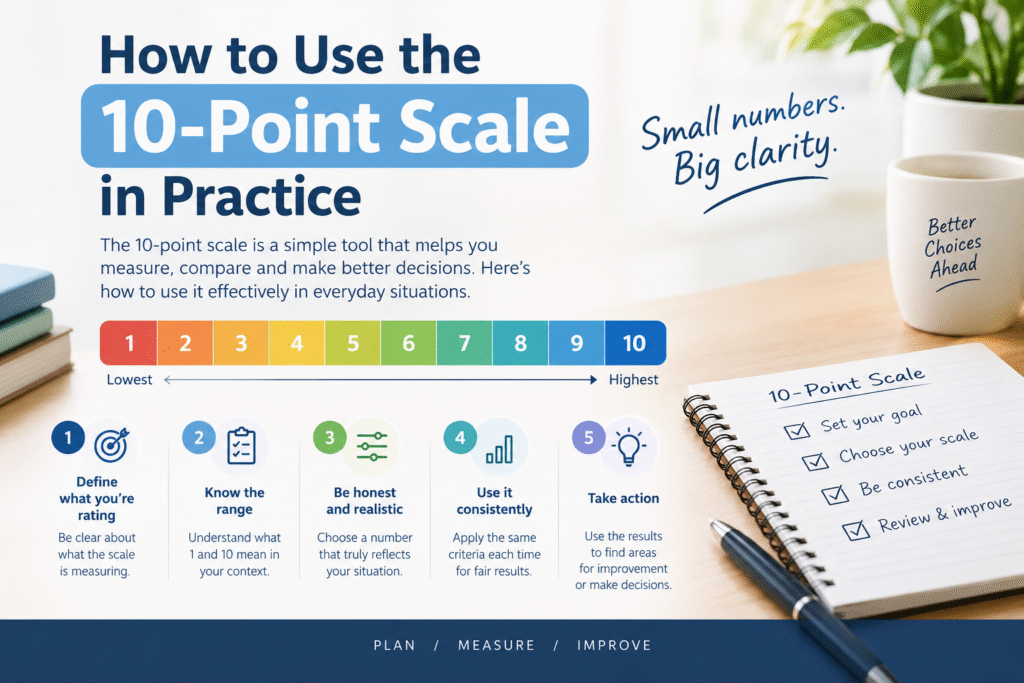
Converting a Single Test Score
Use an easy grade calculator or a percentage calculator to quickly turn a raw score into a percentage, then match it against the chart above.
Applying It to a Full Course
To combine multiple assignments into one overall letter grade, see how to calculate final grades for the complete weighted-average method.
Assigning Grades as a Teacher
For educators building a consistent grading policy, how to grade assignments covers best practices for applying a scale like this one fairly across a whole class, and how to curve test grades explains how a curve interacts with these fixed percentage bands when an assessment turns out harder than expected.
Mistakes People Make With the 10-Point Scale
Mistake 1: Assuming Every School Uses the Same 10-Point Bands
Some schools use the stricter 7-point version, and even within 10-point systems, exactly where plus/minus cutoffs fall can vary. Always confirm your specific institution’s chart rather than assuming the most common version applies.
Mistake 2: Treating a Basic Letter Grade as Precise
An 80% and an 89% both earn a plain “B” on the basic 5-tier version, despite a real 9-point difference. When precision matters — for GPA calculations or close comparisons — always work from the extended plus/minus chart or the raw percentage instead.
Mistake 3: Directly Comparing Letter Grades Across Different Scales
A “B” on a 7-point scale represents meaningfully stronger performance than a “B” on a 10-point scale, since the underlying percentage bands are different. Always convert back to the raw percentage before comparing grades from two different systems.
Mistake 4: Ignoring That International Systems Don’t Use This Structure at All
Countries using a 0–20 or 1–6 scale don’t have a direct “10-point” equivalent — attempting to force a percentage-band comparison onto a fundamentally different numeric system can be misleading without proper conversion.
Mistake 5: Assuming GPA Values Are Identical Everywhere
While the extended 10-point scale commonly maps to the GPA values shown above, some schools use slightly different GPA figures for the same letter grade. Always verify your specific institution’s official conversion chart.
Key Takeaways
- The 10-point grading scale assigns each core letter grade (A, B, C, D) a 10-percentage-point band, with A starting at 90%.
- Most schools extend this into a 13-tier version using plus and minus grades, while preserving the same underlying 10-point structure.
- A stricter 7-point scale exists as a common alternative, requiring higher percentages for the same letter grade.
- The 10-point scale maps cleanly onto the standard 4.0 GPA system, making it the dominant structure across US colleges and universities.
- International grading systems generally don’t use a “10-point” structure at all, relying instead on numeric scales like 0–20 or 1–6.
- Precision is the main tradeoff: the basic 5-tier version groups meaningfully different percentages under one letter, while the extended plus/minus version narrows — but doesn’t eliminate — that gap.
Frequently Asked Questions
It’s the most common US grading system, where each core letter grade spans ten percentage points: 90–100% for an A, 80–89% for a B, 70–79% for a C, 60–69% for a D, and below 60% for an F.
Not exactly. While the basic structure is widely used, specific plus/minus cutoffs can vary by school, and some institutions use a stricter 7-point scale instead. Always check your specific school’s official chart.
The 7-point scale narrows each letter grade band to seven percentage points instead of ten, requiring a higher score for the same letter. An 85%, for example, is a B on the 10-point scale but often only a C on the 7-point scale.
Using the extended 13-tier version, each letter grade maps to a specific GPA value — for example, a B (83–86%) equals 3.0 GPA points. See how to calculate a GPA from letter grades for the full method.
Schools sometimes adopt the 7-point scale specifically because it’s considered more rigorous, requiring stronger performance to earn the same letter grade compared to the more common 10-point version.
No. Many countries use entirely different systems — France and Belgium use a 0–20 numeric scale, Germany uses a 1–6 scale, and others rely on percentage or CGPA systems with their own unique band structures.
On the basic version, a B spans 80–89%. On the extended plus/minus version, it narrows to B– (80–82%), B (83–86%), and B+ (87–89%).
Yes, absolutely. A student scoring 85% could receive a B under a 10-point scale but a C under a 7-point scale. This is exactly why comparing letter grades across schools without checking the underlying scale can be misleading.
Check your syllabus, student handbook, or school’s official grading policy — it should specify the exact percentage cutoffs used for each letter grade, since these details aren’t always identical even among schools that broadly use a “10-point” system.
Yes, it’s common at both levels, though some colleges use stricter cutoffs or entirely percentage-based grading instead. Always verify the specific scale listed in each course’s syllabus rather than assuming it matches your high school’s system.
Conclusion
The 10-point grading scale is the backbone of most American grading — a simple, intuitive structure where each letter grade spans ten percentage points, extended in most schools into a more detailed 13-tier version with plus and minus grades. It maps cleanly onto the standard GPA system, which is a large part of why it’s become the dominant model across US education.
Still, it’s not universal. A stricter 7-point scale exists as a real alternative, and international grading systems often use entirely different numeric structures altogether. The safest approach is never to assume — always confirm which specific scale a school or course actually uses before comparing grades, calculating GPA, or interpreting what a specific letter really represents.
Use grade calculators to convert your own raw scores accurately, and always check your school’s official chart rather than relying on the most common version by default. Understanding exactly which scale applies to you is the first step toward interpreting your grades correctly.