
A passing grade in college is typically a D– or 60% for earning course credit at most four-year institutions — but that’s rarely the full story. Many majors, prerequisite courses, and financial aid programs require a C (73%) or better before a grade actually “counts” toward your degree. Understanding the difference between technically passing a class and meaningfully progressing toward graduation is one of the most important things a college student can learn early.
This guide breaks down exactly what counts as passing in college — course by course, GPA-wise, and by context — along with how pass/fail grading works, how international systems compare, and what to do if you’re sitting right on the line.
Key Takeaways
- Most colleges set the minimum passing grade for course credit at D– (60%), but many majors and prerequisite chains require a C (73%) or better.
- A cumulative 2.0 GPA is the standard threshold for “good academic standing” and is required by federal financial aid rules.
- Passing an individual class and satisfying your degree requirements are two different things — always check your specific program’s minimum grade policy.
What Is a Passing Grade in College?
At the most basic level, “passing” means earning enough credit to move a class off your to-do list. Most US colleges and universities set that bar at a D– (60%), which earns 0.7 GPA points and full course credit. Anything below that — an F — earns no credit and no GPA points.
But “passing the class” and “passing for your degree” are not always the same thing. Here’s the distinction that trips up the most students:
- Passing for credit: Usually just requires a D– or higher (some schools set this at D or C–, varying by institution).
- Passing for a prerequisite: Many programs require a C or C– in a prerequisite course before you can register for the next course in the sequence.
- Passing for your major: Some majors require a C or better in every course that counts toward the major GPA, even if a D would technically pass for general credit.
- Passing for financial aid: Federal Satisfactory Academic Progress (SAP) rules generally require a cumulative GPA of at least 2.0.
If you’re wondering is a 60 an F or D, the answer at most schools is D — but that single grade sitting right at the passing line is exactly the kind of score worth double-checking against your specific program’s requirements.
Quick Reference: Passing Grade Thresholds
| Context | Typical Minimum | Notes |
|---|---|---|
| General course credit | D– (60%) | Varies by school; some set it at D or C– |
| Prerequisite courses | C or C– (70–73%) | Common in math, science, and language sequences |
| Major-specific courses | C (73%) | Many majors require this for every course counted toward the degree |
| Cumulative GPA (financial aid) | 2.0 | Federal Satisfactory Academic Progress requirement |
| Graduation GPA | 2.0 | Standard minimum at most four-year institutions |
| Graduate school (if applicable) | B (83%) or 3.0 GPA | Graduate programs often set a higher bar entirely |
The Percentage Grading Scale
The percentage grading scale is the most universally understood system, converting raw scores into a value between 0% and 100%.
Standard US Percentage Ranges
| Percentage | Letter Grade | Passing Status |
|---|---|---|
| 90–100% | A | Passing — Excellent |
| 80–89% | B | Passing — Above Average |
| 70–79% | C | Passing — Average |
| 60–69% | D | Passing — Below Average |
| Below 60% | F | Failing — No Credit |
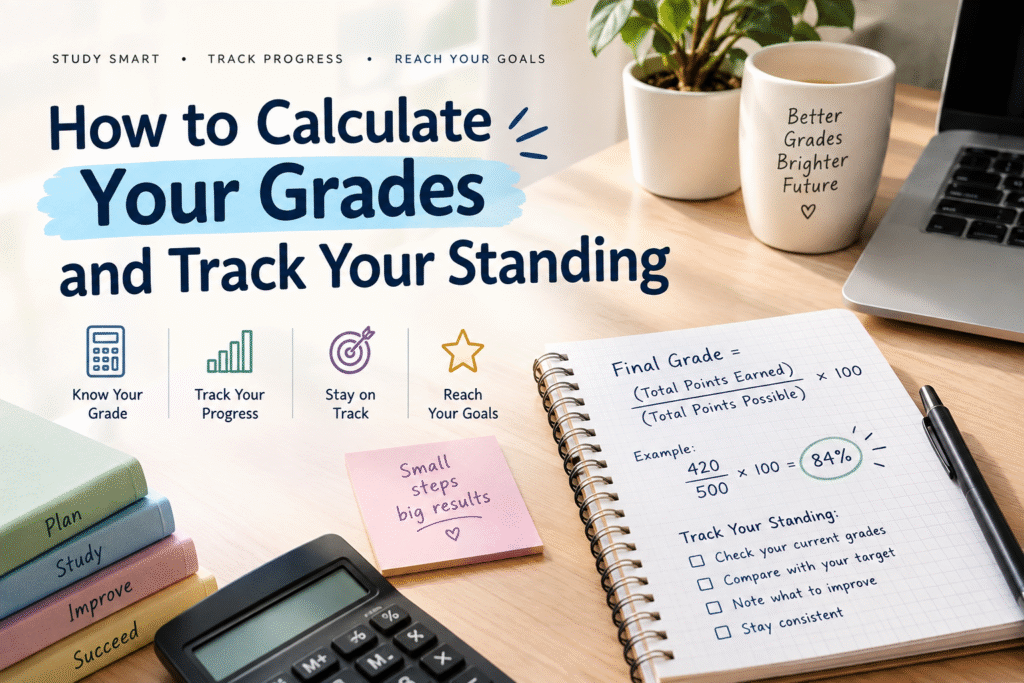
If you want to understand how to calculate grade percentage for a specific test or assignment, the formula is always: (Points Earned ÷ Total Points) × 100. Comparing your raw score to this chart is the fastest way to know exactly where you stand.
The Letter Grading Scale
The letter grading scale (A, B, C, D, F) is the most common system in American colleges. Each letter corresponds to a percentage range and a GPA value.
Standard Letter Grade Scale
| Letter Grade | Percentage Range | GPA Points | Passing? |
|---|---|---|---|
| A+ / A | 93–100% | 4.0 | Yes |
| A– | 90–92% | 3.7 | Yes |
| B+ / B / B– | 80–89% | 2.7–3.3 | Yes |
| C+ / C / C– | 70–79% | 1.7–2.3 | Yes |
| D+ / D | 63–69% | 1.0–1.3 | Yes (usually) |
| D– | 60–62% | 0.7 | Yes — the lowest passing tier at most schools |
| F | Below 60% | 0.0 | No — failing |
A D– sits at the absolute floor of passing. If you’ve ever wondered is 70 a C or D, or is 78 a C, these are the kinds of boundary questions worth confirming directly with your registrar, since even a single point can determine whether a grade satisfies a prerequisite.
The GPA Grading Scale and What It Means to “Pass” Overall
Passing individual classes is only part of the picture. Colleges also track your cumulative GPA, and falling below certain thresholds can trigger academic consequences even if you’ve technically passed every class.
GPA Benchmarks That Matter in College
| GPA | Standing |
|---|---|
| 3.5+ | Dean’s List range at most schools |
| 3.0 | Generally considered a strong, competitive average |
| 2.0 | Minimum for good academic standing and financial aid |
| Below 2.0 | Academic probation at most institutions |
| Below 1.0–1.5 (varies) | Risk of academic dismissal |
If you’re wondering is 70 a 3.0 GPA, the answer is no — 70% typically converts to around 1.7–2.0 GPA points, right at the edge of the “good standing” line rather than solidly within it. Use a cumulative GPA calculator or college GPA calculator to see exactly where a semester of D’s and C’s would leave your overall average.
Weighted GPA vs. Unweighted GPA in College
Unlike high school, most college GPAs are unweighted — a B in an intro course and a B in an advanced seminar both earn the same 3.0. Some graduate and honors programs do apply weighting for specific tracks, but it’s far less common than in K–12 grading. If you’re curious how weighting works generally, see how to calculate GPA with weighted courses — the same underlying math applies whenever a college program does use it.
Pass/Fail Grading in College
Many colleges offer a Pass/Fail (sometimes called Credit/No Credit) grading option, especially for electives outside a student’s major.
How Pass/Fail Works
- A grade of D– or higher (sometimes C– or higher, depending on the school) typically converts to a “Pass”
- Anything below that threshold converts to a “Fail” or “No Credit”
- Pass/Fail grades do not affect GPA — neither helping nor hurting your cumulative average
- Most schools limit how many credits can be taken Pass/Fail, and required major courses usually cannot use this option
Why Students Choose Pass/Fail
- To take a challenging elective outside their comfort zone without GPA risk
- To protect their GPA during an especially demanding semester
- To meet a general education requirement in a subject they’re not confident in
The tradeoff: because Pass/Fail grades don’t contribute positively to GPA either, a strong performance in a Pass/Fail class won’t boost your average the way an A in a graded class would.
International Grading Systems: How “Passing” Differs Worldwide
What counts as passing in the US is not a universal standard. Grading — and passing thresholds specifically — vary significantly by country.
Passing Grade Comparison Table
| Country/System | Scale | Typical Passing Threshold | Notes |
|---|---|---|---|
| United States | A–F / 4.0 GPA | D– (60%) for credit; C for many majors | Varies significantly by institution |
| France / Belgium | 0–20 | 10/20 | The traditional pass mark across French-speaking systems |
| United Kingdom | 0–100 | 40% (undergraduate) | Honours classifications start well above this |
| Germany | 1–6 (1 = best) | 4 (Ausreichend) | 5–6 is failing |
| Canada | A–F / % | 50–60%, varies by province | |
| Australia | HD/D/C/P/F | 50% | “P” (Pass) is the lowest passing grade |
| India | Percentage / CGPA | 35–40% | Varies by university and state board |
| China | 0–100 | 60 | Standard minimum passing score |
| Japan | S/A/B/C/F | 60% (roughly) | Varies by institution |
| Mexico | 0–10 | 6.0 | The exact minimum across most universities |
This table highlights just how far apart passing thresholds can be — the UK’s 40% and Australia’s 50% would both be failing grades in the US, while the US’s 60% would clear the bar comfortably in most other countries. If you’re studying abroad or transferring credits internationally, always confirm the receiving institution’s specific passing policy rather than assuming your home country’s standard applies.
Common Grading Conversion Methods
Method 1: Percentage to Letter Grade
Divide raw score by total possible points, multiply by 100, then match to the letter grade chart.
Method 2: Percentage to GPA Points
Match the percentage to the GPA scale to see its cumulative impact.
Method 3: Letter Grade to GPA
Use a standard conversion table (see below).
Method 4: Weighted Course Average Calculation
Weighted average grades factor in the percentage weight of each assignment category — the same method colleges use to determine your final course grade from midterms, papers, and finals combined.
Formula: (Category Score × Category Weight) + … = Weighted Grade
GPA Conversion Table
| Letter Grade | Percentage | GPA Points | Status |
|---|---|---|---|
| A+ | 97–100% | 4.0 | Passing |
| A | 93–96% | 4.0 | Passing |
| A– | 90–92% | 3.7 | Passing |
| B+ | 87–89% | 3.3 | Passing |
| B | 83–86% | 3.0 | Passing |
| B– | 80–82% | 2.7 | Passing |
| C+ | 77–79% | 2.3 | Passing |
| C | 73–76% | 2.0 | Passing (often the minimum for major courses) |
| C– | 70–72% | 1.7 | Passing (below “good standing” GPA) |
| D+ | 67–69% | 1.3 | Passing (course credit only) |
| D | 63–66% | 1.0 | Passing (course credit only) |
| D– | 60–62% | 0.7 | Passing (course credit only) |
| F | Below 60% | 0.0 | Failing — no credit |
How to Calculate Your Grades and Track Your Standing
Calculating a Single Course Grade
Use our step-by-step guide on how to calculate a grade after a test to check where you stand mid-semester.
Calculating Your Semester Grade
Knowing how to calculate your semester grade — or using a semester grade calculator directly — helps you see exactly what score you need on a final exam to stay above a passing threshold.
Calculating Your Final Course Grade
For a complete picture at the end of a term, see how to calculate final grades or use the final grade calculator directly.
Calculating Your Cumulative GPA
To see how a single class affects your overall standing, use a GPA calculator, a cumulative GPA calculator for your full academic history, or an average grade calculator for a quick check across several classes.
Knowing Exactly What You Need to Pass
If you’re worried about a class, use a what grade do I need calculator to find out exactly what score on your remaining assignments and final exam will keep you above the passing line — rather than guessing.
Mistakes Students Make About Passing Grades
Mistake 1: Assuming Any Passing Grade Counts Toward the Major
A D– might pass the class, but many departments require a C or better for that course to count toward your major requirements. Always check your program’s specific grade policy, not just the university-wide minimum.
Mistake 2: Ignoring the GPA Impact of a “Passing” D
A D still earns only 1.0 GPA points (or less), which drags down your cumulative average even though the class shows as passed on your transcript. If you’re wondering whether one C will hurt your GPA, a D is a considerably bigger concern — it’s much closer to failing on the GPA scale than to average.
Mistake 3: Not Understanding Financial Aid GPA Requirements
Passing your classes individually doesn’t automatically satisfy federal financial aid rules. Satisfactory Academic Progress typically requires both a 2.0 cumulative GPA and a minimum pace of credit completion — falling short on either can jeopardize aid eligibility even with all passing grades.
Mistake 4: Assuming Pass/Fail Grades Help Your GPA
Pass/Fail grading protects your GPA from a poor performance, but a strong Pass/Fail grade also doesn’t help it. Students hoping to boost their GPA should generally take that course for a standard letter grade instead.
Mistake 5: Forgetting That Some Prerequisites Require Higher Than “Passing”
A D– might satisfy general credit requirements, but plenty of prerequisite chains — especially in STEM fields and foreign languages — require a C or C– before you can register for the next course. Always confirm this with your advisor before assuming a passing grade clears you to move on.
Mistake 6: Not Knowing How Grading Scales Vary by Institution
Some colleges use a 4-tier scale, others a 13-tier scale with plus/minus grades, and others still use standards-based or narrative evaluations instead. If you’re transferring between schools, review different grading scales for results calculation or the general grade scale and grading chart reference to understand how your grades will translate.
Tips for Staying (Safely) Above the Passing Line
1. Know Your Program’s Specific Minimum, Not Just the University’s
Check your major or department handbook for course-specific grade requirements — don’t assume the general university passing policy applies everywhere.
2. Track Your Running Grade Throughout the Semester
Don’t wait for a final exam to find out where you stand. Use how to calculate grades in class regularly so a passing grade is never in doubt at the last minute.
3. Understand What Each Assignment Is Worth
Knowing how much a test grade is worth and what the weight of a test grade is helps you prioritize study time on the assignments that actually move your grade.
4. Talk to Your Professor Early If You’re Close to the Line
Office hours exist for exactly this reason. A professor can often clarify grading policy, offer extra credit, or point you toward tutoring resources before a borderline grade becomes a real problem.
5. Use Academic Support Resources Before It’s Urgent
Tutoring centers, writing centers, and academic advising offices are typically free and significantly underused. Catching a struggling grade early is far easier than recovering from a failing one.
6. If You’re Already Below Passing, Ask About Withdrawal Deadlines
Most colleges allow students to withdraw from a class before a certain deadline without it counting as a failing grade on the transcript. If a passing grade genuinely isn’t achievable, this can be a better outcome than an F.
7. Know How to Recover Your GPA After a Rough Semester
If a low grade already happened, there are real, proven strategies for raising your GPA quickly — course retakes, grade replacement policies, and strategic course loads can all help rebuild a cumulative average faster than most students expect.
Frequently Asked Questions
At most US colleges, a D– (60%) is the minimum grade that earns course credit. However, many majors and prerequisite courses require a C or C– (70–73%) instead, so the true minimum depends heavily on your specific program.
Generally, yes — a D (63–66%) earns course credit at most institutions. It’s still a below-average grade that only contributes 1.0 GPA points, and it may not satisfy prerequisite or major-specific requirements even though it passes for general credit.
Not always for general credit, but very often for major requirements and prerequisites. Many departments specifically require a C or C– for a course to count toward degree progress, even if the university-wide passing grade is lower.
A cumulative GPA of 2.0 is the standard minimum for “good academic standing” at most colleges, and it’s also the threshold used for federal financial aid eligibility under Satisfactory Academic Progress rules.
An F earns no course credit and no GPA points, and the class typically needs to be retaken (either the same course or a substitute) to fulfill any credit or prerequisite requirement it was meant to satisfy. Repeated failing grades can also trigger academic probation.
No. A Pass/Fail (or Credit/No Credit) grade doesn’t factor into your GPA at all — a Pass has no positive or negative effect, while a Fail typically does count against you, similar to an F in a regular graded course. Check your school’s specific policy, since some do allow a Fail in a Pass/Fail course to affect GPA.
Yes, 70% is almost always passing — it falls in the C or C– range depending on the specific scale used. It also tends to satisfy most major and prerequisite requirements that call for “a C or better,” though it’s worth confirming exactly where your institution sets that specific letter grade cutoff.
Usually, yes, as long as your cumulative GPA stays at or above the graduation minimum (typically 2.0) and the D isn’t in a course requiring a higher grade for your major. A single D generally won’t block graduation on its own, but multiple low grades can.
Not automatically. Passing thresholds vary dramatically by country — 40% is passing in the UK, 50% in Australia, and 60% is the more typical US and international standard. If you’re transferring credits internationally, always check how the receiving institution evaluates your original grades.
The most reliable way is to calculate your running weighted average using your actual assignment weights, rather than guessing from memory. A what grade do I need calculator can show you exactly where you stand and what’s needed on remaining work to stay above the line.
Conclusion
A passing grade in college is rarely just one number. At the most basic level, a D– (60%) usually earns you course credit — but whether that grade actually moves you forward toward your degree depends on your major, your prerequisites, and your school’s specific policies. A cumulative 2.0 GPA is the benchmark that matters most broadly, since it affects financial aid, academic standing, and graduation eligibility all at once.
The safest approach is to never assume: check your specific program’s grade requirements, track your running average throughout the semester rather than waiting for final grades, and reach out for help well before a borderline grade becomes a real problem. Passing isn’t just about clearing 60% — it’s about understanding exactly what each grade in your specific program actually requires.
Use grade calculators, track your GPA proactively, and know your program’s real requirements — not just the university-wide minimum. Academic standing is always manageable with the right information, and understanding how passing grades actually work is the first step to staying comfortably above the line.