You scored 13 out of 18 on a test. What percentage is that, and is it a passing grade?
A 13/18 grade equals 72.22%. On the standard U.S. 10-point scale, that is a C–, worth about 1.7 GPA points. It is a passing grade that sits 2.22 points above the 70% C– line and less than one point under the 73% C line.
This guide covers the percentage, letter grade, GPA, rounding, and what a 13/18 means inside a weighted course.
Key Takeaways
- 13/18 = 72.22%, which is a C– on the standard U.S. scale (70–72%).
- On the 4.0 GPA scale, a 13/18 converts to 1.7 GPA points (2.0 at schools without plus/minus grades).
- Each question on an 18-point test is worth 5.56%. One more correct answer (14/18 = 77.78%) would lift this to a C+, skipping the C range completely.
What Is 13/18 as a Percentage?
Formula:
(Points Earned ÷ Total Points) × 100 = Percentage Grade
Applied:
(13 ÷ 18) × 100 = 0.7222 × 100 = 72.22%
The fraction 13/18 cannot be simplified, because 13 is prime and does not divide 18. The decimal repeats (0.7222…), so the percentage is rounded to two places. To learn the method for any score, see how to calculate grade percentage, or check any result with the percentage calculator.
Worked Step-by-Step Examples
Example 1: Basic Percentage Conversion
A student misses 5 questions out of 18 and scores 13/18.
- Step 1: Divide points earned by total points → 13 ÷ 18 = 0.7222
- Step 2: Multiply by 100 → 0.7222 × 100 = 72.22%
- Step 3: Match it to the letter scale → C–
Example 2: How Close Is 13/18 to the Next Tier?
- Points needed for 70% (C–): 18 × 0.70 = 12.6 → you earned 13, so you clear it by 0.4 points.
- Points needed for 73% (C): 18 × 0.73 = 13.14 → you are 0.14 points short.
- Next whole score up: 14/18 = 77.78%, a C+.
On an 18-point test, no whole score lands in the C range (73–76%). 13/18 is a C– and 14/18 is a C+. One fewer, 12/18, is 66.67%, a D.
Example 3: A 13/18 Test Inside a Weighted Course Average
Say a student has:
- Homework (20% of grade): 80%
- Test (30% of grade): 72.22% (their 13/18)
- Final Exam (50% of grade): 78%
Weighted Grade = (Score₁ × Weight₁) + (Score₂ × Weight₂) + (Score₃ × Weight₃)
Weighted Grade = (80 × 0.20) + (72.22 × 0.30) + (78 × 0.50) = 16.0 + 21.67 + 39.0 = 76.67%
The course grade lands at a C, two tiers above the test score. See how to calculate weighted average grades for the full method.
Quick-Reference Grade Table (x/18 Scores)
| Score | Percentage | Letter Grade | GPA Points |
|---|---|---|---|
| 18/18 | 100.00% | A+ | 4.0 |
| 17/18 | 94.44% | A | 4.0 |
| 16/18 | 88.89% | B+ | 3.3 |
| 15/18 | 83.33% | B | 3.0 |
| 14/18 | 77.78% | C+ | 2.3 |
| 13/18 | 72.22% | C– | 1.7 |
| 12/18 | 66.67% | D | 1.0 |
| 11/18 | 61.11% | D– | 0.7 |
| 10/18 | 55.56% | F | 0.0 |
| 9/18 | 50.00% | F | 0.0 |
Notice that 12/18 is 66.67%, right at the D/D+ line. Whether it rounds up to 67% (D+) depends on your school. See is 60 an F or D? for another boundary case.
Percentage-to-Letter Grade Scale Used Above
| Percentage Range | Letter Grade | Performance Level |
|---|---|---|
| 97% – 100% | A+ | Outstanding |
| 93% – 96% | A | Excellent |
| 90% – 92% | A– | Excellent |
| 87% – 89% | B+ | Very Good |
| 83% – 86% | B | Good |
| 80% – 82% | B– | Above Average |
| 77% – 79% | C+ | Above Average |
| 73% – 76% | C | Average |
| 70% – 72% | C– | Below Average (13/18 falls here) |
| 67% – 69% | D+ | Poor |
| 63% – 66% | D | Barely Passing |
| 60% – 62% | D– | Barely Passing |
| Below 60% | F | Failing |
This is the standard 10-point scale used by most U.S. schools. On a stricter 7-point scale, 72.22% would be a D (the D range there is 70–76%). Compare your school’s cutoffs with the grade scale and grading chart guides, or see different grading scales.
What GPA Is a 13/18 Grade?
On the standard unweighted 4.0 scale, a C– converts to 1.7 GPA points. Schools without plus/minus grades count it as a flat 2.0 (a C).
Weighted vs. Unweighted Impact
| Course Level | GPA Bonus | C– (72.22%) GPA Value |
|---|---|---|
| Standard | +0.0 | 1.7 |
| Honors | +0.5 | 2.2 |
| AP / IB | +1.0 | 2.7 |
Learn how bonuses work in how to calculate GPA with weighted grades. Run your own numbers in the GPA calculator. Worried one C– will hurt? Read will one C hurt my GPA?
Is 13/18 a Passing Grade?
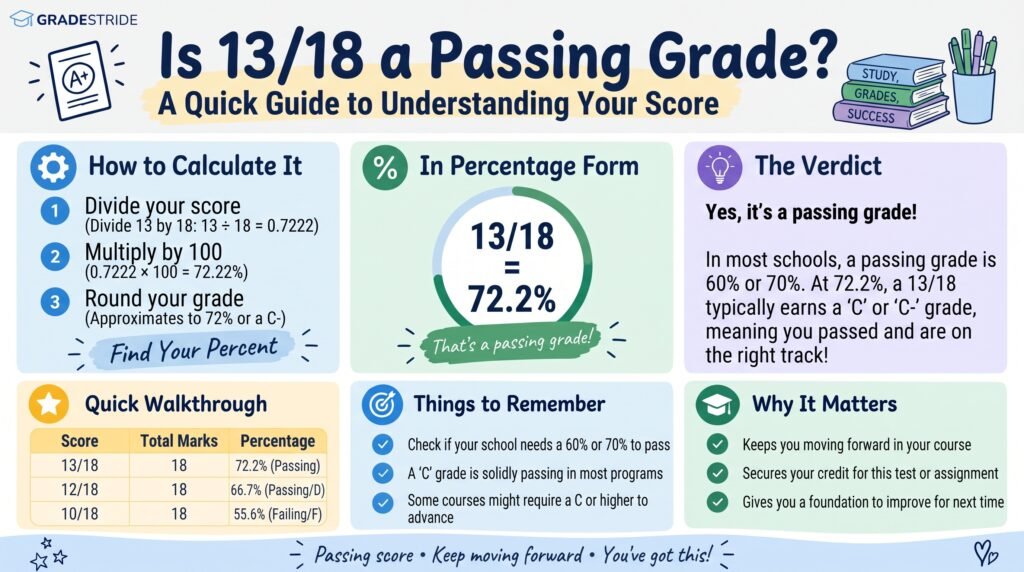
Yes. The usual passing mark is 60%, which is 10.8 out of 18, so you need 11. At 72.22%, you are well above it. It is a below-average result, though, and some courses, prerequisites and scholarships require a C or higher.
How Rounding Affects a 13/18
Because 72.22% is just above the middle of the C– range (70–72%), the result depends on how your school treats the 0.22:
- Round to the nearest whole percent: 72.22% → 72% → C–
- Truncate (drop decimals): 72.22% → 72% → C–
- Use exact decimals: 72.22% is above 72% but below 73% → C– at most schools
Some schools write the C– range as 70.0–72.99, which still gives a C–. A school that rounds to the nearest half point could treat 72.5 as 73 (a C), but 72.22 would not reach that. For a similar close call, see is 70 a C or D?
International Grade Comparison
| Country / System | Approximate Equivalent of 13/18 (72.22%) |
|---|---|
| United States | C– (1.7 GPA) |
| United Kingdom (university) | First-class (70%+) |
| France (0–20 scale) | 14.44/20 — Bien |
| Germany (1.0–5.0, 1 best) | About 2.7–3.0 — Befriedigend |
| Canada | B (70–79% in many provinces) |
The same score can look very different depending on the country. A 72% is a first-class result at a UK university but a below-average C– in the U.S.
Practical Tips: Raising a 13/18 to a C+ or Higher
- Review the 5 missed questions. Look for patterns: one topic, one question type, or time pressure.
- Ask about partial credit. On an 18-point test, half a point is worth 2.78%. A little partial credit could lift you toward the C line.
- Practice with active recall. Flashcards and practice tests beat re-reading notes.
- Know how much the test counts. See how much is a test grade worth before deciding how much effort to spend.
- Plan ahead. Use a what grade do I need calculator to see what you need on future work to reach your target grade. You can also see if you can raise your GPA quickly.
- Teachers: an 18-point test creates uneven grade steps. Consider adding questions or curving test grades.
Frequently Asked Questions (FAQ)
1. What is 13/18 as a percentage?
13 divided by 18 equals 0.7222, which multiplied by 100 gives 72.22%. This is the standard formula for turning any fraction score into a percentage.
2. What letter grade is 13/18?
On the standard 10-point U.S. scale, 72.22% is a C–. On a stricter 7-point scale, it would be a D.
3. What GPA is 13/18?
A C– is worth 1.7 GPA points on the unweighted 4.0 scale. Schools without plus/minus grades count it as a 2.0.
4. Is 13/18 a good grade?
It’s a passing but below-average grade. The typical class average is 75–80%, so 72.22% is a few points under it. One more correct answer would raise it to a C+.
5. Is 13/18 passing?
Yes. The passing mark of 60% equals 10.8 out of 18, and 13/18 is 72.22%.
6. How many points do I need for a C on an 18-point test?
For 73%, you need 13.14 points. With whole points, that means 14/18 (77.78%), which is a C+. No whole score lands exactly in the C range on an 18-point test.
7. What is 13/18 out of 20?
Multiply by 20: 0.7222 × 20 = 14.44/20. In France, this is “Bien” territory.
8. What happens if I miss one more question (12/18)?
12/18 equals 66.67%, which is a D (1.0 GPA), or a D+ if your school rounds up to 67%. Each question on an 18-point test costs 5.56%.
9. How many questions can I miss and still get a C–?
You can miss 5. The minimum for 70% is 12.6 points, so 13/18 is the lowest whole-number score that earns a C–. Missing 6 gives 66.67%, a D.
10. Can one 13/18 test change my final course grade?
Only by its weight. A test worth 10% of the course moves your final grade very little. Use a calculator to see the exact effect.
Conclusion
A 13/18 grade is 72.22%, a C–, and 1.7 GPA points on the standard scale. It passes, and it is one correct answer away from a C+. Review the questions you missed and plan the rest of the term to move it up.
Track every score with the easy grade calculator, and keep the full picture in mind with a clear view of how to calculate grades in class.