
The 7 point grading system means one of two things. In Denmark, it is the national scale with seven grades: 12, 10, 7, 4, 02, 00 and -3, where 02 is the lowest passing grade. In the United States, it is a letter-grade scale with 7-point bands: A = 93–100%, B = 85–92%, C = 77–84%, D = 70–76%, and F = below 70%.
This guide explains both versions with charts, worked examples, conversions and a comparison with the 10-point scale. Use the quick table below to jump to the one you need.
Key Takeaways
- Danish 7-point scale: 12 (excellent), 10, 7 (good, the average), 4, 02 (minimum pass), 00 and -3. It has been used in all state-regulated Danish education since August 2007.
- U.S. 7-point scale: A starts at 93%, B at 85%, C at 77%, D at 70%. It is stricter than the 10-point scale, which starts the A at 90%.
- Both are called “7-point”, but they are not the same system. One is a list of seven grade values. The other is a percentage band width.
| Danish 7-Point Scale | U.S. 7-Point Scale | |
|---|---|---|
| Type | Seven fixed grades | Letter grades with 7-point bands |
| Grades | 12, 10, 7, 4, 02, 00, -3 | A, B, C, D, F |
| Lowest pass | 02 | 70% (D) |
| Used in | Denmark | Some U.S. schools and districts |
The Danish 7-Point Grading Scale
Denmark introduced its 7-point scale to make Danish grades easier to compare with other countries. It replaced the older 13-point scale and applies to all state-regulated education, from primary school to university.
Danish 7-Point Scale Chart
| Grade | Label | What It Means | ECTS Equivalent |
|---|---|---|---|
| 12 | Excellent | Strong command of all aspects of the material, with no or only a few minor weaknesses | A |
| 10 | Very good | Strong command of most aspects, with only minor weaknesses | B |
| 7 | Good | Good command of the material, with some weaknesses | C |
| 4 | Fair | Some command of the material, with some major weaknesses | D |
| 02 | Adequate | Meets only the minimum requirements for acceptance | E |
| 00 | Inadequate | Does not meet the minimum requirements | Fx |
| -3 | Unacceptable | Unacceptable in all respects | F |
The pass mark is 02. Grades 00 and -3 are fails.
How the Danish Scale Works
- Grading is absolute. The grade shows how well the student met the learning objectives of the course. It is not based on ranking students against each other.
- No forced distribution. Teachers should not aim for a set number of 12s or 4s.
- 7 is the average. Learning objectives are set so that a student with average effort earns a 7.
- The steps are uneven. The gap between 12 and 10 is 2 points, between 10 and 7 is 3 points, and between 7 and 4 is 3 points. Only seven values are possible. There is no 8, 9 or 11.
Converting the Old 13-Point Scale to the 7-Point Scale
| Old 13-Point Scale | New 7-Point Scale |
|---|---|
| 13 | 12 |
| 11 | 12 |
| 10 | 10 |
| 9 | 7 |
| 8 | 7 |
| 7 | 4 |
| 6 | 02 |
| 5 | 00 |
| 03 | 00 |
| 00 | -3 |
Rough Danish-to-U.S. Comparison
There is no official conversion. Credential evaluators and universities each use their own tables, so treat this as a rough guide only.
| Danish Grade | ECTS | Rough U.S. Letter Guide | Rough 4.0 GPA Guide |
|---|---|---|---|
| 12 | A | A | 4.0 |
| 10 | B | A– / B+ | 3.3–3.7 |
| 7 | C | B | 3.0 |
| 4 | D | C | 2.0 |
| 02 | E | D | 1.0 |
| 00 / -3 | Fx / F | F | 0.0 |
Always use the table your school or evaluator publishes for applications.
Worked Example: Danish Grade Average
A student has five exam grades: 12, 10, 7, 7 and 4.
Average = Sum of Grades ÷ Number of Grades
- Step 1: Add the grades → 12 + 10 + 7 + 7 + 4 = 40
- Step 2: Divide by the number of grades → 40 ÷ 5 = 8.0
An 8.0 sits between a 7 (good) and a 10 (very good). Many institutions use a weighted average based on credits (ECTS):
| Course | Grade | ECTS | Grade × ECTS |
|---|---|---|---|
| A | 12 | 10 | 120 |
| B | 7 | 5 | 35 |
| C | 10 | 15 | 150 |
| Total | 30 | 305 |
Weighted Average = 305 ÷ 30 = 10.17
Rounding and the treatment of the -3 grade vary by institution, so check the rules where you study. The weighted method works the same as in how to calculate weighted average grades, and you can compute plain averages with the average grade calculator.
Appeals Under the Danish System
Students can appeal an exam grade. In primary and lower secondary school (Folkeskole), the appeal goes to the head of school within two weeks. In upper secondary education, a written appeal goes to the head of the institution within two weeks, and a further appeal can go to the Ministry of Children and Education.
The U.S. 7-Point Grading Scale
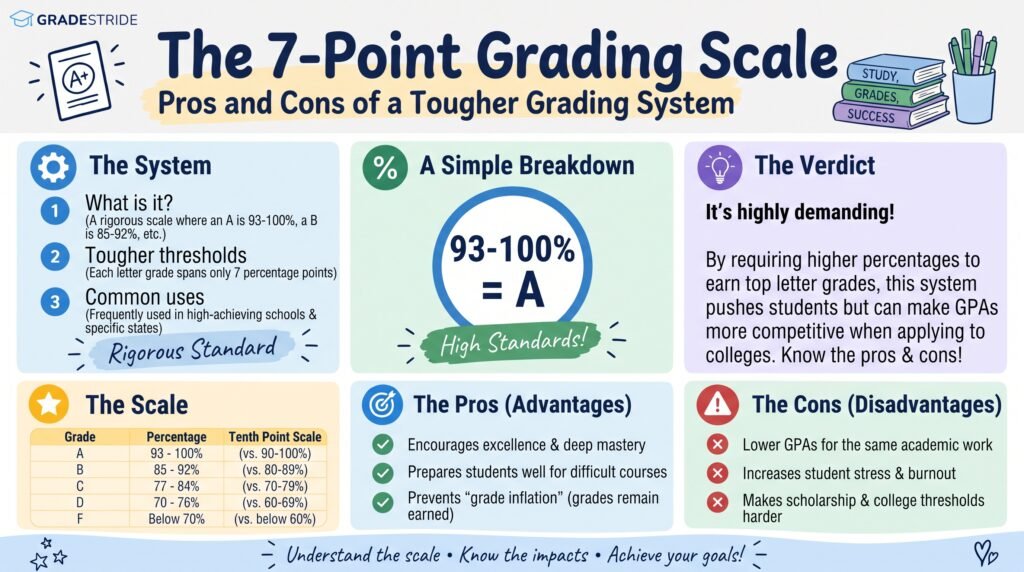
In the United States, a “7-point scale” means each letter grade covers about 7 percentage points instead of 10. You need a higher percentage to earn the same letter.
U.S. 7-Point Scale Chart
| Percentage | Letter Grade | GPA (4.0 Scale) | Meaning |
|---|---|---|---|
| 93 – 100% | A | 4.0 | Excellent |
| 85 – 92% | B | 3.0 | Good |
| 77 – 84% | C | 2.0 | Average |
| 70 – 76% | D | 1.0 | Barely passing |
| Below 70% | F | 0.0 | Failing |
Exact cutoffs can vary slightly by district, so check your handbook.
7-Point vs. 10-Point Scale
| Letter Grade | 7-Point Scale | 10-Point Scale |
|---|---|---|
| A | 93 – 100% | 90 – 100% |
| B | 85 – 92% | 80 – 89% |
| C | 77 – 84% | 70 – 79% |
| D | 70 – 76% | 60 – 69% |
| F | Below 70% | Below 60% |
The same percentage can earn a different letter:
- 80% → C on the 7-point scale, B on the 10-point scale
- 65% → F on the 7-point scale, D on the 10-point scale
- 91% → B on the 7-point scale, A on the 10-point scale
See the pages on what grade is 80, what grade is 75 and is 70 a C or D for more boundary cases, and compare other systems in different grading scales for results calculation.
Worked Examples on the U.S. 7-Point Scale
Formula:
(Points Earned ÷ Total Points) × 100 = Percentage → match to the 7-point chart
Example 1: Test score. A student scores 41 out of 50.
- Step 1: 41 ÷ 50 = 0.82
- Step 2: 0.82 × 100 = 82%
- Step 3: Match the chart → C on the 7-point scale (B– on the 10-point scale)
See how to calculate grade percentage for the full method.
Example 2: Weighted course grade. Say a student has:
- Homework (20% of grade): 90%
- Test (30% of grade): 84%
- Final Exam (50% of grade): 88%
Weighted Grade = (Score₁ × Weight₁) + (Score₂ × Weight₂) + (Score₃ × Weight₃)
Weighted Grade = (90 × 0.20) + (84 × 0.30) + (88 × 0.50) = 18.0 + 25.2 + 44.0 = 87.2%
That is a B on the 7-point scale (85–92%) and a B+ on the 10-point scale with plus/minus grades (87–89%).
GPA on the 7-Point Scale
The usual 7-point GPA values are A = 4.0, B = 3.0, C = 2.0, D = 1.0 and F = 0.0. Because the bands are narrower, the same effort tends to produce a lower letter and a lower GPA. Learn the method in how to calculate a GPA from letter grades, or use the GPA calculator.
Pros and Cons of a 7-Point Grading System
Danish scale: pros
- Only seven values, so grades are easy to compare
- Based on learning goals, not ranking
- Linked to ECTS letters for international use
Danish scale: cons
- Uneven steps and no values between grades
- Averages can fall between two grades
- No single official conversion to U.S. grades
U.S. 7-point scale: pros
- Seen as more rigorous
- Clear percentage bands
- Easy to convert to a 4.0 GPA
U.S. 7-point scale: cons
- Lower letters for the same percentage than the 10-point scale
- Can affect scholarships and GPA cutoffs
- Not used everywhere, so comparisons across schools can mislead
Mistakes to Avoid
- Mixing up the two systems. Danish “7” is a grade, not a percentage.
- Treating the Danish 02 as a low C. It is the minimum pass, roughly a D.
- Converting without an official table. Danish-to-U.S. conversions vary by evaluator.
- Assuming your school uses 10-point bands. Check your syllabus.
- Comparing letters across scales. Compare percentages first, using the grade scale and grading chart pages.
Practical Tips
- Students: Find out which scale your school uses on day one. Use the what grade do I need calculator to plan your final.
- International applicants: Ask the admissions office which conversion they use for Danish grades.
- Teachers: Publish the scale, the cutoffs and the rounding rules in your syllabus.
- Everyone: Use the easy grade calculator to turn raw scores into letters fast.
Frequently Asked Questions (FAQ)
1. What is the 7 point grading system?
It is a grading system with seven levels or seven-point bands. In Denmark, it means the grades 12, 10, 7, 4, 02, 00 and -3. In the U.S., it means A = 93–100%, B = 85–92%, C = 77–84%, D = 70–76%, F = below 70%.
2. What is the Danish 7-point grading scale?
It is Denmark’s national scale with seven grades: 12, 10, 7, 4, 02, 00 and -3. It has been used in all state-regulated education since August 2007.
3. What is the passing grade on the Danish 7-point scale?
The minimum passing grade is 02. Grades 00 and -3 are fails.
4. What does a 7 mean in the Danish grading system?
A 7 means “good”: good command of the material with some weaknesses. It is the grade an average student with average effort is expected to earn.
5. What is the highest grade in Denmark?
The highest grade is 12 (excellent). The lowest is -3 (unacceptable).
6. How do you convert the Danish 7-point scale to a U.S. GPA?
There is no official formula. As a rough guide, 12 is about an A (4.0), 7 is about a B (3.0), and 02 is about a D (1.0). Use the table your school or evaluator publishes.
7. What is the difference between the 7-point and 10-point grading scale?
The 7-point scale needs 93% for an A, while the 10-point scale needs 90%. An 80% is a C on the 7-point scale and a B on the 10-point scale.
8. Is a 7-point scale harder than a 10-point scale?
Yes. You need a higher percentage for each letter grade, so it is usually harder to earn an A, B or C.
9. What was the old Danish 13-point scale?
It was the previous scale, replaced in 2007. For example, a 13 or an 11 became a 12, and a 9 or an 8 became a 7.
10. How do I calculate a grade average on a 7-point scale?
For the Danish scale, add the grades and divide by the number of grades, or weight them by ECTS credits. For the U.S. scale, convert scores to percentages, average them, and match the result to the chart.
Conclusion
The 7 point grading system is not one single scale. Denmark’s version uses the grades 12, 10, 7, 4, 02, 00 and -3, with 02 as the pass mark. The U.S. version uses 7-point percentage bands, with an A starting at 93%. Knowing which one applies to you is the first step to reading any grade correctly.
Track your scores with the easy grade calculator and check how much each grade counts with how to calculate grades in class.